
Selling a Franchise Clinic vs. an Independent One
The Question Many Buyers Ask Last and Should Ask First
Nobody Buys a Clinic Planning to Sell It
Which is exactly why exit terms get skimmed. A buyer evaluating a franchise is thinking about opening, staffing, and filling the schedule. The transfer provisions sit deep in an agreement few buyers read closely at that stage.
But the exit defines what you are actually building. Two clinics with identical revenue can be worth very different amounts depending on what the owner owns and who must approve the sale.
For the full franchise comparison, see Longevity Clinic Franchises in 2027. To compare who owns the brand, the patients and the accounts under a consultant, a franchise or a platform, see who owns your clinic.
This post is educational and does not constitute legal or financial advice. Franchise terms change between FDD versions and registration states; prospective buyers should request the current Franchise Disclosure Document directly from the franchisor and have it reviewed by a franchise attorney and an accountant before signing anything.
Selling a Franchised Clinic
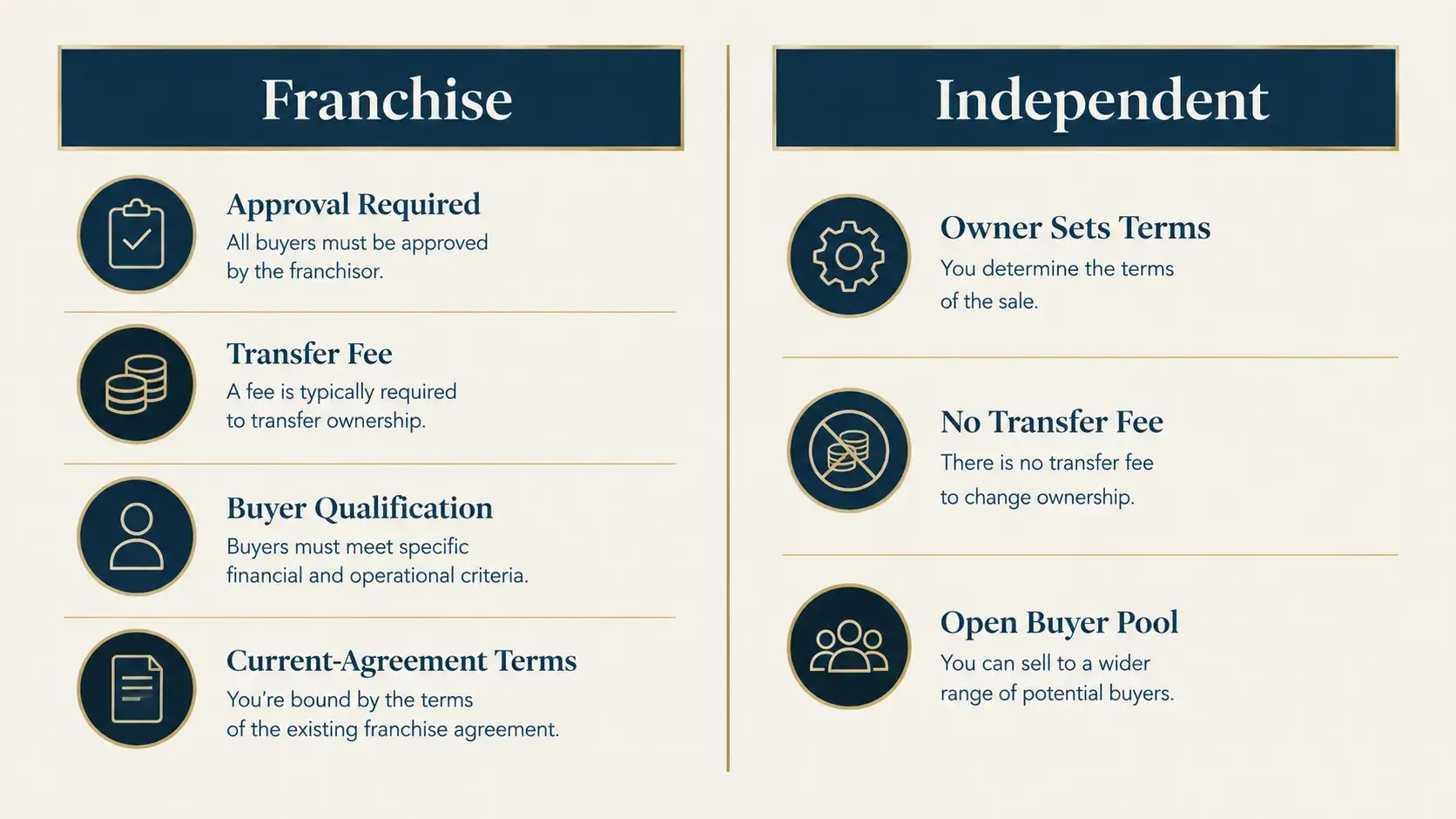
A franchise interest is generally not freely transferable. Typical provisions across franchise agreements include several that materially affect a sale.
•Franchisor approval of the buyer, including their own qualification standards for net worth and experience
•A transfer fee, listed with the other fees in Item 6 of the FDD
•A right of first refusal allowing the franchisor to buy on the same terms
•A requirement that the buyer sign the then-current franchise agreement, which may carry different terms than yours
•Possible remodel or re-equipment requirements triggered at transfer
None of these are unusual or improper. They exist to protect brand consistency. They also mean the seller's buyer pool is limited to people the franchisor will accept, and the terms the buyer inherits may be worse than the terms the seller enjoyed.
The practical consequence is a narrower market and a longer sale process. Read Item 17 of the FDD, which covers renewal, termination, and transfer, before you sign.
Selling an Independent Clinic
An independent clinic is sold like any other private business. The owner sets the terms, selects the buyer, and negotiates the structure. There is no franchisor to approve the buyer or collect a transfer fee, and no obligation for the buyer to adopt someone else's agreement.
What gets sold is the business: the brand, the recurring revenue, the lease, the equipment, the systems, the referral network, and the local market position. None of it is licensed from a franchisor.
The trade-off is that the owner built the brand rather than licensing a recognized one, which means the buyer is acquiring a local reputation rather than a national name.
What Actually Drives Value in This Category
Regardless of structure, buyers of a cash-pay clinic are purchasing predictability. The factors that move valuation are consistent.
•Recurring membership revenue and its retention rate, which is one of the strongest drivers
•Revenue concentration: a practice dependent on the departing owner personally is worth less than one with a clinical team the patients trust
•Documented systems and clean financials
•A stable medical director relationship that survives the transition
•Compliance posture, because an acquirer's diligence will surface anything unresolved
That last item is worth emphasizing. Unresolved compliance exposure (unapproved products, undocumented protocols, marketing claims that cannot be substantiated) reduces value or kills deals outright, because the acquirer inherits the problem. For the compliance problems that shut clinics down, see our guide to regenerative health clinic compliance.
For the peptide side of a clinic's menu, what can be compounded today is covered in our post on peptide clinic compliance.
What a Buyer's Diligence Actually Examines
Whether the clinic is franchised or independent, an acquirer runs the same examination. Knowing what they look at tells you what to build.
•Revenue quality. Recurring membership revenue with documented retention is valued very differently from episodic procedure revenue at the same annual total.
•Patient records and consent documentation. Gaps here are both a valuation issue and a liability the buyer is being asked to assume.
•The medical director arrangement. A buyer wants to know the clinical relationship survives the sale, and that the agreement is assignable or replaceable.
•Regulatory posture. Products offered, sourcing documentation, and marketing claims are all examined. Anything unresolved becomes a price adjustment or a deal condition.
•Owner dependence. If patients come for the owner, the buyer is purchasing an asset that partially leaves on closing day.
•Lease assignability and remaining term.
Most of these are inexpensive to get right at launch and expensive to repair under the time pressure of a transaction. An owner who runs the business as though diligence is coming tends to receive a cleaner process and a better number when it does.
Building for Exit From Day One
The decisions that determine exit value are made at launch, not at sale. An owner who treats the exit as a question for later generally discovers that the structural choices were already made years earlier, by default rather than deliberately.
A membership model built on recurring revenue is worth more than a transactional one. A clinical team that owns patient relationships is worth more than an owner-dependent practice. Documented protocols (written and approved by the clinic's Medical Director) and clean compliance are far easier to build in at launch than to add later.
The recurring revenue model that drives this is covered in The Longevity Clinic Revenue Model.
And on the ownership question specifically: no medical background is required to own the business; an independent, state-licensed Medical Director directs all clinical care. Some states have corporate practice of medicine (CPOM) laws that restrict non-physicians from owning medical practices; in those states a licensed physician usually owns the professional entity that delivers care, and the business side runs through a management services organization (MSO). The structure is the same whether the clinic is franchised or independent, and the rules vary widely by state.
That structure is explained in our post on whether a non-physician can own a TRT or hormone clinic.
Because exit value is set at launch, our team helps founders set up a new clinic to be sellable from day one; for the clinic itself, start with how to open a longevity clinic. To discuss building an independent longevity clinic as a durable asset, book a free 30-minute strategy call.
Frequently Asked Questions
Can I sell a franchise clinic whenever I want?
Generally not without franchisor approval. Many franchise agreements require the franchisor's approval of the buyer and a transfer fee, and may include a right of first refusal. Review Item 17 of the FDD, which covers renewal, termination and transfer, before signing.
What is a clinic worth at sale?
Valuation depends on recurring revenue, retention, owner dependence, documented systems, and compliance posture. A clinic with a stable membership base and a clinical team that owns the patient relationships can command a stronger multiple than an owner-dependent, transactional practice at the same revenue.
Does franchise brand recognition increase resale value?
It can help attract buyers who want a known system. It is offset by the restricted buyer pool, transfer fees, and the fact that the buyer inherits the ongoing royalty obligation, which reduces what they can pay for the cash flow. Both effects are real; which dominates depends on the system and the market. For the cost and exit comparison across clinic categories, see independent clinic vs. franchise.
How early should I think about exit?
At launch. Recurring revenue structure, clinical team design, documentation standards, and compliance posture all drive valuation, and all are far cheaper to establish at the start than to retrofit under the pressure of a pending sale.
What reduces a clinic's value most at sale?
Two of the largest factors are owner dependence and unresolved compliance exposure. A practice whose patients come for the departing owner loses part of its value on closing day. Undocumented protocols, unsubstantiated marketing claims, or products with unclear regulatory standing become price adjustments, deal conditions, or in some cases the reason a transaction does not close at all.
Written by Nova, Senior Content Strategist at Altos Consulting Group.