
Peptide Clinic Compliance in 2026: What the FDA Reclassification Means for Entrepreneurs Opening a Clinic
The Regulatory Moment That Is Reshaping the Peptide Clinic Market
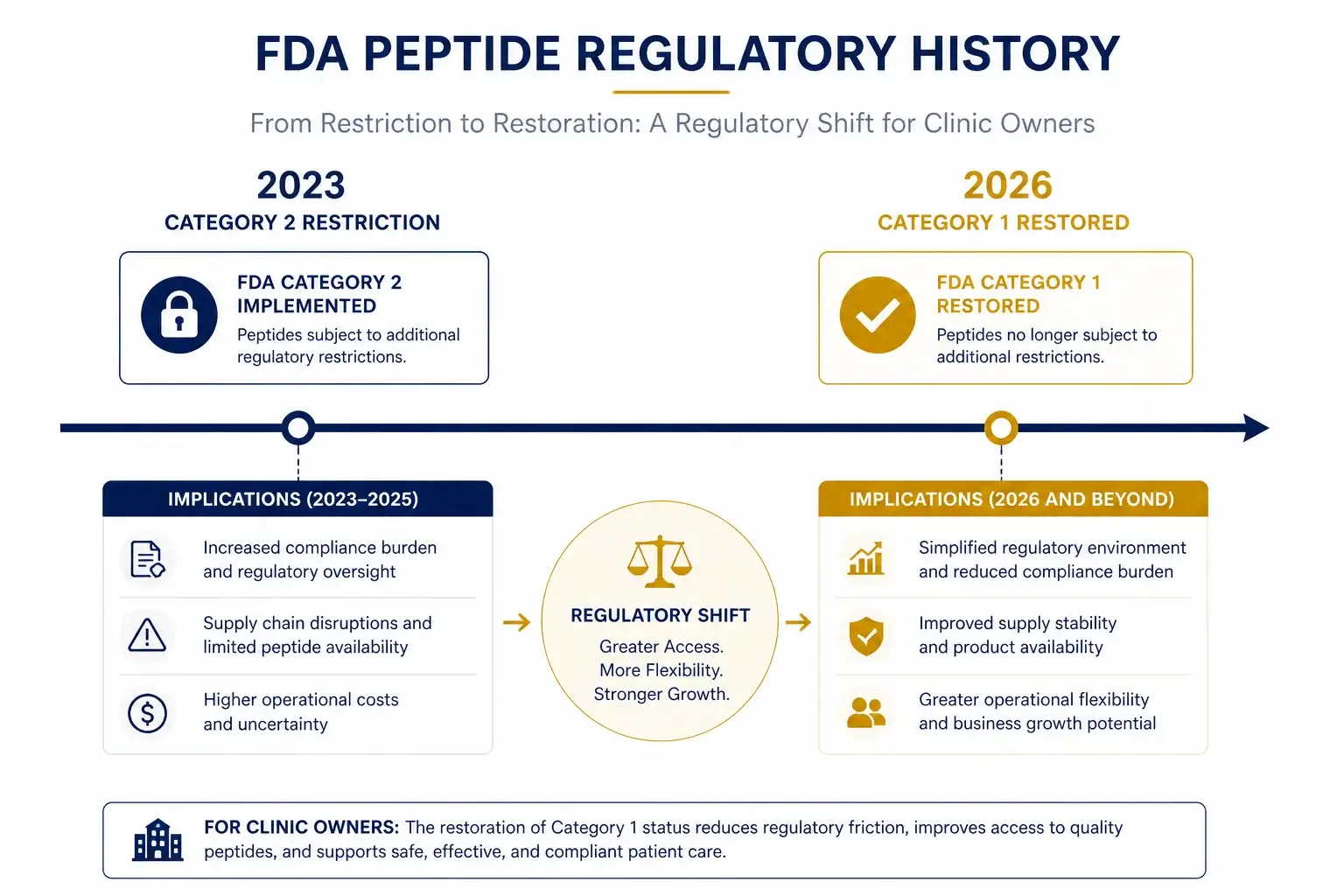
In early 2026, HHS Secretary Robert F. Kennedy Jr. announced that approximately fourteen of the nineteen peptides placed on the FDA's Category 2 restricted list since 2023 would be moved back to Category 1 — restoring legal compounding access for compounds including BPC-157, CJC-1295, Ipamorelin, and Thymosin Alpha-1. The formal Federal Register notice has not yet published as of April 2026, but the policy direction is clear.
For a complete overview of why the peptide therapy clinic market is growing faster than any other cash-pay health category in 2026, see The Peptide Therapy Clinic Business Model (altosconsultinggroup.com/post/peptide-therapy-clinic-business-2026). This post focuses specifically on the compliance framework every clinic owner must understand.
ACG navigates compliance setup for peptide therapy clinics as a core component of the launch engagement. To see the peptide clinics ACG has supported, visit altosconsultinggroup.com/clinics-supported/peptide-therapy.
Understanding the Peptide Regulatory Landscape
Category 1 vs. Category 2 Peptides
Under Section 503A of the Federal Food, Drug, and Cosmetic Act, bulk drug substances used in compounding are classified as Category 1 or Category 2. Category 1 peptides are approved for use in 503A compounding — a licensed pharmacy can legally prepare them for patient use under a valid prescription. Category 2 peptides cannot be used in 503A compounding unless the FDA authorizes their use through formal rulemaking. Between 2023 and 2025, the FDA moved nineteen commonly used peptides to Category 2. The announced reclassification of approximately fourteen back to Category 1 restores that access — but only for clinics operating within the 503A compounding framework.
What the Reclassification Means Practically
For a new clinic owner, the reclassification means that the compounds most patients are actively searching for — BPC-157, CJC-1295, Ipamorelin, Thymosin Alpha-1 — are expected to be legally available through licensed 503A compounding pharmacies once formal rulemaking completes. Clinics already structured with a medical director and compounding pharmacy relationships are positioned to offer these compounds as soon as formal access restores.
The Compliance Framework Every Peptide Clinic Needs
Medical Director and Prescribing Authority
Every compound offered to a patient must be prescribed by a licensed medical professional. The medical director relationship — structured correctly through the MSO model — provides the prescribing authority and clinical oversight that makes legal peptide therapy clinic operations possible for a non-physician owner. The medical director reviews patient labs, approves protocols, and is responsible for clinical decisions that determine patient safety and regulatory compliance.
Licensed Compounding Pharmacy Relationships
Every peptide compound must be sourced through a licensed 503A or 503B compounding pharmacy. The pharmacy must be disclosed to patients. Clinics should be able to produce documentation of which pharmacy fills each prescription, the pharmacy's current licensing status, and batch testing documentation for the compounds being dispensed.
Clinical Documentation Standards
Patient records for peptide therapy protocols must include a documented clinical rationale for each prescription, informed consent addressing the regulatory status of the compound and the nature of the clinical relationship, baseline labs where clinically appropriate, protocol specifications, and follow-up documentation. The clinic that treats documentation as a bureaucratic inconvenience is the one that faces enforcement exposure.
Payment Processing Compliance
In 2026, payment processors are applying increasing scrutiny to transactions associated with peptide therapy services. Clinics that advertise or bill peptides improperly face the risk of account freezes or termination. Using a processor with experience in cash-pay health services and ensuring billing language is consistent with clinical documentation is an operational compliance requirement many new operators underestimate.

Why Building the Compliance Framework Now Is the Right Move
The compliance landscape for peptide therapy clinics in 2026 is more consequential than at any point in the recent history of the space. The regulatory environment is improving for entrepreneurs who build correctly — but the gap between operating correctly within the compounding pharmacy framework and operating outside of it has never been wider in terms of legal exposure and business durability.
ACG's launch engagement for peptide therapy clinics includes compliance navigation as a core component. Entity structure, medical director setup, supplier access through vetted compounding pharmacy networks, documentation standards, and marketing compliance are addressed sequentially before the first patient is seen. To learn more, visit altosconsultinggroup.com/new-clinic-launch. To start the conversation, visit altosconsultinggroup.com/survey.
Building a Compliance Culture That Protects the Clinic as the Regulatory Environment Continues to Evolve
The FDA's announced reclassification of approximately fourteen Category 2 peptides back to Category 1 is genuinely good news for the peptide therapy clinic space. It restores legal compounding access to compounds with the strongest patient demand — BPC-157, CJC-1295, Ipamorelin, Thymosin Alpha-1 — and signals a regulatory posture toward the compounding community that is more permissive than the direction of 2023 and 2024. But the entrepreneurs who benefit most from this shift are not those who treat it as a green light to operate loosely. They are the ones who use this moment to build the compliance infrastructure that will protect their clinic through the next regulatory shift — because there will be one.
Compliance culture in a peptide clinic is not a set of rules the team follows reluctantly to avoid getting caught. It is an operational philosophy that shapes how every clinical decision is documented, every patient relationship is structured, and every marketing claim is phrased. A clinic with a genuine compliance culture does not wait for the next FDA guidance document to determine whether its practices are defensible. It builds practices that are defensible under any reasonable regulatory interpretation, because the clinical relationships and the business reputation it has built are worth protecting.
The practical components of compliance culture in a peptide clinic start with documentation. Every prescription must have a documented clinical rationale — not a boilerplate note that restates the patient's request, but a clinical observation that connects the patient's specific lab findings, symptom presentation, and health goals to the protocol being prescribed. The medical director who reviews and signs off on protocols must actually review them, not rubber-stamp them. The informed consent process must be a genuine conversation, not a form the patient signs before they have had time to read it. These documentation standards are not bureaucratic inconveniences. They are the evidence that a clinic operates correctly when it is ever scrutinized.
Marketing compliance is the dimension of compliance culture most consistently underestimated by new clinic operators. The peptide therapy clinic that makes medical efficacy claims in its advertising — even subtly, even by implication — is creating legal exposure that compounds over time. The platform that flags a health-related ad today can suspend an advertising account tomorrow. The FTC that receives a complaint about an income or outcome claim in a testimonial can open an inquiry that consumes enormous management attention and legal fees. The standard that ACG applies to all marketing for peptide therapy clinics — outcome language, patient story framing, FTC-compliant testimonial disclaimers — is not conservative for conservatism's sake. It is the standard that keeps the marketing working indefinitely rather than creating an event that shuts it down.
Supplier compliance is the third dimension. Every compound that enters the clinic must come from a licensed, verified compounding pharmacy. The clinic must maintain documentation of the pharmacy's current accreditation status and state licensing for every pharmacy it uses. When the FDA inspects a pharmacy that supplies a clinic — which does happen, and the clinic receives a copy of the inspection findings — the clinic must be able to demonstrate that it sourced from a compliant facility and that it responded appropriately to any findings that affected the compounds it was dispensing.
The peptide clinic that builds compliance culture into its DNA from day one does not experience the operational disruptions — account suspensions, pharmacy relationship terminations, medical board inquiries — that periodically force non-compliant operators to rebuild from scratch. Compliance is not the ceiling that limits what a peptide clinic can do. It is the foundation that allows it to grow continuously without the interruptions that slow non-compliant competitors down.
Frequently Asked Questions
Which peptides are being reclassified back to Category 1?
HHS Secretary Kennedy announced approximately fourteen of the nineteen Category 2 peptides would be moved back to Category 1. Compounds under active reinstatement review include BPC-157, CJC-1295, Ipamorelin, Thymosin Alpha-1, and AOD-9604. The formal Federal Register notice has not yet published as of April 2026. Full restoration is expected through Q2 and Q3 2026.
Can I open a peptide clinic now before the reclassification is finalized?
Yes. The compliance framework required — medical director relationship, 503A pharmacy sourcing, clinical documentation — applies regardless of where specific compounds are classified. Clinics that build their compliance infrastructure now are positioned to expand their formularies as access restores, rather than building infrastructure at the same time competitors are already operating.
What is the biggest compliance mistake new peptide clinic owners make?
Sourcing compounds through channels that are not 503A or 503B licensed compounding pharmacies. The gray market for research peptides cannot be lawfully used in a clinical setting for patient care. Clinics sourcing through these channels expose themselves to FDA enforcement, state medical board scrutiny, and the personal liability of the medical director.
Written by Nova, Senior Content Strategist at Altos Consulting Group.