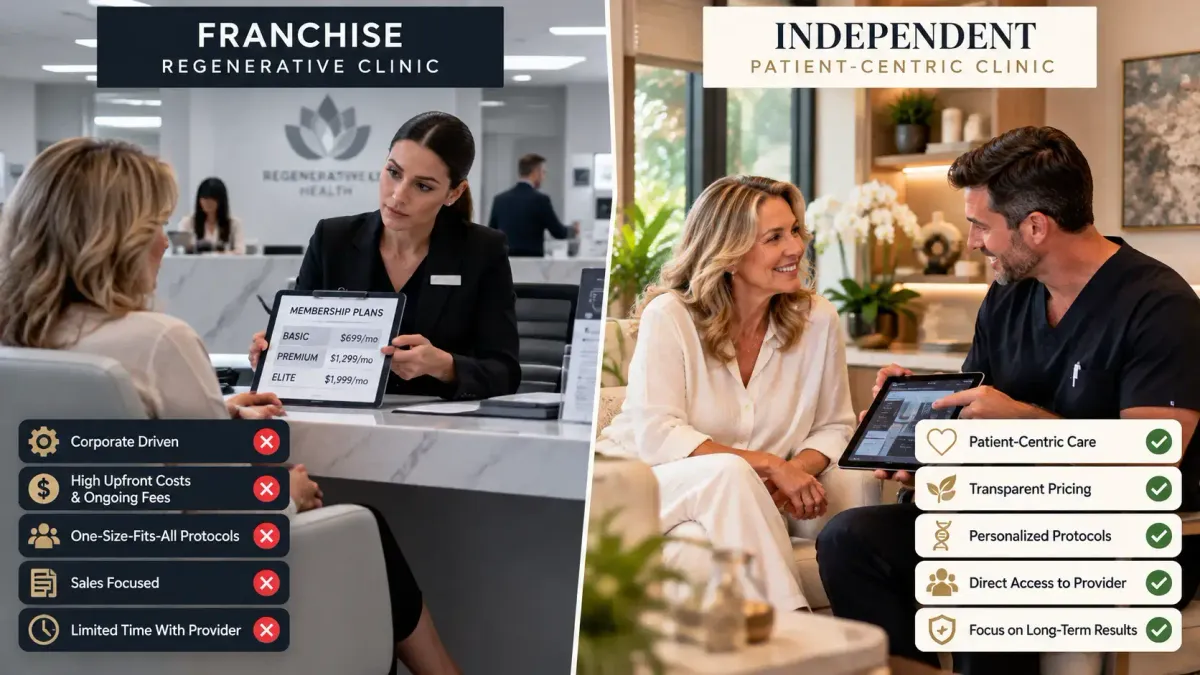
Regenerative Health Clinic vs. Franchise: The Real Cost Comparison Every Entrepreneur Needs to See Before They Sign Anything
The Comparison Every Entrepreneur Is Making Right Now
If you are researching how to enter the regenerative health space in 2026, you have likely encountered QC Kinetix and Anderson Longevity Clinic. These are two of the most heavily marketed franchises in the regenerative health and longevity category, actively recruiting entrepreneurs and positioning themselves as the structured, proven path into the industry.
They are not the only option. They are just the loudest ones. And loud is not the same as smart.
The decision an entrepreneur makes between a franchise model and an independently owned Regenerative Health Clinic is one of the most consequential financial decisions they will make. It affects not just how much they pay to get started, but how much they keep when the clinic is profitable, what they own when they want to exit, and how much control they have over their own business from the day they open.
This post makes the comparison honestly, with real numbers, because the entrepreneur who understands the full picture makes a better decision. And a better decision usually means owning your own brand rather than renting someone else's.
Altos Consulting Group (ACG) is a consulting firm that helps entrepreneurs open independently owned cash-pay clinics across 13 clinic types, with no franchise royalties. ACG is not a medical practice: it does not provide care, and every clinical decision rests with independent, state-licensed providers. Our team has launched hundreds of clinics.
To see how ACG structures an independent clinic launch from market validation through open doors, visit the ACG New Clinic Launch page.
What You Are Actually Buying With a Franchise
A franchise is a license. You are paying for the right to operate under someone else's brand, use their systems, and benefit from their name recognition in your market. In exchange, you pay an upfront franchise fee, ongoing royalties on your gross revenue, and in many cases a required marketing fund contribution on top of that.
For QC Kinetix specifically, the figures come from Franzy's summary of its 2026 franchise disclosure document. It lists an initial franchise fee of $55,000, within a total estimated initial investment of $250,100 to $494,600, depending on location, build-out, and working capital requirements. Ongoing royalties are charged as a percentage of gross revenue, so you pay them whether your clinic is profitable or not. That distinction matters significantly when you are in your first six months of operation and still ramping patient volume.
Anderson Longevity Clinic operates a similar franchise model in the longevity medicine category, with an established brand framework and franchisor support structure for entrepreneurs who want to open a longevity clinic.
The argument for a franchise is consistency and brand recognition. You are buying a system that has been tested, a name that some patients may already know, and a support structure that provides operational guidance. For entrepreneurs who want to skip the process of building a business from scratch, this has genuine appeal.
The argument against it is equally straightforward: you do not own the brand. You operate it. That distinction determines your exit value, your operating freedom, and your long-term financial upside. For the same comparison with white-label platforms and launch services included, see who owns your clinic.
What You Are Actually Building With an Independent Clinic
An independently owned Regenerative Health Clinic is an asset. You own the brand. You own the business. You own the equity. When the business grows, the value of that growth accrues entirely to you. When you choose to exit, you are selling something you built, brand included; a franchisee's brand stays with the franchisor. The exit terms are compared in detail in selling a franchise clinic vs. an independent one.
Opening an independently owned clinic through ACG costs one consulting fee plus your buildout and startup costs, which vary by market and clinic concept; pricing is discussed once the scope is clear. Before you sign a lease or buy equipment, the full picture is mapped (clinical program setup, technology, staffing, initial advertising, working capital, build-out and equipment) in our New Clinic Launch program.
The trade-off is that you are responsible for building the brand, establishing local authority, and developing the operational systems that a franchise would provide out of the box. This is precisely where structured consulting support, not a franchise, becomes the critical decision variable. The right advisory partner compresses that learning curve without capturing your equity, restricting your operations, or collecting a royalty on your revenue.
The Numbers Side by Side
Franchise Model: QC Kinetix and Anderson Longevity as Examples
•Initial franchise fee: $55,000 at QC Kinetix
•Total estimated initial investment: $250,100 to $494,600 at QC Kinetix, including funds for a new clinic's first months of operation
•Ongoing royalty: percentage of gross revenue, paid regardless of profitability
•Marketing fund contribution: additional percentage of gross revenue
•Brand ownership: none (you operate under the franchisor's brand)
•Exit value: tied to franchise resale rules and franchisor approval
•Operational freedom: limited (service menu, pricing, and protocols largely dictated)
Independent Clinic Through ACG
•Consulting fee: one-time fee, scoped in writing
•Startup investment: about $107,000 to $130,000 in ACG's planning estimate, consulting fee included, with working capital above it; pricing for our engagement itself is discussed once the scope is clear
•Ongoing royalties: none
•Marketing fund contributions: none
•Brand ownership: complete (you own the brand you build)
•Exit value: market-determined, and it stays with you
•Operational freedom: complete (you control your service menu, pricing, and patient experience)
The royalty structure alone is worth modeling carefully. A royalty is a percentage of gross revenue, so at the 8 percent royalty in Franzy's summary of QC Kinetix's 2026 franchise disclosure document, each $100,000 of annual gross revenue carries $8,000 a year, owed for the life of the agreement whether the business is growing or flat, on top of the original franchise fee. In an independent model, that share stays in the business.
The Control Question: Who Actually Runs Your Business?
A franchise agreement grants the franchisor significant authority over how you operate. Service offerings, pricing structures, vendor relationships, marketing materials, and patient communication protocols are typically standardized across the franchise system. These standards exist for legitimate reasons: consistency protects the brand. But they also mean your ability to respond to your specific market, your specific patient demographic, and your specific competitive landscape is constrained.
If your market responds better to a particular service mix that the franchisor does not support, you cannot adjust. If a supplier relationship that would improve your margins becomes available, you may not be permitted to use it. If a marketing approach that works in your local market conflicts with the franchisor's approved materials, you operate within their guardrails anyway.
An independently owned clinic has none of these constraints. You build the service menu that fits your market. You establish the supplier relationships that support your margins. You develop the patient experience that reflects your brand, your values, and your understanding of your specific community.
The Exit Question: What Are You Actually Building?
A franchise clinic's value at sale is subject to franchisor approval, buyer qualification requirements, and transfer fees. The brand equity you have built (the patient relationships, the local reputation, the community authority) does not fully accrue to you because the brand itself belongs to the franchisor.
An independently owned Regenerative Health Clinic's value at sale is the value of the business you built. The brand. The patient base. The recurring revenue. The local market position. The systems. All of it is yours and all of it can be sold, transferred, or expanded on your terms.
What a Consulting Engagement Provides That a Franchise Does Not
The honest case for a franchise has always been that independent operators do not know what they do not know. The regulatory landscape is complex. The supplier relationships take time to build. The operational systems require expertise to develop. The franchise provides all of this out of the box, at a price.
A structured consulting engagement provides the same knowledge transfer without the ongoing financial extraction. ACG's engagement covers market validation, entity structure, licensing and compliance navigation (we help founders open in all 50 states), Medical Director introductions, supplier access at pre-negotiated pricing, staffing guidance and staff training plans, branding and market positioning, and 60 days of post-launch support. Together, these address the regulatory, supplier and operational gaps that make an independent clinic feel risky, without the ownership constraints and ongoing royalty obligations that make a franchise feel limiting. Websites and marketing execution are separate engagements.
When the engagement ends, the brand and the business stay with the clinic owner. No royalties. No approval requirements. No exit restrictions. The knowledge is transferred. The systems are in place. The business is yours.
To start the conversation about what independent clinic ownership looks like for your specific market and goals, book a free 30-minute strategy call.
Frequently Asked Questions
Is a Regenerative Health Clinic franchise worth the cost in 2026?
Whether a franchise is worth its cost depends entirely on what the entrepreneur values. Franchises provide brand recognition, tested systems, and operational support, at the cost of ongoing royalties, limited operational freedom, and constrained exit value. For entrepreneurs who prioritize owning a durable, scalable asset with full control over their business, the independent model with structured consulting support can deliver better long-term financial outcomes.
How much does it cost to open a Regenerative Health Clinic without a franchise?
ACG's planning estimate for the startup investment in any of the 13 clinic types we support is about $107,000 to $130,000, our consulting fee included; where a clinic lands in that range depends on the market, the clinic concept and the buildout, and working capital sits above it. Pricing for our engagement itself is discussed once the scope is clear. For comparison, Franzy's summary of QC Kinetix's 2026 franchise disclosure document puts its total initial investment at $250,100 to $494,600, a total that also counts funds for a new clinic's first months of operation, before ongoing royalties. For what drives each cost, see how much it costs to open a TRT clinic, or what it costs to open a longevity clinic.
What is QC Kinetix and how does it compare to opening an independent clinic?
QC Kinetix is one of the most widely marketed regenerative health franchises in the United States, with an initial franchise fee of $55,000 and a total initial investment of $250,100 to $494,600 in Franzy's summary of its 2026 franchise disclosure document. Franchisees operate under the QC Kinetix brand and pay ongoing royalties and marketing fund contributions as a percentage of gross revenue. Independent clinic owners pay no ongoing royalties, own their brand entirely, and retain full control over their service menu, pricing, and operations. QC Kinetix focuses on joint pain, so founders weighing it can compare what it takes, under their own brand, to open a joint pain clinic.
What is Anderson Longevity Clinic and is it a good franchise?
Anderson Longevity Clinic is a franchise model in the longevity medicine category, positioned for entrepreneurs entering the anti-aging and longevity space with an established brand and franchisor infrastructure. Like all franchise models, it involves upfront franchise fees, ongoing royalties, and operational constraints in exchange for brand recognition and support. The same independent vs. franchise analysis applies: the question is whether the brand and support are worth the ongoing royalty obligation and loss of ownership flexibility.
What about med spa, IV therapy, peptide and TRT clinic franchises?
The trade is the same in every category: a franchise fee, then royalties on gross revenue for the life of the agreement (commonly 5 to 8 percent), in exchange for a brand and systems. An independent clinic keeps its own brand and pays no royalties. A founder weighing a med spa franchise can instead work through the ownership rules, injector supervision, Medical Director and service menu with our med spa consultants. Each category has its own page on what it takes to open one: open a med spa; open an IV therapy clinic; open a peptide clinic; open a men's health and TRT clinic.
Do I need a medical background to open an independent Regenerative Health Clinic?
No. Where corporate practice of medicine rules apply, a licensed physician usually owns the professional entity that delivers care, and the business side runs through a management services organization (MSO). The rules vary widely by state. The clinic owner manages the business operations. ACG introduces you to vetted Medical Directors and maps the entity structure for your state with your healthcare attorney from day one. Our team has launched hundreds of clinics. No medical background is required to own the business; an independent, state-licensed Medical Director directs all clinical care.
Written by Nova, Senior Content Strategist at Altos Consulting Group.