
Item 19: Why a Longevity Franchise May Not Be Able to Tell You What You'll Earn
The Most Important Page in a Franchise Disclosure Document, and What It Means When It's Empty
The Page Experienced Buyers Turn to First
A Franchise Disclosure Document contains 23 required items. Experienced franchise buyers tend to read them in a particular order, and Item 19 is usually first.
Item 19 is titled Financial Performance Representations. It is where a franchisor discloses what its units earn or may earn (revenue, and sometimes expenses and profitability), as results from existing locations or as a forecast. It is the only place a prospective buyer can find authorized data about what the business might produce, apart from two cases the FTC's Franchise Rule names: the actual records of an existing outlet you are considering buying, and a supplement to the figures already in Item 19.
It is also optional.
For the longevity franchise landscape generally, see Longevity Clinic Franchises in 2027.
This post is educational and does not constitute legal or financial advice. Franchise terms change between FDD versions and registration states. Figures cited are drawn from publicly available franchise directories and reporting; prospective buyers should request the current Franchise Disclosure Document directly from the franchisor and have it reviewed by a franchise attorney and an accountant before signing anything.
What the Franchise Rule Actually Requires
The FTC Franchise Rule, codified at 16 CFR Part 436, permits but does not require a franchisor to make financial performance representations. A franchisor may decide to disclose nothing about what its units earn and still be fully compliant.
What the Rule does require is this: if a franchisor does make a financial performance representation, it must have a reasonable basis and written substantiation at the time the representation is made, the representation must appear in Item 19, and the substantiation must be made available to prospective franchisees on reasonable request.
And if a franchisor makes no Item 19 representation, the Rule prohibits it from making financial performance representations anywhere else, including in any advertisement or on a website directed at prospective franchisees; the one exception left is the actual records of an existing outlet you are considering buying.
That prohibition is the part many buyers have never heard, and it is the most useful thing in this post.
What an Empty Item 19 Means for You
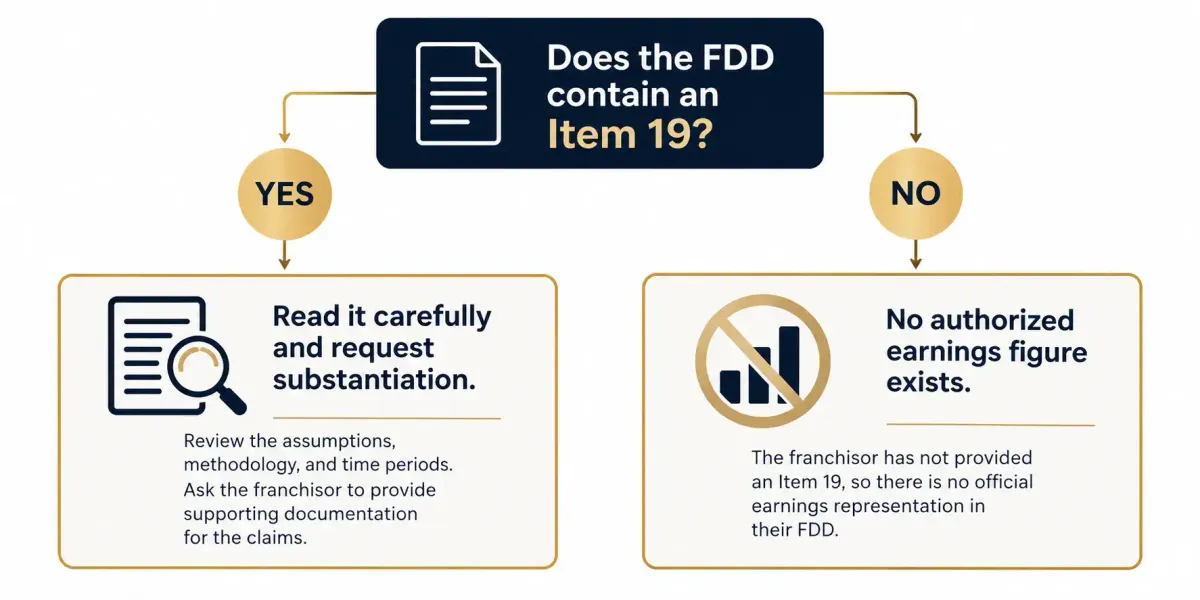
If a franchise's Item 19 contains no financial performance representation, there is no authorized source for what a new unit will earn. Not from the franchisor. Not from a franchise broker. Not from a sales presentation. Not from a number mentioned casually on a discovery call.
This matters practically in three ways.
•You cannot build a defensible financial model from franchisor-supplied figures, because there are none you may rely on.
•Any number you are given verbally is, by definition, not an authorized representation, and relying on it is your risk, not the franchisor's.
•Your lender will ask how you projected revenue, and the honest answer is that you estimated it independently.
None of this means a franchise without an Item 19 is a bad investment. New systems frequently have no operating history to disclose. It means the burden of estimating returns falls entirely on you.
Ultimate Longevity Center, a longevity franchise that launched in December 2025, is one such new system: IFPG's listing for the brand, checked October 2026, shows "Item 19: No" and no franchised units open. For the rest of its published figures, see what the Ultimate Longevity Center FDD shows.
How to Read an Item 19 That Does Exist
When a franchisor does provide one, the disclosure rewards careful reading.
•Is it historical or projected? The Rule requires franchisors to state which. Historical data from operating units is far more useful than a forecast.
•How many units are included, and what percentage of the system do they represent? A figure drawn from the top-performing quartile describes those units, not the system.
•What percentage of included outlets actually achieved the stated result? The Rule requires this for historical performance data.
•Is it revenue or profit? Gross revenue tells you nothing about what an owner takes home.
•Does it include company-owned units? Those often perform differently from franchised units.
Then request the written substantiation. The Rule entitles you to it, and asking is both reasonable and informative.
The Connection to Earnings Claims Generally
This is a specific application of a broader principle the FTC enforces across business opportunities. In January 2025 the Commission proposed changes to its Business Opportunity Rule and a new Earnings Claim Rule. The changes would extend the Business Opportunity Rule to money-making opportunities such as business coaching, prohibit material misrepresentations, including about earnings, and require written substantiation for any earnings claim, available to consumers on request; the new rule would set the same substantiation requirement for multilevel marketers. As of October 24, 2026, the FTC's pages show no further action on either, and neither is a final rule.
The principle is the same whether the seller is a franchisor, a business coach, or a consultant: if someone tells you what you will earn, they should be able to substantiate it in writing, and you should ask them to.
The consultant-side version of this question is covered in our post on why honest clinic consultants won't promise you income.
State Review Adds Another Layer
Beyond the federal Rule, a number of states require franchise registration and review disclosure documents before a franchise may be offered there.
In those registration states, examiners evaluate whether an Item 19 disclosure conforms to federal and state requirements. That review does not validate the underlying business, and it is not an endorsement, but it does mean the figures in a registered Item 19 have been through more scrutiny than a number spoken aloud in a sales meeting.
It also explains why the same brand sometimes shows slightly different investment ranges across directories: different registration states and different FDD versions produce different published figures. Always work from the FDD you were given, dated and current, for the state where you intend to operate.
What to Do With This
Request the current FDD. Read Item 19 first, then Item 20 for unit counts and transfers, then Items 5, 6 and 7 for fees and investment. If Item 19 is empty, treat every revenue figure you have been given as unverified, and build your own model from market data.
Then compare that model against the alternative. An independent clinic has no Item 19 either, but it also has no franchise fee, no royalty, and no brand fund, and the owner controls the pricing and service mix the model depends on. For the full comparison, see independent clinic vs. franchise, and how our team helps you plan a new clinic on your own numbers.
For an independent longevity clinic, monthly recurring revenue is the number of enrolled members times the average membership fee, before costs, with each tier priced for the clinic's own market; the method is set out in The Longevity Clinic Revenue Model.
See what it takes to open a longevity clinic. To discuss building an independent longevity clinic, book a free 30-minute strategy call.
Frequently Asked Questions
Is Item 19 required in every FDD?
No. The FTC Franchise Rule permits but does not require financial performance representations. A franchisor may decline to make one and remain fully compliant. What it may not do is make such representations outside Item 19 when none is disclosed in it.
A franchise rep told me what a location earns. Can I rely on that?
If the FDD contains no Item 19 financial performance representation, that statement is not an authorized representation under the Franchise Rule. Ask for it in writing and ask where it appears in the FDD. The answer to that request is informative regardless of what it is.
Why would a franchisor skip Item 19?
Common reasons include having no operating units yet, having too few units for meaningful data, or having results the franchisor would rather not disclose. A new brand with no open locations genuinely has nothing to report. The reason matters: ask.
Does an independent clinic have better data?
Not in a disclosure-document sense, since none exists. What an independent owner has instead is control over the variables that determine the result (pricing, service mix, cost structure) and no obligation to share revenue. ACG does not publish an average revenue figure: it models the numbers for each founder's market and category, as illustrative planning scenarios, not projections, typical results or guarantees of income or profitability.
Written by Nova, Senior Content Strategist at Altos Consulting Group.