
New Earnings Claims and the FTC: Why Honest Consultants Won't Promise You IncomePost
How to Evaluate Anyone Selling You a Clinic Opportunity
The Pitch That Should End the Conversation
If someone selling you a clinic opportunity tells you what you will earn, you have learned something important — just not what they intended you to learn.
Specific income promises in this context are not confidence. They are, depending on how they are made and whether they can be substantiated, a violation of federal law. Understanding why gives you a reliable filter for evaluating anyone in this market.
This is part of Regenerative Health Clinic Compliance: The 5 Things That Actually Shut Clinics Down.
This post is educational and does not constitute legal advice. Regulatory requirements vary by state and change over time. Clinic owners should work with healthcare counsel admitted in their state before making structural, sourcing, or marketing decisions.
What the FTC Actually Requires
The standard is well settled. FTC staff have stated that under the FTC Act, claims about the potential to achieve a wealthy lifestyle, career-level income, or significant income are false or misleading if business opportunity participants generally do not achieve such results.
Read that carefully, because it is stricter than most people assume. The question is not whether anyone achieved the result. It is whether participants generally do. A claim can be literally true of one person and still be deceptive as a representation of what a buyer should expect.
The same guidance addresses testimonials directly: even truthful testimonials from participants who do earn significant income can be misleading when they are unrepresentative of typical results.
The FTC has also been expanding its tools here. In January 2025 it proposed changes to the Business Opportunity Rule and a new Earnings Claim Rule that would cover money-making opportunities including business coaching, prohibit material misrepresentations about earnings, and require sellers to have written substantiation for any earnings claim and make it available to consumers on request.
This Is Actively Enforced
The enforcement record in the health and wellness business opportunity space is substantial and recent.
In April 2026 the FTC announced an order prohibiting Forever Living Products and its operators from deceiving consumers about potential earnings. The Commission alleged the company used deceptive earnings claims to attract participants, most of whom made no money or lost money. The Bureau of Consumer Protection's director described participants being misled with promises of substantial income that bore little resemblance to actual earnings.
In a separate action the same month, the FTC took action against senior participants in a health and wellness MLM over inflated earnings claims. The resulting order prohibits earnings representations unless they are not misleading, can be substantiated in writing at the time they are made, and the substantiation is provided to anyone expressing interest.
That last condition is the useful one for a buyer. It describes exactly what you are entitled to ask for.
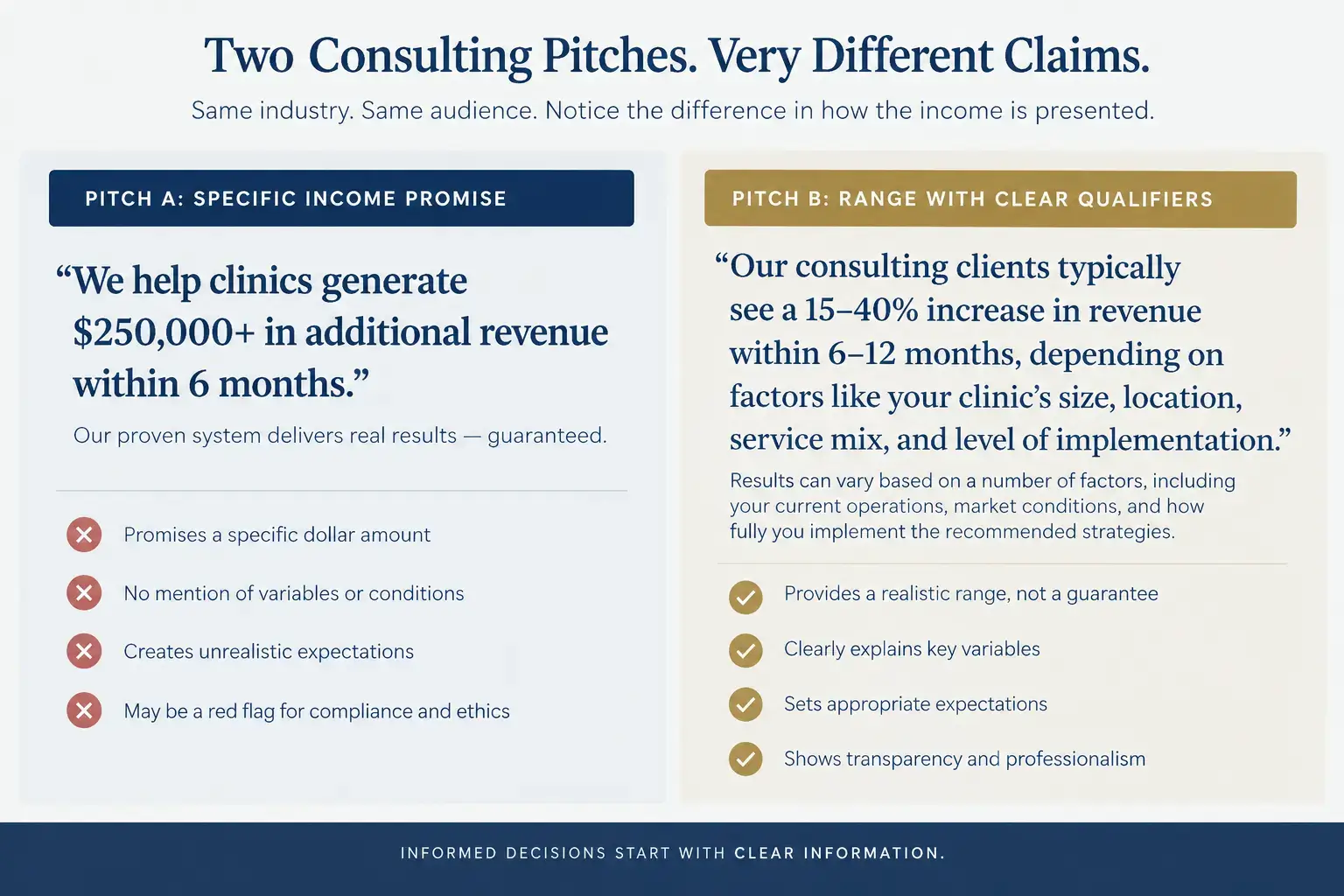
The Difference Between an Illustration and a Promise
This is not an argument that financial information is off limits. A consultant who cannot discuss economics at all is not being careful — they are being unhelpful.
The distinction is between a planning benchmark and a representation of what you will earn. A legitimate discussion describes a range, identifies the variables that drive it, uses the conditional rather than the definite, and states plainly that results depend on market conditions, patient volume, pricing, and execution.
A deceptive claim does the opposite. It attaches a specific number to your outcome, presents an exceptional result as typical, and omits the conditions that produced it.
Every revenue figure ACG publishes carries the same qualifier: these are illustrative planning benchmarks, and actual results depend on market conditions, patient volume, pricing structure, and operational execution. That language is not legal boilerplate. It is the accurate description of what the number is.
Why the Promise Is Often the Product
There is a structural reason income promises cluster in this market, and understanding it makes the pattern easier to spot.
Selling a process is harder than selling an outcome. A process requires the buyer to evaluate whether the knowledge being transferred is worth the fee — which requires them to understand the work. An outcome requires no such evaluation. It only requires belief. Sellers with thin operational substance gravitate toward outcome selling because it is the only pitch available to them.
This produces a reliable inverse signal. The more specific and confident the income promise, the less likely the seller has substantive operational depth behind it. Consultants with genuine expertise tend to talk about sequencing, compliance structure, supplier relationships, and staffing — because that is what they actually do, and because those are the variables that determine results.
If a sales conversation spends more time on what you will earn than on how the clinic gets built, you are being sold a belief rather than a capability.
What to Ask Before You Sign
•Can you substantiate that figure in writing, and will you provide the substantiation?
•What percentage of your clients achieved it, and over what period?
•What happened to clients who did not?
•What specific variables drive the difference?
•Can I speak with clients who are not in your marketing materials?
The reaction to these questions is more informative than the answers. A consultant with real data treats them as reasonable. A consultant selling a promise treats them as an objection to overcome.
Be equally attentive to urgency. Representations that you must act immediately to be considered for an opportunity, or that a money-making opportunity is risk-free or involves little risk, are among the practices the FTC has specifically identified as improper.
Why This Matters After You Sign
The standard does not only apply to the person selling to you. Once you own a clinic, it applies to you — in how you market to patients, and in how you would describe the opportunity if you ever brought on a partner or investor.
The FTC's Health Products Compliance Guidance governs the patient-facing side, covering substantiation, testimonials, and outcome claims. A clinic owner who accepted an unsubstantiated income promise going in is more likely to make unsubstantiated outcome promises going out, because they have internalized a standard that does not hold.
To discuss what ACG's engagement includes and what it does not promise, visit altosconsultinggroup.com/survey.
Frequently Asked Questions
Is it illegal for a consultant to discuss potential revenue?
No. Discussing economics with appropriate qualification is normal and useful. What the FTC addresses is unsubstantiated or misleading representations about what a buyer will earn — particularly claims of significant income where participants generally do not achieve it, and testimonials presented as typical when they are not.
What if the consultant shows me real client results?
Ask what percentage of clients achieved them and what happened to the rest. Real results from unrepresentative clients, presented without that context, are the specific pattern the FTC identifies as misleading. Under the proposed Earnings Claim Rule, sellers would be required to have written substantiation and provide it on request.
Are clinic consultants a scam?
The category is not. Legitimate consulting transfers real operational knowledge — compliance frameworks, supplier relationships, clinical protocols, systems — and charges a fee for it. What distinguishes legitimate from predatory is not price but what is being sold: a process and a knowledge transfer, or a promised outcome. The second is both a worse purchase and a regulatory problem.
Does this apply to franchises too?
Franchises operate under the FTC's Franchise Rule, which requires a disclosure document including any financial performance representations. Franchises that make earnings claims must have a reasonable basis and disclose them in the document. A franchise making verbal income promises outside that disclosure is a warning sign.
Written by Nova, Senior Content Strategist at Altos Consulting Group.