
Med Spa Franchise: What It Costs and What You Give Up
The franchise fee is the smallest number in a med spa franchise. On the three franchise listings we read for this guide, the fee runs $50,000 to $60,000, while the total initial investment the franchisor must disclose runs from about $490,000 to more than $1.2 million. Then the royalty starts, and it runs for the life of the agreement. Those last two numbers are the ones to budget.
This guide from Altos Consulting Group (ACG) walks through what a med spa franchise sells, what it costs fee by fee, what you give up in return, and the questions to ask before you sign. Every figure is as published on franchise directory listings that cite each brand's 2026 Franchise Disclosure Document (FDD), checked October 29, 2026. Our team has launched hundreds of clinics, and we help founders open a med spa.

What a Med Spa Franchise Sells
A med spa franchise sells a business that has already been designed. The buyer gets a brand patients may already recognize, an operating system with written procedures, a build-out specification for the space, relationships with product and equipment vendors, a training program, and in many systems national or regional marketing funded by every location.
For a founder with no background in aesthetics or clinic operations, that package has real value. It shortens the list of decisions to make alone, and it comes with people who have opened locations before. The question is not whether a franchise offers something. It is what the package costs over the full term, and what it asks you to give up.
Med Spa Franchise Costs, Fee by Fee
The franchise fee
The initial franchise fee buys the right to use the brand and system, and it is disclosed in Item 5 of the FDD. On the 2026 figures, the fee is $50,000 for VIO Med Spa, $55,000 for dermani MEDSPA and $60,000 for 4Ever Young. These figures appear in Prospyr's comparison of med spa franchises, and on each brand's listing on Franzy.
The total initial investment (Item 7)
Item 7 is the number to plan around. It covers the fee plus build-out, equipment, opening inventory, signage, insurance, deposits and more, as a low and high range. On the 2026 figures, dermani MEDSPA lists $491,792 to $906,189 (Prospyr and Franzy agree), and 4Ever Young about $522,700 to $807,400 (Franzy's 2026 FDD summary and Prospyr agree).
Listings do not always agree. For VIO Med Spa, three listings give three ranges: $642,722 to $1,231,677 on Franzy, $642,722 to $1,109,954 on Prospyr, and $794,261 to $1,231,677 on Peersense. That gap is a strong reason to read Item 7 in the current FDD itself rather than in a directory.
Item 7 also includes additional funds for the initial period of operations, which the FTC's rule describes as at least three months or a reasonable period for the industry, under 16 CFR 436.5(g). Keep that in mind when you compare an Item 7 total with any other startup figure.
Royalties and brand funds, for the life of the agreement
Item 6 lists the fees you pay after opening. On the listings we read, the royalty is 5 percent of gross revenue plus a 0.25 percent brand fund for dermani MEDSPA (Franzy), 6 percent plus 1.5 percent for VIO Med Spa (Peersense and Franzy), and 7 percent plus a 2 percent brand fund for 4Ever Young (Franzy). Franchise royalties commonly run 5 to 8 percent for the life of the agreement.
The arithmetic is simple and easy to skip. At a 6 percent royalty plus a 1.5 percent fund, every $100,000 of gross revenue carries $7,500 in fees, before rent, payroll or product. It is owed in slow months as well as busy ones, and it is paid on top of the initial investment.
What You Give Up With a Med Spa Franchise
The fees are the visible cost. The agreement also sets limits that last as long as the fees do:
A share of revenue for the full term. The royalty and brand fund come off gross revenue, not profit, for as long as the agreement runs.
Territory. Item 12 defines where you may operate and what protection you get. Opening a second location, or serving patients outside the territory, depends on the agreement's terms.
Approved vendors. Item 8 lists the products and services you must buy from approved sources. In a med spa, that can include devices, skin care lines and software, and it limits your ability to change suppliers when a better price or product appears.
Renewal and transfer. Item 17 sets the term, what renewal requires, when the franchisor may terminate, and the conditions for selling your location. Selling usually needs the franchisor's approval.
The brand. You build patient loyalty to a name you license. If the agreement ends, the name, and often the phone number and website, stay with the franchisor.
None of this makes a franchise a poor choice. It makes the agreement the document to read slowly, with a franchise attorney.
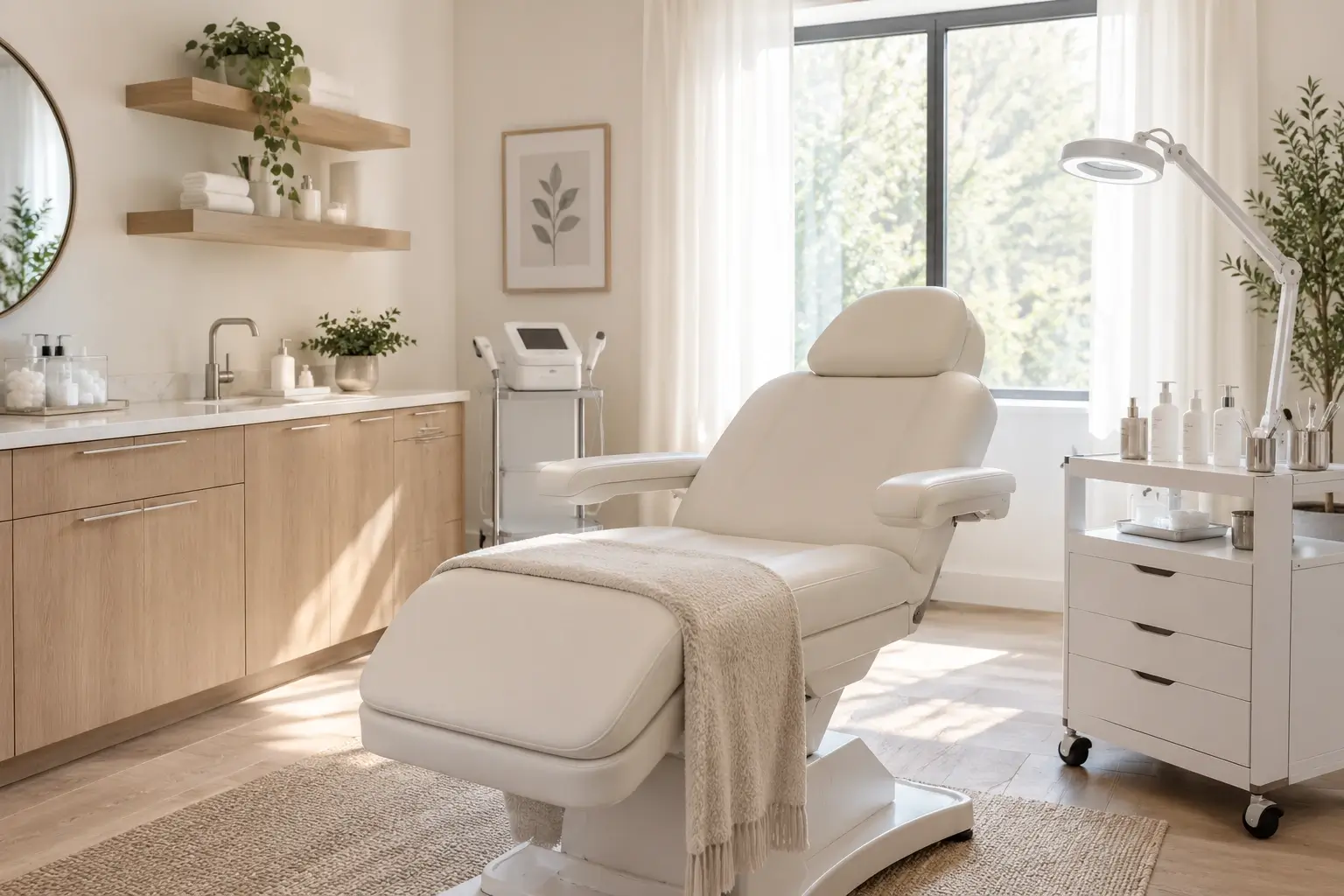
The Independent Alternative to a Med Spa Franchise
An independent med spa trades the franchise package for decisions you make yourself, with advisers you choose. You own the brand, you set the service menu with your Medical Director, you choose your suppliers, and you pay no royalty or brand fund.
ACG's planning estimate for the startup investment in any of the 13 clinic types we support is about $107,000 to $130,000, our consulting fee included; working capital sits above it. Pricing for our engagement itself is discussed once the scope is clear. When you compare that estimate with a franchise's Item 7 total, remember that the Item 7 total also counts additional funds for the first months of operation (16 CFR 436.5(g)), and that a franchise build follows the franchisor's specification for the site, finishes and equipment.
For where the money goes in an independent build, see our guide to what it costs to open a med spa. For the same choice across other clinic types, read our comparison of independent clinic vs. franchise, and for a worked example in another category, see what a longevity clinic franchise costs. For the services, compliance and patient model behind an independent practice, see our guide on how to open a med spa.
ACG works with partner Medical Director networks that cover all 50 states. If you want to open a med spa without a franchise, our launch program covers entity structure, Medical Director introductions, supplier access and brand identity. Websites and marketing execution are separate engagements.
Questions to Ask Before You Sign a Med Spa Franchise Agreement
Ask each franchisor these questions, and read the answers against the current FDD:
Is there an Item 19, and what is it based on? Item 19 is where a franchisor may make financial performance representations. The Franzy listings for all three brands above show an Item 19 document. Ask how many locations the figures cover, and how long those locations had been open.
How many locations opened and closed? Item 20 shows outlets opened, transferred, terminated and closed over three years, with contact details for current and former franchisees. Call several of each.
Who supervises clinical care in my state? Supervision and delegation rules for injectables and lasers vary by state. Ask how the system staffs a Medical Director where you plan to open.
Does the ownership structure fit my state? Many states restrict who may own a medical practice under the corporate practice of medicine doctrine. Ask whether the franchise model uses a management company and a physician-owned practice, and have healthcare counsel in your state confirm it. For one strict state, see California's med spa ownership rules.
What does Item 7 leave out? Ask what recent franchisees actually spent compared with the Item 7 range, and how long their ramp took.
Med Spa Franchise FAQs
How much does a med spa franchise cost?
On the 2026 listings we read, franchise fees run $50,000 to $60,000 and Item 7 totals run from about $490,000 to more than $1.2 million, with royalties of 5 to 7 percent of gross revenue on top. Read Item 7 in the current FDD itself, since listings can disagree.
What royalty do med spa franchises charge?
The listings we read show 5, 6 and 7 percent of gross revenue, with brand or advertising funds of 0.25 to 2 percent on top. Franchise royalties commonly run 5 to 8 percent for the life of the agreement. Confirm the current figures in Item 6 of the FDD.
Do I need to be a doctor to own a med spa franchise?
No medical background is required to own the business; an independent, state-licensed Medical Director directs all clinical care, and some states require physician ownership or a management-company structure.
Is a med spa franchise better than opening independently?
It depends on what you value. A franchise gives you a brand, a tested system, vendor relationships and training, and asks for a larger initial investment and a share of revenue for the full term. An independent med spa asks you to make more decisions with your own advisers, and you keep the brand, with no share of revenue paid to a franchisor. A franchise can suit a buyer who wants a proven playbook and has the capital; an independent build can suit an owner who wants control of the menu, suppliers and brand. To compare both paths for your market, talk with our med spa consulting firm, or book a free 30-minute strategy call.
This article is educational and is not legal or financial advice. Franchise terms change with each year's FDD; read the current FDD and have it reviewed before you sign. Figures as published, checked October 29, 2026.
Written by Nova, Senior Content Strategist at Altos Consulting Group.