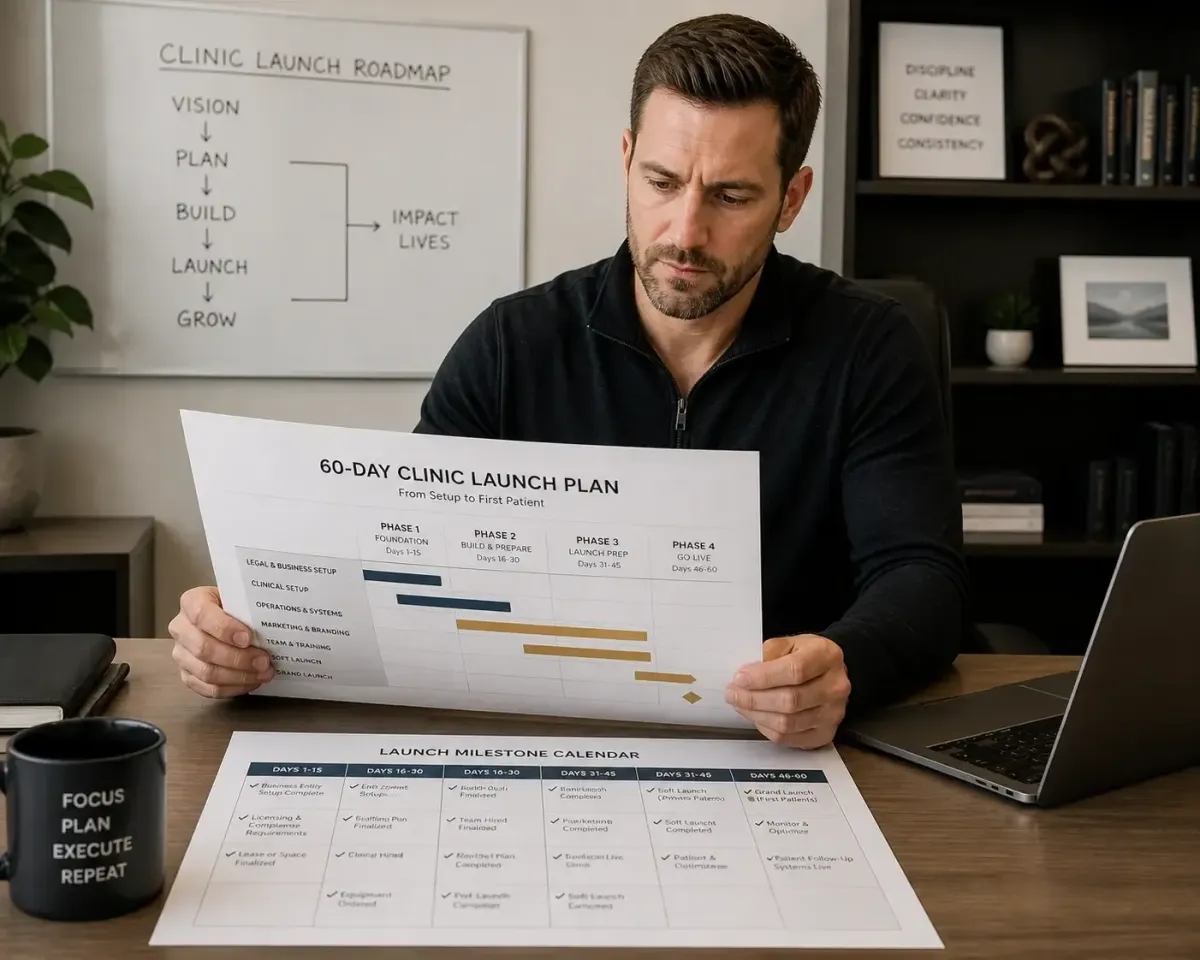
Clinic Setup Timeline: What Can Be Done in Parallel (and What Can’t)
One of the fastest ways to create delays, cost overruns, and unnecessary stress when opening a Regenerative Health Clinic is misunderstanding the setup timeline.
Many founders assume the process is linear: step one, then step two, then step three. In reality, a successful launch depends on understanding what can happen in parallel and what absolutely cannot without creating downstream problems.
This is where many entrepreneurs get tripped up. They either:
Try to do everything at once and create chaos, or
Move too slowly because they believe everything must be completed sequentially
This post breaks down the regenerative health clinic setup timeline from an operational perspective, explaining which setup tasks can safely overlap, which ones depend on earlier decisions, and where rushing actually creates setbacks.
If you want the high-level framework this post supports, review the full New Clinic Process behind the 60-day target launch window, from keys to first patient, market and regulatory conditions permitting.
Why Timeline Mismanagement Is One of the Most Expensive Launch Mistakes
Founders rarely miss timelines because they’re lazy. They miss timelines because they don’t understand dependencies.
In a clinic launch, many tasks look independent, but they aren’t. Decisions made too early (or too late) ripple across:
Budget
Staffing
Workflow design
Space usage
Patient experience
The role of regenerative health clinic consulting is not just to tell founders what to do, but when to do it, and what must be locked before moving forward.
A clean timeline reduces:
Rework
Vendor changes
Staff confusion
Opening-day chaos
The Three Categories of Clinic Setup Tasks
Every setup task falls into one of three buckets:
Parallel-safe: can be done simultaneously without conflict
Conditional-parallel: can overlap, but only after certain decisions are locked
Sequential-only: must follow a strict order or risk failure
Understanding these categories is the foundation of a stable setup timeline.
What CAN Be Done in Parallel (If Planned Correctly)
1. Entity Formation and Early Market Validation
Once the decision to move forward is real, these two activities can overlap safely:
Early market validation and positioning work
You do not need to wait for every operational detail to be finalized before forming the business or validating the market concept. In fact, delaying both often leads to stagnation.
What matters is that market validation informs later decisions, not the other way around.
This parallel work sets the foundation for smart setup decisions later in the timeline.
2. High-Level Workflow Mapping and Location Search
You should never search for a physical space without understanding your intended workflow, but you can work on both at the same time.
Parallel-safe actions include:
Drafting a high-level patient flow model
Identifying space requirements (room count, layout needs)
Touring potential locations that could support that model
The mistake founders make is locking a lease before confirming the workflow fits the space. But exploration and planning can, and should, overlap.

3. Brand Direction and Operational Planning (At a High Level)
Founders often believe branding must wait until everything is finalized. That’s not true, as long as branding stays directional, not final.
You can work in parallel on:
Brand tone and positioning
Operational role definitions
Early staffing assumptions
What you should not finalize yet:
Final messaging scripts
Marketing execution
Public-facing claims or language
Brand direction should support operations, not force operations to conform to branding decisions made too early.
What CAN Be Done in Parallel, But Only After Key Decisions Are Locked
This is where many timeline mistakes happen.
4. Lease Finalization and Detailed Workflow Design
Once you have:
A confirmed workflow model
A space that actually supports it
You can move forward with both:
Lease finalization
Detailed workflow design
At this stage, workflow design becomes specific:
Front desk placement
Room usage sequencing
Staff movement patterns
Trying to design detailed workflows before space is locked leads to rework. Lock the right space first, then design in detail.
5. Staffing Planning and Systems Selection
Staffing and systems should be designed together, not separately.
Once workflow complexity is defined, you can plan:
How many non-clinical staff are required
Which roles must exist before opening day
What systems support those roles
This parallel work prevents over-hiring and over-buying software.
This phase is a core part of regenerative health clinic business consulting, because poor alignment here leads to bloated payroll or broken operations.
What CANNOT Be Done in Parallel (Without Creating Problems)
6. Staff Training Before Workflow Finalization
This is a hard stop.
Training staff before workflows are finalized leads to:
Confusion
Inconsistent execution
Retraining costs
Staff training must come after:
Workflow documentation
Role clarity
Communication standards
Training should teach staff how the clinic actually operates, not how the founder hopes it will operate. Who to hire, and when, is covered in clinic staffing and training.
7. Marketing Execution Before Operational Readiness
This is one of the most damaging timeline errors founders make.
Running marketing before operations are ready leads to:
Missed calls
Poor intake experiences
Inconsistent follow-up
Reputation damage early
Visibility should come after:
Scheduling systems are tested
Staff knows exactly what to do
Intake processes run smoothly
Marketing timing is coordinated as part of the broader regenerative health clinic launch, not treated as an isolated activity.
8. Opening Day Before Pre-Launch Testing
Opening without testing is not bold; it’s careless. For what else to confirm before opening, see our guide to clinic launch readiness planning.
Pre-launch testing cannot be parallelized with opening. It must come first.
Testing includes:
Scheduling dry runs
Intake simulations
Staff role rehearsals
Issue escalation scenarios
Skipping this step creates avoidable chaos that no amount of enthusiasm can fix.
A Sample High-Level Setup Timeline (Founder View)
While timelines are always market- and situation-dependent, a clean setup often follows this structure:
Planning, market validation, entity setup
Workflow modeling + location search (parallel)
Lease finalization + detailed workflow design
Staffing planning + systems setup
Staff training + pre-launch testing
Opening day and stabilization
This sequence illustrates how parallelization works without breaking dependencies. Altos plans each launch around a 60-day target from keys to first patient, market and regulatory conditions permitting: a target, not a guarantee. The timing of the work before keys, from planning to the lease, varies by state, clinic type and regulatory complexity.
Why Founders Struggle to Manage This Without Guidance
Many entrepreneurs are good at execution, not dependency mapping.
Without guidance, founders:
Do tasks too early
Lock decisions prematurely
Create rework loops
Lose momentum
This is why opening a clinic is not just about effort; it’s about orchestration. For the full sequence, see our guide on how to open a regenerative health clinic.
Altos exists to help founders sequence correctly, parallelize intelligently, and avoid timeline traps that cost far more than they save.
You can explore how this applies specifically to your situation with a launch plan sequenced for your market.
Final Takeaway: Parallel Work Is a Tool, Not a Shortcut
Parallel execution accelerates progress only when dependencies are respected.
The fastest clinic launches are not the most rushed; they’re the most deliberate.
If you understand:
What can overlap
What must wait
What decisions unlock others
You gain speed and stability.
That’s the difference between a clean launch and a stressful one.
