How to Open a Regenerative Health Clinic in 2026: The Complete Guide for Entrepreneurs
Why 2026 Is the Right Year, and Why the Process Matters More Than the Timing
Patient demand for the services these clinics offer shows up plainly in search data: Google Keyword Planner reports 10K to 100K U.S. searches a month for "longevity clinic" and 100K to 1M for "medical spa" (U.S., Sep 2025 to Aug 2026, in the ranges Google reports). Demand differs from market to market, which is why the first step below is local.
But timing alone does not decide whether a clinic succeeds. The entrepreneurs who open regenerative health clinics and build them into durable businesses make the right decisions in the right order: market selection before a location commitment, legal structure before the lease, the Medical Director before the build-out, protocols before patients.
This guide covers the process for opening a regenerative health clinic in 2026, every decision in order, with the compliance and operational context each one needs. Our team has launched hundreds of clinics, and we help entrepreneurs open clinics in all 50 states. To see how we work through these steps with a founder, read how ACG runs a new clinic launch.
Step 1: Validate Your Market Before You Commit to Anything
Market selection is one of the most consequential decisions in the launch, and one many entrepreneurs treat as a default rather than a deliberate choice.
A regenerative health clinic needs a local patient base that can support cash-pay services: household incomes that fit premium pricing, a habit of spending on health, and a competitive landscape that leaves room for a new clinic. These factors do not line up the same way in every U.S. market. A city that looks attractive by population alone may not have the incomes to support premium cash-pay services, and a market that looks crowded may be served by operators who struggle to keep patients.
The data points that matter: population demographics and income distribution in the target zip code cluster, local search volume for longevity medicine and regenerative health keywords, direct audit of existing operators and how they are positioned, and zoning and licensing complexity for the specific services the clinic intends to offer. This validation must be completed before any location commitment is made.

Step 2: Choose Your Clinic Type and Service Mix
The regenerative health space includes distinct clinic models, each with its own patients, services, compliance profile and financial model. Choosing the right one for your market before the legal or location work begins avoids one of the most expensive mistakes in a launch: building a clinic for patients your market does not have in real numbers. You can compare the 13 categories we support by patient demand to decide which type of clinic to open.
The 13 clinic categories we support:
•Open a longevity clinic: NAD+, red light therapy, biomarker monitoring and healthspan memberships.
•Open a hormone optimization and HRT clinic: TRT, HRT and BHRT for men, women or both, with ongoing lab monitoring.
•Open a men's health and TRT clinic: Schedule III handling, DEA-registered prescribers and an ongoing protocol model.
•Open a women's health and menopause clinic: BHRT, perimenopause and menopause programs with 503A pharmacy access.
•Open a medical weight loss clinic: FDA-approved GLP-1 programs with metabolic and body composition care.
•Open a peptide clinic: protocols built on lawfully compoundable peptides, through licensed 503A pharmacies and registered 503B outsourcing facilities.
•Open a sexual wellness clinic: ED treatment, women's intimacy and libido care for a discreet patient base.
•Open a joint pain clinic: PRP, shockwave and regenerative therapies, with package pricing.
•Open a neurological wellness clinic: HBOT, NAD+ infusion and neurofeedback, alongside each patient's existing care.
•Open a hair restoration clinic: PRP, low-level laser and FDA-approved topical and oral treatments.
•Open an IV therapy clinic: drip bars, NAD+ and hydration protocols, standalone or alongside other services.
•Open a stem cell clinic: cellular service lines built on HCT/P rules (21 CFR Part 1271) and supplier documentation.
•Open a med spa: injectables, laser and skin treatments, body contouring and memberships.
Telehealth is a service rather than a clinic category: many ACG clients start virtual and open a physical clinic once demand in their market is proven. See our telehealth consulting services.
Step 3: Establish the Legal Foundation
The legal structure of a regenerative health clinic comes before any other business commitment: before a lease, a bank account or a vendor contract. Getting it right is not a formality. It decides whether the clinic can operate legally, attract the right Medical Director and hold up to regulatory scrutiny as the business grows. The five compliance failures that close clinics are covered in our guide to regenerative clinic legal requirements.
The MSO Model for Non-Physician Owners
No medical background is required to own the business; an independent, state-licensed Medical Director directs all clinical care. Some states have corporate practice of medicine (CPOM) laws that restrict non-physicians from owning medical practices. In those states a licensed physician usually owns the professional entity that delivers care, and the business side runs through a management services organization (MSO), under a management services agreement. The rules vary widely by state. If CPOM applies in yours, ACG maps the structure with your healthcare attorney before you file anything, not after.
Healthcare counsel admitted in your state drafts the entity documents and, where CPOM applies, the management services agreement. Corporate practice rules, nurse practitioner practice authority and entity requirements vary by state, so the structure is mapped before anything is filed.
Licensing and Compliance by State
Every state sets its own licensing requirements, and each service line adds its own. Every clinician who prescribes a controlled substance such as testosterone (Schedule III) generally needs a DEA registration, and each location where it is administered, dispensed or stocked needs its own registration. Add state business licensing for health facilities, zoning verification for medical use, malpractice and general liability insurance, and the prescribing rules for services such as testosterone, GLP-1 programs and compounded peptides. ACG maps this sequence for your state before you commit to a location.
Step 4: Engage the Medical Director
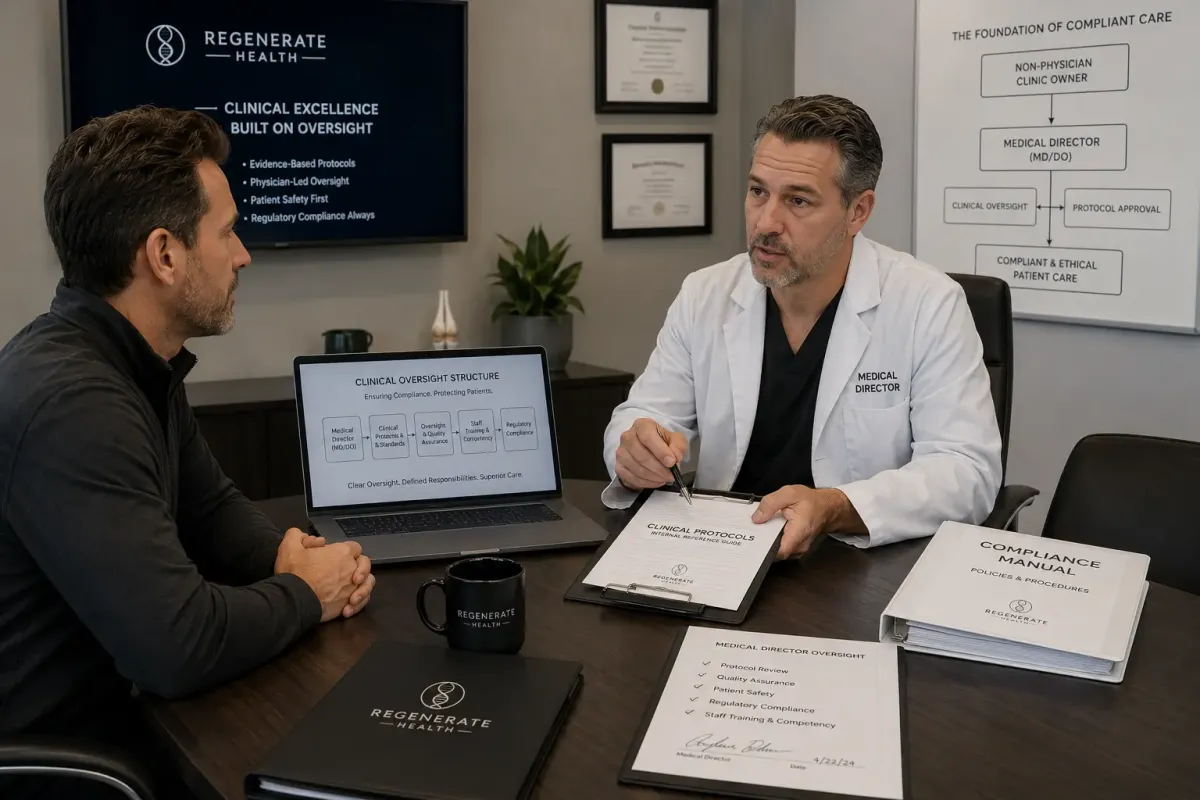
Every regenerative health clinic needs a Medical Director: a licensed physician (MD or DO) who provides clinical oversight, approves treatment protocols, holds prescribing authority for your clinic's services and meets your state's medical oversight requirements. Engage the Medical Director before the build-out begins, because their protocols and oversight shape what the space and technology must support.
The role is usually part-time or supervisory, not a full-time position, and pay depends on the state, the service mix and the scope of oversight. ACG works with partner Medical Director networks that cover all 50 states and introduces you to vetted Medical Directors suited to the clinic type you are building, not just any physician willing to sign a contract.
Step 5: Establish Supplier Access and Protocol Infrastructure
The supplier relationships that shape a clinic's margins need to be in place before it opens: licensed 503A pharmacies and FDA-registered 503B outsourcing facilities for the compounded medications your Medical Director prescribes, within FDA's compounding rules; equipment suppliers for services such as shockwave therapy, HBOT and IV therapy; lab partners for biomarker panels and monitoring; and an EMR configured for your protocols' documentation.
Through our clinic supplier network, ACG introduces you to vetted suppliers with pre-negotiated pricing on clinical supplies, materials and equipment that is unavailable outside the network. Supplier introductions are made at no additional charge.
Step 6: Select Location, Build Out, and Configure Technology
With the legal structure in place, the Medical Director engaged and the service mix and suppliers confirmed, choose the location knowing what the space needs to support: a reception and waiting area, consultation rooms, treatment space suited to your services, and clinical storage with the right refrigeration. The size depends on your service mix.
Technology comes next: a HIPAA-compliant EMR, scheduling, payment processing and patient communication, configured and tested before the first appointment. Assembling these during the first week of operations shows up in the patient experience.
Step 7: Hire, Train, and Build the Team
A regenerative health clinic needs a trained team in place before opening. Depending on your clinic type, you will need licensed clinical staff, typically a Nurse Practitioner, PA or RN, to administer treatments; what each may do depends on your services and your state's scope-of-practice rules. Add a medical assistant or patient coordinator and a consultation coordinator who manages the inquiry-to-membership conversion process, and hire and train each role before the first patient walks in.
Clinical training covers the protocols the clinic will offer, the documentation standards for each service, adverse event recognition and reporting, and the patient communication standards that set appropriate expectations; your Medical Director sets the clinical standards. ACG maps your roles, introduces candidates and trains the team before you open; see our clinic staff training.
Step 8: Launch Marketing Before Opening
The weeks before opening are when the local patient base is seeded. A pre-launch plan of brand awareness, local search visibility and advertising, designed to fill the first consultation calendar, means the clinic can open to booked consultations rather than an empty schedule.
ACG plans that pre-launch marketing strategy, built for your clinic type and local market and within the advertising platforms' rules for healthcare categories. Marketing execution is a separate engagement.
To talk through your market and timeline, book a free 30-minute strategy call.
Step 9: Open and Optimize
The first 90 days of operation can set the clinic's trajectory for its first year. Consultation-to-membership conversion in the first 30 days sets the recurring revenue floor; the first patients' experience decides whether they stay and refer; and early marketing data shows how to improve acquisition cost and lead quality before the budget grows.
ACG's post-launch advisory runs for 60 days after opening: marketing diagnosis and campaign recommendations, bottleneck identification and staff follow-up training, so the clinic is prepared for days 60 to 90.
Frequently Asked Questions
Do I need a medical background to open a Regenerative Health Clinic?
No. No medical background is required to own the business; an independent, state-licensed Medical Director directs all clinical care. ACG introduces you to vetted Medical Directors through partner networks that cover all 50 states, and many ACG clinic owners come from business, finance and real estate. Some states' corporate practice rules shape the ownership structure, as Step 3 explains.
How long does it take to open a Regenerative Health Clinic?
ACG targets a 60-day launch window from keys received, market and regulatory conditions permitting. The compliance and setup work happens before keys, and its timing varies by state, clinic type and regulatory complexity. On the strategy call we tell you what a realistic timeline looks like in your market.
How much does it cost to open a Regenerative Health Clinic?
ACG's planning estimate for the startup investment in any of the 13 clinic types we support is about $107,000 to $130,000, our consulting fee included. Where a clinic lands in that range depends on the state, the market, the lease and the build-out. Working capital until revenue covers costs sits above that range. Pricing for our engagement itself is discussed once the scope is clear. ACG maps the full picture before you commit and can introduce vetted lending partners, with options such as SBA loans and healthcare lending programs; ACG is not a lender and does not guarantee financing. Examples by clinic type: the cost to open a TRT clinic; what it costs to open a longevity clinic; how much it costs to open a medical weight loss clinic; the cost to open a stem cell clinic.
Which type of Regenerative Health Clinic should I open?
The right clinic type depends on your market's demographics, its competitive landscape and your own operational strengths. Some models build recurring revenue through memberships and ongoing monitoring, such as longevity and hormone optimization; others draw strong new-patient interest, such as medical weight loss. The demand and competitive analysis in Step 1 points to the right one for your market, and the list in Step 2 links each category's page.
Do I need a consultant to open a Regenerative Health Clinic?
No. Founders do open clinics on their own, but many costly setbacks come from taking the steps above out of order: a lease signed before the legal structure, a build-out before the Medical Director's protocols, marketing before intake is ready. A good consulting firm should bring a tested sequence, partner networks and a compliance map for your state. If you weigh that option, ask any firm to put what its fee covers in writing, whether its team has opened clinics of your type and whether you can speak with a client who opened one; a video on our launch page covers what to ask a clinic consultant before you sign. You can also meet the clinic consultants who run our launches.
Written by Nova, Senior Content Strategist at Altos Consulting Group.