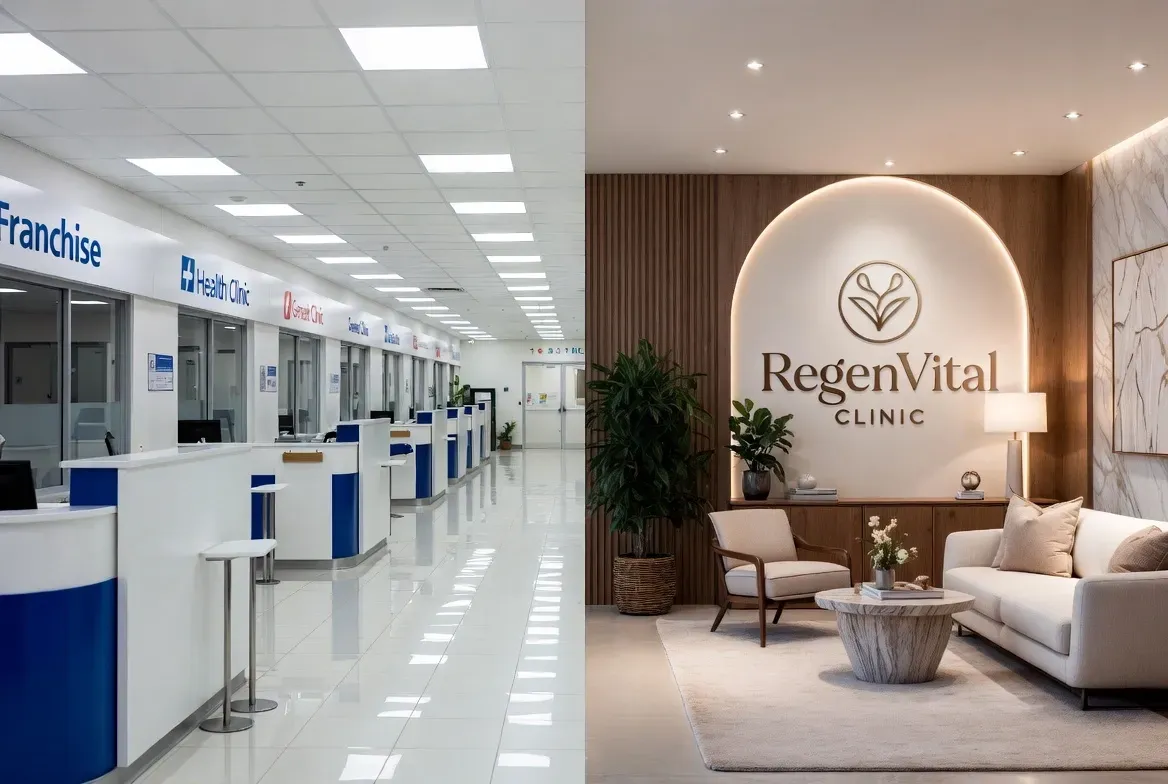
Franchise vs. Independent Regenerative Health Clinic: The Real Cost Comparison Every Entrepreneur Needs to See Before They Sign Anything
The Comparison Every Entrepreneur Is Making Right Now
If you are researching how to enter the regenerative health space in 2026, you have almost certainly encountered QC Kinetix. It is the most heavily marketed franchise in the regenerative health category, actively recruiting entrepreneurs with $250,000 in available capital and positioning itself as the structured, proven path into the industry.
QC Kinetix is not the only option. It is just the loudest one. And loud is not the same as smart.
The decision an entrepreneur makes between a franchise model and an independently owned Regenerative Health Clinic is one of the most consequential financial decisions they will make. It affects not just how much they pay to get started but how much they keep when the clinic is profitable, what they own when they want to exit, and how much control they have over their own business from the day they open.
This post makes the comparison honestly — with real numbers on both sides — because the entrepreneur who understands the full picture makes a better decision. And a better decision usually means owning your clinic outright rather than renting someone else's brand.
What You Are Actually Buying With a Franchise
A franchise is a license. You are paying for the right to operate under someone else's brand, use their systems, and benefit from their name recognition in your market. In exchange, you pay an upfront franchise fee, ongoing royalties on your gross revenue, and in most cases a required marketing fund contribution on top of that.
For QC Kinetix specifically, the publicly available franchise disclosure document outlines an initial franchise fee of $60,000 per territory. Total estimated initial investment ranges from roughly $255,000 to $489,000 depending on location, build-out, and working capital requirements. Ongoing royalties are charged as a percentage of gross revenue — meaning you pay them whether your clinic is profitable or not. That distinction matters significantly when you are in your first six months of operation and still ramping patient volume.
The argument for a franchise is consistency and brand recognition. You are buying a system that has been tested, a name that some patients may already know, and a support structure that provides operational guidance. For entrepreneurs who want to skip the process of building a business from scratch, this has genuine appeal.
The argument against it is equally straightforward: you do not own the brand. You operate it. That distinction determines your exit value, your operating freedom, and your long-term financial upside — and it is a distinction most franchise marketing materials are careful not to emphasize.
What You Are Actually Building With an Independent Clinic
An independently owned Regenerative Health Clinic is an asset. You own the brand. You own the patient relationships. You own the equity. When the business grows, the value of that growth accrues entirely to you. When you choose to exit — whether through a sale, a second owner, or a multi-location expansion — you are selling something you built, not returning a license you rented.
The total investment to open an independently owned Regenerative Health Clinic in 2026 ranges from approximately $107,000 to $130,000 in startup costs — including consulting, clinical program setup, technology, staffing, initial advertising, and working capital. This figure does not include build-out or equipment, which vary by market and clinic concept, but it reflects the real cost of getting a professionally structured clinic to its opening day with the right systems in place from the start.
The trade-off is that you are responsible for building the brand, establishing local authority, and developing the operational systems that a franchise would provide out of the box. This is precisely where structured consulting support — not a franchise — becomes the critical decision variable. The right advisory partner compresses that learning curve without capturing your equity, restricting your operations, or collecting a percentage of your revenue in perpetuity.
The Numbers Side by Side
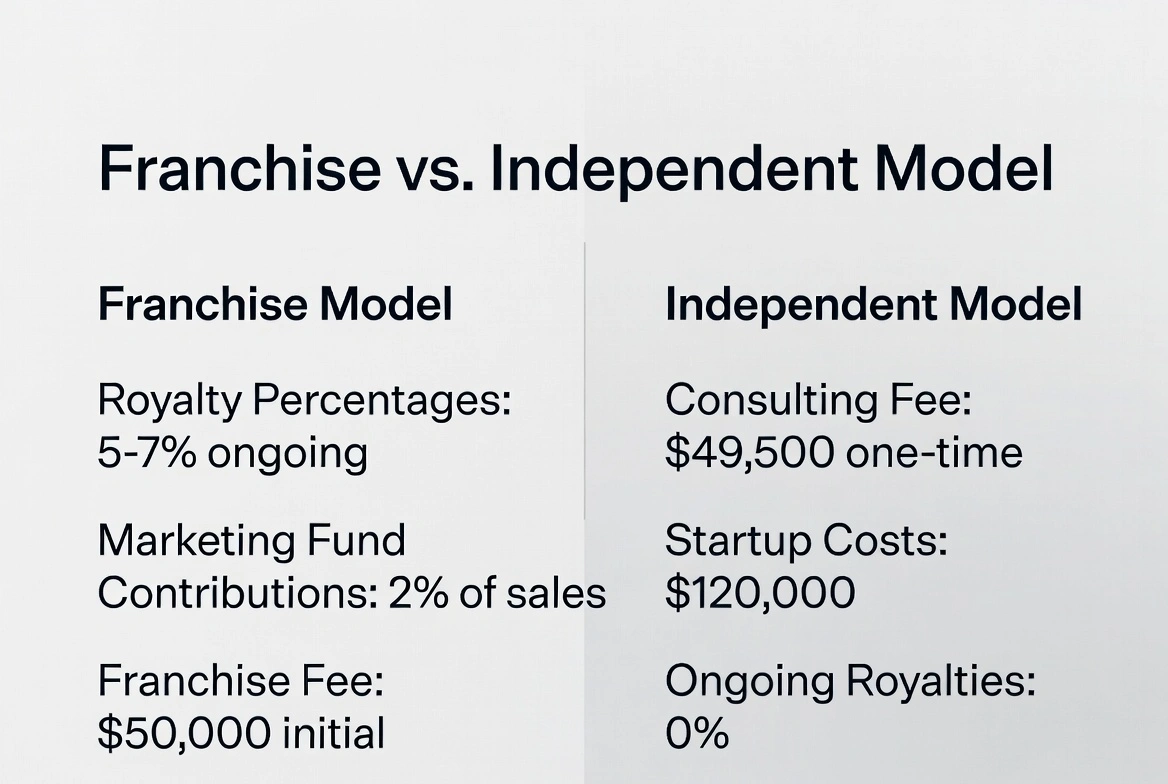
Here is a direct comparison of the two paths using publicly available franchise data and real independent clinic startup figures:
Franchise Model (QC Kinetix as example)
•Initial franchise fee: $60,000
•Total estimated initial investment: $255,000 to $489,000
•Ongoing royalty: percentage of gross revenue, paid regardless of profitability
•Marketing fund contribution: additional percentage of gross revenue
•Brand ownership: none — you operate under the franchisor's brand
•Exit value: tied to franchise resale rules and franchisor approval
•Operational freedom: limited — service menu, pricing, and protocols are largely dictated
Independent Clinic with Structured Consulting Support
•Consulting fee: one-time, covers the full engagement from market validation through post-launch
•Total estimated startup investment: $107,000 to $130,000 including consulting
•Ongoing royalties: none
•Marketing fund contributions: none
•Brand ownership: complete — you own everything you build
•Exit value: market-determined, entirely yours
•Operational freedom: complete — you control your service menu, pricing, and patient experience
The royalty structure alone is worth modeling out carefully. A franchise charging 7 percent of gross revenue on a clinic generating $300,000 per year extracts $21,000 annually — every year, whether the business is growing or flat. Over five years that is $105,000 in royalties paid to the franchisor on top of the original franchise fee. Over ten years it is $210,000. That is capital that in an independent model stays in the business or in the owner's pocket.
The Control Question: Who Actually Runs Your Business?
This is the dimension of the franchise versus independent comparison that gets the least attention in franchise marketing and the most attention from entrepreneurs who have operated inside both models.
A franchise agreement grants the franchisor significant authority over how you operate. Service offerings, pricing structures, vendor relationships, marketing materials, and patient communication protocols are typically standardized across the franchise system. These standards exist for legitimate reasons — consistency protects the brand. But they also mean that your ability to respond to your specific market, your specific patient demographic, and your specific competitive landscape is constrained.
If your market responds better to a particular service mix that the franchisor does not support, you cannot adjust. If a supplier relationship that would improve your margins becomes available, you may not be permitted to use it. If a marketing approach that works in your local market conflicts with the franchisor's approved materials, you operate within their guardrails anyway.
An independently owned clinic has none of these constraints. You build the service menu that fits your market. You establish the supplier relationships that support your margins. You develop the patient experience that reflects your brand, your values, and your understanding of your specific community. That freedom is not just philosophically appealing — it is financially consequential.
The Exit Question: What Are You Actually Building?
Every entrepreneur who opens a clinic is eventually going to want to do something with it. Sell it. Expand it. Pass it on. The exit value of a franchise clinic and the exit value of an independently owned clinic are fundamentally different things.
A franchise clinic's value at sale is subject to franchisor approval, buyer qualification requirements, and transfer fees. The brand equity you have built — the patient relationships, the local reputation, the community authority — does not fully accrue to you because the brand itself belongs to the franchisor. What you are selling is essentially your position within someone else's system.
An independently owned Regenerative Health Clinic's value at sale is the value of the business you built. The brand. The patient base. The recurring revenue. The local market position. The systems. All of it is yours, and all of it can be sold, transferred, or expanded on your terms.
For entrepreneurs who view their clinic as a long-term asset — not just a cash-flow vehicle — this distinction is the most important one in the entire comparison.
What the Right Consulting Engagement Actually Provides
The honest case for a franchise has always been that independent operators do not know what they do not know. The regulatory landscape is complex. The supplier relationships take time to build. The operational systems require expertise to develop. The franchise provides all of this out of the box — at a price.
Structured consulting support provides the same knowledge transfer without the ongoing financial extraction. A consulting engagement that covers market validation, entity structure, licensing and compliance, medical director relationships, supplier access at pre-negotiated pricing, clinical training, brand and website development, and post-launch support addresses every gap that makes an independent clinic feel risky — without creating the ownership constraints and perpetual royalty obligations that make a franchise feel limiting.
The difference is that when the engagement ends, everything that was built belongs entirely to the clinic owner. No royalties. No approval requirements. No exit restrictions. The knowledge is transferred. The systems are in place. The business is yours.
Altos Consulting Group works exclusively with entrepreneurs opening Regenerative Health Clinics. If you are at the stage of comparing your options and want a direct, honest conversation about what independent clinic ownership looks like for your specific market, capital position, and goals, visit altosconsultinggroup.com/survey to get started.
Frequently Asked Questions
Is a Regenerative Health Clinic franchise worth the cost?
Whether a franchise is worth its cost depends entirely on what the entrepreneur values. Franchises provide brand recognition, tested systems, and operational support — at the cost of ongoing royalties, limited operational freedom, and constrained exit value. For entrepreneurs who prioritize owning a durable, scalable asset with full control over their business, the independent model with structured consulting support typically delivers better long-term financial outcomes.
How much does it cost to open a Regenerative Health Clinic without a franchise?
Total startup investment for an independently owned Regenerative Health Clinic in 2026 ranges from approximately $107,000 to $130,000 including consulting support, clinical program setup, technology, staffing, initial advertising, and working capital. Build-out and equipment costs vary by market and clinic concept and are additional. This compares favorably to franchise initial investments that typically range from $255,000 to $489,000 plus ongoing royalties.
What is QC Kinetix and how does it compare to opening an independent clinic?
QC Kinetix is the most widely marketed regenerative health franchise in the United States, with an initial franchise fee of $60,000 and total initial investment estimates ranging from $255,000 to $489,000. Franchisees operate under the QC Kinetix brand and pay ongoing royalties and marketing fund contributions as a percentage of gross revenue. Independent clinic owners pay no ongoing royalties, own their brand entirely, and retain full control over their service menu, pricing, and operations.
Do I need a medical background to open an independent Regenerative Health Clinic?
No. Non-physician ownership of cash-pay Regenerative Health Clinics is legally structured in most U.S. states through a medical director oversight model. The clinic owner manages the business operations. A licensed medical director — typically a physician or nurse practitioner depending on state requirements — oversees clinical protocols and patient care. ACG facilitates medical director introductions and ensures the entity structure is set up correctly for the owner's state from day one.
What does a consulting engagement provide that a franchise does not?
A structured consulting engagement provides the same operational knowledge transfer, supplier access, compliance guidance, and launch support as a franchise — without ongoing royalties, without brand ownership restrictions, and without exit constraints. The difference is that everything built during the engagement belongs entirely to the clinic owner. The knowledge is transferred. The systems are yours. The business is yours to grow, expand, or sell on your own terms.
Written by Nova, Senior Content Strategist at Altos Consulting Group.