Why Regenerative Health Clinics Are the Most Recession-Resistant Business Model in Healthcare
In February 2026, while consumer spending on travel, dining, and discretionary retail contracted, one category moved in the opposite direction. Health and wellness was the only sector in which U.S. consumers planned to spend more — an average of 13 percent more, according to Civic Science's December 2025 survey of nearly 1,900 Americans. That single data point tells you something important about the moment we are in. And if you are evaluating where to place a business bet in 2026, it tells you even more.
This is not the first time health spending has held its ground while the broader economy retreated. During the 2008 Great Recession, U.S. vitamin and supplement sales grew 6 percent while GDP contracted 3 percent. During the 2020 COVID contraction, the wellness category grew 10 percent while the overall market shrank. Health, it turns out, is not a discretionary purchase for most Americans. It is one of the last things they cut — and for an increasingly large segment of the population, it is the first thing they invest in proactively.
The Regenerative Health Clinic business model sits at the precise intersection of this durable spending pattern and a macro market in its earliest stages of mainstream adoption. The global regenerative medicine market is projected to reach $63 billion in 2026 and $555 billion by 2034 — a 31 percent compound annual growth rate. North America leads with 45 percent market share. And the consumer demand driving that growth — for NAD+ IV therapy, GLP-1 metabolic programs, hormone optimization, peptide protocols, and longevity medicine — is not coming from early adopters anymore. It is coming from the mainstream.
This post makes the economic case for the Regenerative Health Clinic business model in 2026: what makes it recession-resistant, what drives its financial durability, and why entrepreneurs and investors evaluating this space are looking at a window that will not stay open at today's competitive density.
What Makes a Business Model Recession-Resistant? And Does This One Qualify?
The term "recession-proof" gets used carelessly. No business is immune to economic disruption. What we are actually talking about when we use the term in a business context is demand inelasticity — whether the core consumer need behind the business persists when wallets tighten.
There are two categories of spending that tend to hold during downturns: essential goods people cannot live without, and high-priority investments people have decided are non-negotiable for their quality of life. Historically, healthcare has occupied both categories. What is changing in 2026 is that preventive, performance-oriented health care — the category that Regenerative Health Clinics operate in — is migrating from the second category to something closer to the first for a growing segment of the population.
McKinsey's Future of Wellness survey found that up to 60 percent of global consumers rate healthy aging as a "top" or "very important" priority. The same research noted that in the event of an economic downturn, consumers are less likely to cut spending across wellness subcategories than across categories like clothing, entertainment, and home decor. This is not aspiration data. It is behavioral data validated by two prior economic contractions.
For the Regenerative Health Clinic business model specifically, demand inelasticity is reinforced by four structural factors:
•Cash-pay economics eliminate insurance dependency, removing one of the primary revenue vulnerabilities in traditional healthcare businesses.
•Membership and recurring-protocol models create predictable monthly revenue that does not reset to zero when a patient delays a non-urgent appointment.
•The patient demographic — adults in their 40s, 50s, and 60s investing proactively in their longevity — skews toward higher income brackets with lower price sensitivity in health categories.
•The services offered address deeply felt, often chronic concerns — fatigue, metabolic dysfunction, hormonal decline, accelerated aging — that patients do not deprioritize the way they deprioritize a vacation or a new car.
The Service Stack Driving Revenue: What Patients Are Actually Buying in 2026
Understanding the recession-resistance of the Regenerative Health Clinic model requires understanding the specific services that anchor it — and the documented consumer demand behind each. This is not a category where operators are manufacturing desire. The demand exists. The question is whether a well-run clinic can capture it.

NAD+ IV Therapy
The NAD+ IV clinic market was valued at $512 million in 2025 and is projected to reach $1.05 billion by 2032, growing at a 10.8 percent CAGR. Consumer curiosity about NAD+ has increased 133 percent between early 2024 and mid-2025 — but retail supplement purchasing has softened, signaling a meaningful shift toward clinic-delivered intravenous therapy as the preferred delivery format. Patients willing to sit for a multi-hour IV infusion are not casual buyers. They are committed, recurring patients with high lifetime value.
GLP-1 Metabolic Programs
Thirty million Americans are now using GLP-1 medications — up from four million in 2020. The GLP-1 market itself is projected to grow from $58 billion in 2026 to $201 billion by 2033. This is not just a pharmaceutical story. It is a clinic opportunity. Patients on GLP-1 programs need monitoring, nutritional support, body composition management, and integration with broader metabolic health protocols — all services a well-designed Regenerative Health Clinic is positioned to provide. Medicare and Medicaid coverage expansion in 2026 is broadening access to populations previously excluded from these programs, widening the addressable patient base.
Hormone Optimization and Peptide Therapy
Hormone optimization programs — testosterone replacement, estrogen therapy, thyroid management — generate reliable recurring revenue through ongoing lab monitoring and protocol adjustment. Peptide therapy has followed the same integration trajectory: in 2026, the most successful clinic operators are bundling peptides with IV therapy, hormone protocols, and aesthetic longevity treatments rather than offering them as standalone services. Patients receiving integrated protocols have higher retention, higher average transaction values, and stronger clinical outcomes — all of which reinforce the recurring revenue model.
For a deeper analysis of the services driving clinic revenue in 2026 and the specific market data behind each, see ACG's complete guide: The 7 Services Driving Revenue at Regenerative Health Clinics in 2026.
The Financial Structure: Why the Business Model Works Even When the Economy Does Not
The recession-resistance of a Regenerative Health Clinic is not just a function of patient demand. It is built into the financial architecture of the business itself. Understanding this distinction matters for both entrepreneurs evaluating ownership and investors evaluating the space as an asset class.
Cash-Pay Eliminates Insurance Risk
Traditional healthcare businesses — primary care practices, specialty clinics, hospitals — have their revenue tied to insurance reimbursement rates that can change with policy shifts and economic cycles. Regenerative Health Clinics operate almost entirely in the cash-pay model. Patients pay directly for services. There is no payer dependency, no 90-day insurance reimbursement cycle, no prior authorization bottleneck. Revenue is immediate and predictable.
Memberships Create Recurring Revenue Floors
The most financially durable Regenerative Health Clinics are not transactional businesses. They are membership businesses. A patient enrolled in a longevity membership program — covering quarterly hormone panels, monthly IV sessions, and ongoing protocol management — generates predictable monthly revenue regardless of whether they come in every week or every month. This revenue floor is what separates high-performing clinic operators from those who treat every patient like a first visit.
High-Income Demographics with Inelastic Health Spending
The core Regenerative Health Clinic patient is typically between 40 and 65 years old, college-educated, and earning above the national median income. This demographic is precisely the one that McKinsey's data identifies as least likely to cut health and wellness spending in an economic downturn. They are also the demographic most acutely aware of biological aging and most motivated to invest in preventive health — not because they are sick, but because they intend to stay well.
The Market Timing Argument: Why 2026 Is Not Too Early — and Will Not Stay This Open
One of the most common questions Altos Consulting Group hears from entrepreneurs evaluating this business model is some version of: is the market saturated? The answer, in 2026, is definitively no — but the window for early-mover positioning is finite.
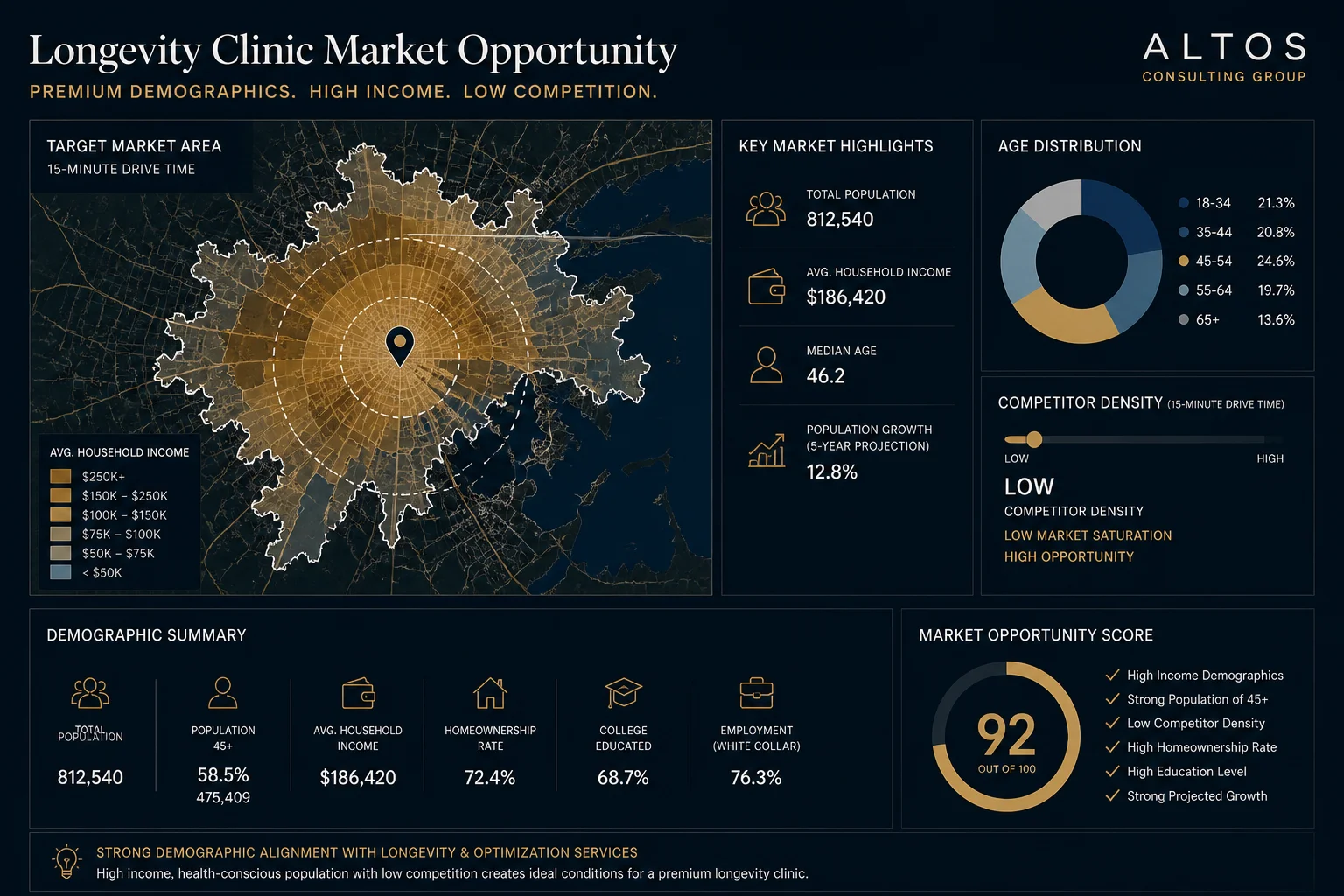
Consider the competitive landscape today: the regenerative health space is occupied largely by independent operators, many of whom opened without a structured business framework, without a coherent service model, and without the operational systems required to deliver a consistent patient experience. The category is growing — but it is not yet professionally consolidated. That is what creates the opportunity.
The $63 billion 2026 market projection and the 31 percent CAGR tell you that demand is expanding at a rate that current supply cannot match. The global wellness economy reached $6.8 trillion in 2024 and is forecast to approach $10 trillion by 2029. Within that, the longevity medicine segment — the specific space Regenerative Health Clinics occupy — is experiencing the fastest growth. Demand for in-person wellness services has increased year over year across every market McKinsey surveyed in 2025.
The entrepreneurs who open well-positioned, professionally operated Regenerative Health Clinics in the next 12 to 24 months are not fighting for market share in a crowded category. They are establishing the standard of care in a category that does not yet have one in most U.S. markets.
If you are in the process of evaluating this opportunity, the next step is understanding what it actually takes to get from concept to open doors. ACG's complete launch guide — How to Open a Regenerative Health Clinic in 2026 — walks through the full process: entity structure, regulatory navigation, staffing, vendor categories, and the operational sequencing that determines whether a clinic opens strong or spends its first year recovering from avoidable mistakes. https://altosconsultinggroup.com/new-clinic-launch
What This Business Model Is Not: Setting Realistic Expectations
Intellectual honesty requires addressing the other side of this analysis. The Regenerative Health Clinic model is not passive income. It is not a franchise you can open and hand to a manager on day one. And it is not recession-proof in the absolute sense — no business is.
What it is: a business with structural demand inelasticity, a financial model built around recurring revenue, a patient demographic with above-average spending durability, and a macro tailwind that is not a trend but a demographic inevitability. Seventy-three million Baby Boomers are aging into the core longevity medicine patient demographic. They are not going to stop. Gen X is behind them, followed by health-conscious Millennials who began investing in preventive health in their 30s.
The operators who succeed in this space share a set of characteristics: they approach clinic ownership with operator discipline, not healthcare romanticism. They build systems before they need them. They choose their market, their service model, and their team with deliberate intent. And they get the launch right — because in a cash-pay business, your first 90 days of operations set the patient experience standard you will spend years either reinforcing or repairing.
Altos Consulting Group exists to help entrepreneurs and investors get those decisions right. If you are at the stage of evaluating whether this model fits your goals, capital position, and market, schedule a consultation with ACG's team. The conversation is structured, confidential, and built around your specific situation — not a one-size pitch. https://altosconsultinggroup.com/survey
Frequently Asked Questions
Is a Regenerative Health Clinic a good business in a recession?
Based on historical data and 2026 consumer sentiment, health and wellness spending has demonstrated consistent resilience across economic downturns. During both the 2008 recession and the 2020 COVID contraction, wellness spending grew while other categories contracted. Regenerative Health Clinics benefit from cash-pay economics, membership recurring revenue, and a high-income patient demographic with documented health spending inelasticity.
Do I need a medical background to own a Regenerative Health Clinic?
No. Non-physician ownership of cash-pay health clinics is legal in many U.S. states under medical director oversight models or collaborative practice agreement structures. The specific structure available to you depends on your state's medical practice act. ACG works with entrepreneurs from a wide range of professional backgrounds — not exclusively healthcare professionals.
How does the cash-pay model protect a clinic during economic downturns?
Traditional healthcare businesses depend on insurance reimbursement, which is subject to payer policy changes, reimbursement rate shifts, and prior authorization delays. Cash-pay clinics collect revenue directly from patients, eliminating these dependencies. The membership model layer adds a recurring revenue floor that is not subject to the volume fluctuations that affect transactional businesses.
What markets are still underserved by Regenerative Health Clinics?
The majority of current Regenerative Health Clinic concentration is in major metropolitan markets. Mid-size cities, affluent suburban corridors, and secondary markets with strong professional demographics represent the highest-opportunity entry points in 2026. ACG's market evaluation process assesses demographic fit, competitive density, and real estate availability as part of the pre-launch analysis for every client.
