
Is Compounded Semaglutide Still Legal in 2026? What Clinic Owners Need to Know
A Regulatory Reality Check for Weight Loss Clinics Built on Compounded GLP-1s
The Short Answer Most Clinics Do Not Want to Hear
Compounded semaglutide has not been banned. But the pathway that made it broadly available to weight loss clinics between 2022 and 2025 is closed, and what remains is narrow enough that it cannot support a clinic's primary business model.
If your clinic is still sourcing compounded semaglutide the way it did in 2024, the legal basis for that arrangement no longer exists. This is not a prediction about future enforcement. It is a description of the current regulatory position, published by the FDA and updated as recently as April 2026.
For the full metabolic clinic business model and where GLP-1s fit within it, see The Metabolic Weight Loss Clinic Business Opportunity.
What Actually Changed, and When
The compounding boom depended entirely on shortage status. Under federal law, compounders may produce copies of a commercially available drug when that drug appears on the FDA's shortage list. Both GLP-1s were on it for years, and the compounding market grew to fill genuine unmet demand.
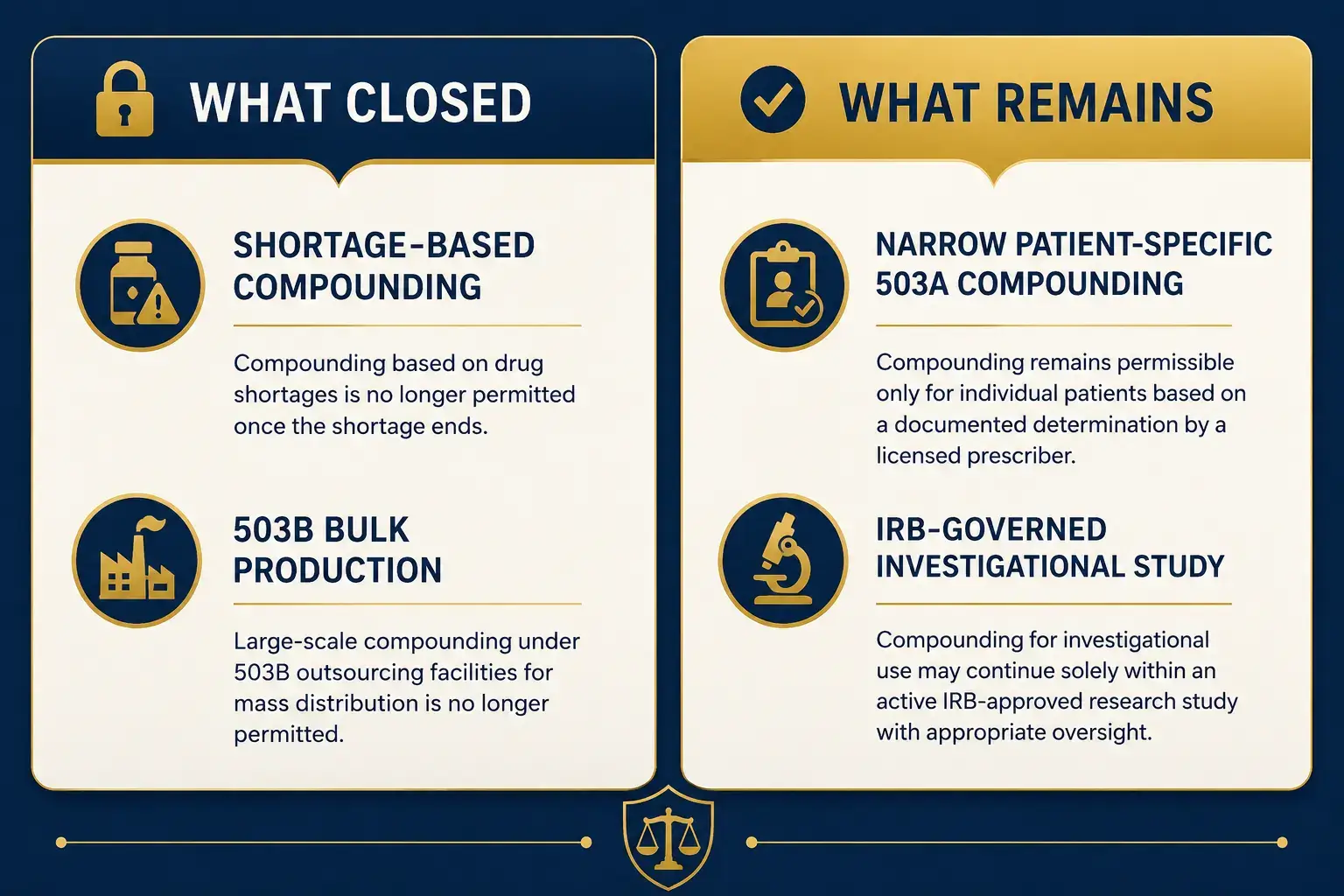
The FDA declared the tirzepatide shortage resolved in December 2024 and the semaglutide shortage resolved on February 21, 2025. That removed the legal basis. The agency then set wind-down deadlines: enforcement discretion for state-licensed 503A pharmacies ended April 22, 2025, and for 503B outsourcing facilities on May 22, 2025.
The FDA's compounding page, current as of April 2026, states the position plainly: tirzepatide and semaglutide do not currently appear on the 503B bulks list or on FDA's drug shortage list. Both doors — shortage status and bulks list inclusion — are shut at the same time.
On April 30, 2026, the agency proposed permanently excluding semaglutide, tirzepatide, and liraglutide from the 503B bulks list. If finalized, that would foreclose bulk compounding of these substances even if a future shortage were declared.
The Combination Workaround — What the FDA Actually Said
When shortage status ended, much of the industry pivoted to combination formulations. Semaglutide plus vitamin B12. Semaglutide plus glycine. Semaglutide plus L-carnitine. The argument was that adding a second active ingredient creates a different product that is no longer essentially a copy of Ozempic or Wegovy.
The FDA addressed this directly and rejected the premise. Its guidance gives semaglutide combined with vitamin B12 as its own worked example, and concludes that such a product is still considered essentially a copy when it is given by the same route of administration and the ingredient amounts fall within 10 percent of the commercially available products' strengths.
What actually creates the exception is not the added ingredient. It is a prescriber's determination, documented on the prescription itself, that the change produces a significant difference for an identified individual patient.
As Foley & Lardner's analysis of the guidance notes, the FDA has not defined what type or amount of documentation satisfies that determination — which means the burden falls on the prescribing provider, and the standard against which it will be judged is unsettled.
There is also a volume ceiling that matters commercially. The FDA has stated it does not currently intend to act against a 503A compounder that fills four or fewer prescriptions of an essentially-a-copy product in a calendar month. Four. That number is not a foundation for a weight loss clinic's patient panel.
The Pathway Most Clinics Have Not Considered: An IRB-Governed Study
There is a structurally different route that does not depend on the essentially-a-copy analysis at all — offering compounded semaglutide within a formal investigational study governed by an Institutional Review Board.
Under this structure, the clinic operates as a research site under an approved protocol rather than as a retail dispenser. An IRB such as WCG — one of the largest independent review boards in North America — reviews and approves the protocol, and the study operates under its ongoing oversight.
Altos Consulting Group helps clinic clients navigate this filing. It is worth being direct about what it involves, because it is not a shortcut and should not be sold as one.
•IRB fees typically run $5,000 to $8,000 depending on the state and the number of clinic locations included
•ACG's filing fee for preparing and submitting the application is $10,000
•Approval is not guaranteed. ACG has not had an application denied to date, but no consulting firm can promise an IRB outcome, and applicants should plan for the possibility of a rejection or a request for substantial protocol revision
•Approval creates ongoing obligations — protocol adherence, documentation, adverse event reporting, and continuing review — that are real research duties, not paperwork formalities
The clinics best suited to this pathway are those genuinely prepared to operate as a research site. A clinic looking for a label to put on business as usual is not a good candidate, and the obligations that follow approval will make that obvious quickly.
What This Means for Your Clinic's Model
The strategic read is straightforward. A weight loss clinic whose margin depends on cheap compounded semaglutide is exposed, and the exposure is increasing rather than stabilizing. Clinics have three realistic responses: source FDA-approved branded product and compete on clinical depth rather than price, pursue the IRB pathway if genuinely prepared for research obligations, or build a metabolic health model where GLP-1s are one component rather than the entire business.
Most durable clinics are doing some combination of the first and third. To discuss which structure fits your clinic, visit altosconsultinggroup.com/survey.
Frequently Asked Questions
Is compounded semaglutide illegal now?
Not categorically. It remains legal in narrow, patient-specific circumstances under 503A when a prescriber documents on the prescription that a change produces a significant difference for that individual patient, and within a volume the FDA has indicated it does not currently intend to pursue — four or fewer prescriptions of an essentially-a-copy product per calendar month. What ended was the broad, shortage-based access that supported high-volume clinic programs.
Does adding B12 or another ingredient make compounded semaglutide legal?
Not on its own. The FDA gave semaglutide plus B12 as its explicit example of a combination it still considers essentially a copy when the route of administration matches and strengths are within 10 percent of the approved products. The exception depends on a documented prescriber determination of significant difference for an individual patient — not on the presence of an additional ingredient.
How does the IRB study pathway differ from ordinary compounding?
It changes the legal frame entirely. Rather than dispensing a compounded copy of a commercially available drug, the clinic operates as a site in an approved investigational study under IRB oversight. That brings genuine research obligations — protocol adherence, documentation standards, adverse event reporting, and continuing review — and it requires both IRB fees and a filing process with no guaranteed approval.
What happens if the FDA finalizes the 503B bulks list exclusion?
It would remove the last pathway for outsourcing facilities to bulk-compound these substances, and would do so permanently — meaning a future shortage designation would not reopen it. Clinics relying on 503B-sourced GLP-1s should assume that supply line is ending and plan sourcing accordingly rather than waiting for a final rule.