
The Metabolic Weight Loss Clinic Business Opportunity: How GLP-1 Is Reshaping the Highest-Search-Volume Category in Cash-Pay Health
The Largest Consumer Health Search Category in the United States
Medical weight loss is the highest consumer search volume category in cash-pay health. The GLP-1 market alone — semaglutide, tirzepatide, and their compounded equivalents — hit $58 billion in 2026 and is tracking toward $201 billion by 2033. Thirty million Americans are currently on GLP-1 medications. That number was four million in 2020.
The commercial opportunity in this moment is not the GLP-1 medication itself — it is the clinical infrastructure around it. GLP-1 patients need monitoring. They need nutritional guidance and body composition management. They need support for the muscle loss that frequently accompanies rapid weight loss. They need integration with the broader metabolic protocol work — hormone optimization, peptide support, biomarker monitoring — that a well-structured metabolic health clinic is positioned to provide.
The clinic that positions around metabolic health optimization — not just weight loss — captures this patient with a clinical framework that produces better outcomes, stronger retention, and significantly higher average revenue per patient than a transactional weight loss program alone.
Altos Consulting Group has helped launch metabolic and weight loss clinics across the United States. To see the clinics ACG has supported in this category, visit altosconsultinggroup.com/clinics-supported/metabolic-weight-loss.
Why This Is Not the Same as a Traditional Weight Loss Clinic
The traditional weight loss clinic — selling caloric restriction programs, meal replacement products, and phentermine prescriptions — operates in a commoditized, highly price-sensitive market that competes with consumer apps, gym memberships, and direct-to-consumer supplement programs. Margins are thin. Patient retention is weak. Competition is intense.
The metabolic health clinic operates in a different market with a different patient. The metabolic health patient is not primarily motivated by aesthetics or a number on a scale. They are motivated by function — energy levels, insulin sensitivity, inflammatory load, cardiovascular risk markers, hormonal balance, and the measurable improvement of the underlying biological systems that govern their health outcomes. This patient is less price-sensitive, more outcome-oriented, more likely to enroll in ongoing monitoring programs, and significantly more likely to refer peers who share their orientation toward data-driven health optimization.
This patient profile is commercially valuable not just because of willingness to pay — but because of long-term retention. A metabolic health patient enrolled in a GLP-1 program with quarterly biomarker monitoring, hormone optimization support, and body composition tracking generates recurring revenue for as long as they are engaged in the program — which is often measured in years, not months.
The Service Stack: What a Metabolic Health Clinic Offers
GLP-1 Metabolic Programs
Semaglutide and tirzepatide — prescribed under medical director oversight and sourced through a defensible pathway, which since 2025 means FDA-approved branded product, narrow patient-specific compounding with documented clinical justification, or an IRB-governed study — monitored through regular clinical check-ins, dose adjustments, and quarterly lab panels.The GLP-1 program is the entry point for most metabolic health clinic patients and the anchor service that generates the consistent prescription management revenue that sustains the business through the ramp period.
Body Composition Tracking
GLP-1 programs reduce total body weight — but they also reduce lean muscle mass at rates that can exceed 25 to 40 percent of total weight lost in patients not actively managing the muscle preservation component. A metabolic health clinic that includes body composition tracking — DEXA scan access, InBody bioelectrical impedance assessments, or equivalent — and addresses muscle preservation as an explicit clinical priority delivers meaningfully better patient outcomes than one that only tracks scale weight.
Hormone Optimization Integration
Metabolic dysfunction and hormonal imbalance are deeply interconnected. Low testosterone in men and estrogen dysregulation in women both contribute to insulin resistance, reduced metabolic rate, and impaired body composition management. A metabolic health clinic that pairs GLP-1 programs with hormone optimization panels — identifying and addressing the hormonal factors that affect metabolic function — delivers meaningfully better clinical outcomes and creates a natural pathway to hormone optimization enrollment from the GLP-1 patient base.
Peptide Protocol Support
The GLP-1 patient experiencing muscle loss during a weight loss program is a natural candidate for peptide protocols supporting muscle preservation and tissue repair — growth hormone secretagogues like Sermorelin and Ipamorelin, and tissue repair peptides like BPC-157. These add-ons create additional clinical value, increase monthly revenue per patient, and address a documented limitation of GLP-1 programs that most metabolic health clinics do not systematically address.
Metabolic Biomarker Panels
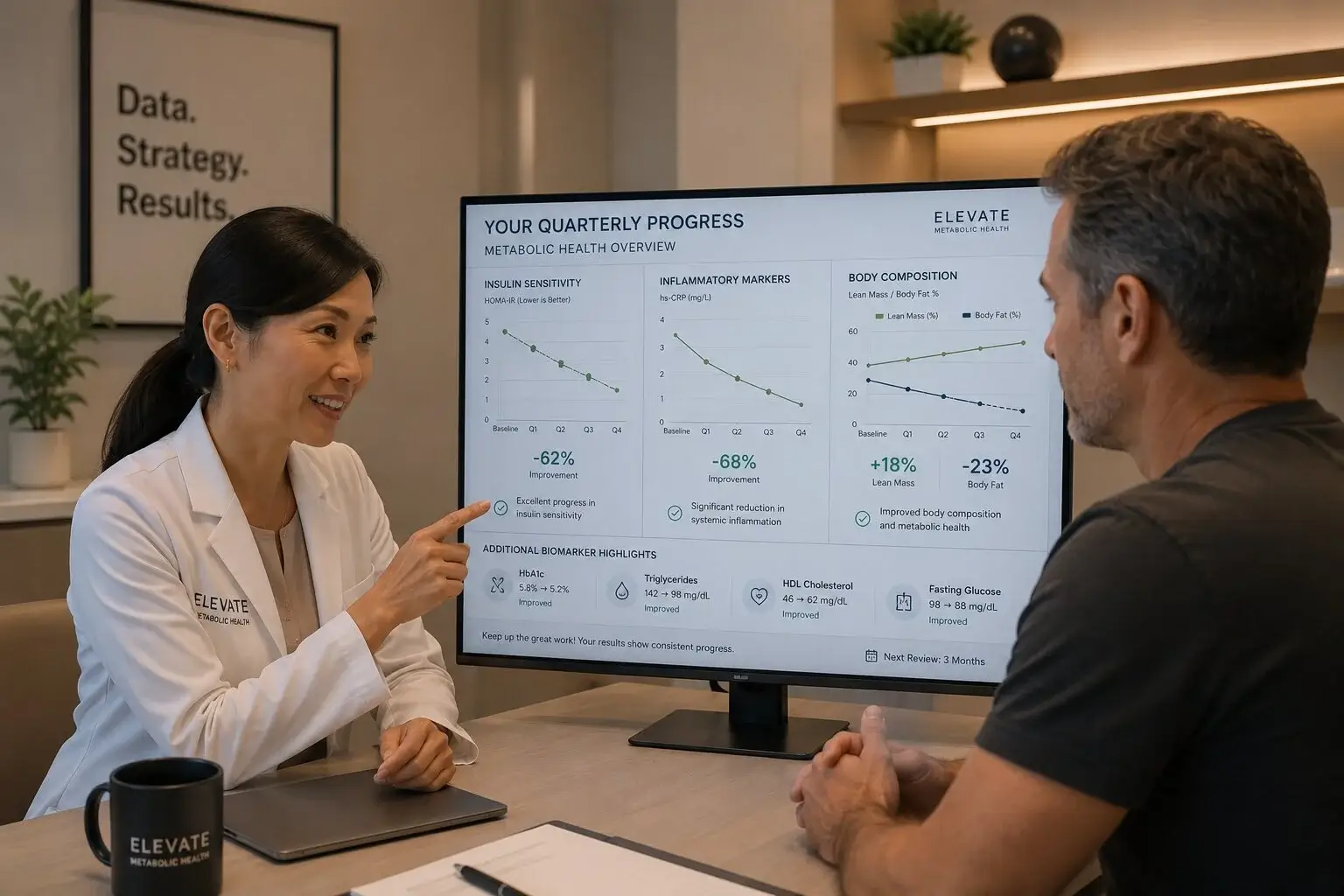
Comprehensive metabolic panel, insulin sensitivity markers, inflammatory biomarkers (hs-CRP, homocysteine), lipid panel, and hormonal assessment — quarterly panels that give the patient a data-driven picture of their metabolic progress beyond weight loss. Patients who see objective improvement in their insulin sensitivity, inflammatory markers, and hormonal status across quarterly monitoring events do not discontinue their programs. They renew them.
The Business Model: Why Metabolic Health Generates Durable Recurring Revenue
A metabolic health clinic patient enrolled in a GLP-1 program with monthly protocol management, quarterly biomarker monitoring, and body composition tracking generates between $300 and $700 per month in recurring revenue depending on the depth of the protocol and the specific pricing structure. A clinic with 50 enrolled metabolic patients at the midpoint of this range generates approximately $25,000 per month in recurring revenue before additional service revenue.
The revenue compounds as the patient relationship deepens. A GLP-1 patient who adds hormone optimization generates an additional $200 to $400 per month. One who adds peptide protocol support generates another $300 to $600 per month. The metabolic health patient who enrolls in a comprehensive program — GLP-1 management, hormone optimization, peptide support, and quarterly monitoring — generates between $800 and $1,400 per month in total recurring revenue from a single patient relationship.
These figures are illustrative planning benchmarks — actual results depend on market conditions, patient volume, pricing structure, and operational execution.
Compliance: What GLP-1 Clinic Operators Must Get Right
GLP-1 medications are prescription drugs requiring a valid prescription from a licensed medical professional. What has changed materially since 2024 is the legal basis for compounding them.
Compounded semaglutide and tirzepatide were widely available during the shortage years because federal law permits compounders to produce copies of a commercially available drug while that drug appears on the FDA's shortage list. Both drugs have since come off it — tirzepatide in December 2024, semaglutide on February 21, 2025. Enforcement discretion for state-licensed 503A pharmacies ended April 22, 2025, and for 503B outsourcing facilities on May 22, 2025.
The FDA's compounding page, current as of April 2026, states the position directly: tirzepatide and semaglutide do not appear on the 503B bulks list or on the drug shortage list. On April 30, 2026, the agency proposed permanently excluding semaglutide, tirzepatide, and liraglutide from the 503B bulks list, which would foreclose bulk compounding even if a future shortage were declared.
Combination formulations do not resolve this. The FDA's guidance uses semaglutide combined with vitamin B12 as its own worked example and concludes that such a product is still essentially a copy when the route of administration matches and ingredient amounts fall within 10 percent of the approved products' strengths. The narrow exception depends on a prescriber's determination — documented on the prescription itself — that a change produces a significant difference for an identified individual patient. The FDA has also indicated it does not currently intend to act against a 503A compounder filling four or fewer prescriptions of an essentially-a-copy product per calendar month, a ceiling that cannot support a clinic's patient panel.
Clinics have three defensible sourcing paths: FDA-approved branded product through an authorized distributor, genuinely patient-specific 503A compounding with documented clinical justification, or an IRB-governed investigational study. ACG helps clinic clients navigate the IRB filing where that structure fits.
What ACG Provides
ACG's launch engagement for a metabolic weight loss clinic covers market validation, entity structure, medical director introduction with GLP-1 and metabolic health experience, compounding pharmacy supplier access for semaglutide and related compounds, body composition monitoring equipment access, clinical protocol setup, brand and website development, compliance-structured marketing campaigns, and 60 days of post-launch advisory support.
To start the conversation about the metabolic weight loss clinic opportunity in your specific market, visit altosconsultinggroup.com/survey.
The GLP-1 Patient Is Not the Weight Loss Patient — and the Distinction Determines Everything
The single most important positioning insight for a metabolic health clinic in 2026 is this: the patient seeking a GLP-1 program is not the same patient who walked into a traditional weight loss clinic in 2018. The traditional weight loss patient was primarily motivated by appearance and a number on the scale. They were price-sensitive, prone to churn when results slowed, and willing to cycle through programs repeatedly without sustained commitment to any single clinical relationship. The GLP-1 metabolic patient is motivated by something more durable — the documented biological risks of metabolic dysfunction, the specific functional limitations they are experiencing, and in many cases a physician conversation that has made the urgency of intervention concrete rather than aesthetic.
This distinction matters commercially because the GLP-1 metabolic patient makes different decisions than the traditional weight loss patient. They are less likely to shop on price because they have already framed their decision as a health investment rather than a cosmetic one. They are more likely to engage with monitoring because they understand their metabolic markers — HbA1c, fasting insulin, inflammatory markers, body composition ratios — as clinically meaningful data rather than abstract numbers. And they are significantly more likely to stay enrolled through the inevitable plateaus and dose adjustments that characterize a well-managed GLP-1 program, because they are measuring success against biological outcomes that do not plateau the way scale weight does.
The clinic that positions around this patient — explicitly, in its messaging, its consultation framework, and its clinical program design — attracts a fundamentally different and more commercially durable patient than the one marketing a weight loss program to anyone who wants to lose weight. The language that attracts the GLP-1 metabolic patient is not weight loss language. It is metabolic health language. Not "lose 30 pounds in 12 weeks" — which is both legally problematic and strategically wrong for the patient you want. But rather "optimize your metabolic function, reduce your inflammatory burden, and build the biological foundation for sustained body composition management." This language repels the patient looking for a quick fix and attracts the patient who is ready for a clinical relationship.
Building the clinical program around this patient requires a service model that goes beyond GLP-1 prescription management. It requires a metabolic intake assessment that establishes the patient's specific biological baseline across the markers that the program will improve. It requires a monitoring cadence that tracks those markers quarterly and connects each monitoring event to a protocol review conversation. It requires a body composition tracking component that separates fat mass loss from lean mass preservation — because the patient who loses 40 pounds but loses 15 pounds of muscle alongside 25 pounds of fat has not had a successful metabolic outcome regardless of what the scale says. And it requires a clinical team that is trained to have these conversations in language that is accessible to a motivated health consumer without requiring a medical background to understand.
The metabolic health clinic that builds this program correctly is not competing with the telehealth GLP-1 prescription services on price or convenience. It is competing on clinical depth — and clinical depth is a competition that a well-structured in-person metabolic health clinic wins every time against a platform optimized for subscription volume rather than clinical outcomes.

Why Muscle Preservation Is the Clinical Differentiator No GLP-1 Competitor Is Talking About
The clinical reality of GLP-1 programs that the telehealth prescription platforms are not talking about — and that the in-person metabolic health clinic can own as a differentiating clinical position — is muscle loss. Multiple peer-reviewed studies published between 2022 and 2025 document that patients on semaglutide and tirzepatide lose between 25 and 40 percent of their total weight loss as lean muscle mass rather than fat when muscle preservation protocols are not actively implemented. At scale, this means a patient who loses 50 pounds on a GLP-1 program may be losing 15 to 20 pounds of muscle alongside 30 to 35 pounds of fat — a body composition outcome that increases metabolic fragility, reduces resting metabolic rate, accelerates the conditions that lead to weight regain after discontinuation, and produces physical performance limitations the patient did not anticipate.
The metabolic health clinic that addresses muscle preservation explicitly — as a core component of the GLP-1 clinical program, not an optional add-on — is offering something that none of the telehealth GLP-1 platforms are structured to deliver at scale. The muscle preservation protocol includes resistance training guidance integrated into the clinical program, protein intake targets calibrated to lean mass preservation goals, growth hormone secretagogue peptide protocols for patients experiencing significant lean mass loss, and body composition monitoring that tracks the muscle-to-fat ratio of weight loss rather than only total weight. Each of these components has a clinical rationale and a commercial implication: the patient who understands that their GLP-1 program includes active muscle preservation management is getting a meaningfully superior clinical service, and they know it.
This clinical differentiator is also a marketing differentiator — one that is compliant, specific, and impossible for telehealth platforms to credibly claim. A piece of content titled "Why Most GLP-1 Programs Are Making You Weaker — and What a Metabolic Health Clinic Does Differently" targets the exact search behavior of the informed GLP-1 patient who has read about muscle loss and is evaluating whether to find a more clinically serious provider. That patient is looking for exactly what a well-structured metabolic health clinic offers. The content that educates them about the problem and positions the clinic as the solution is both genuinely useful to the patient and commercially effective for the clinic — the combination that produces the highest-quality inbound patient leads available in the metabolic health category.
The metabolic health clinic that owns this clinical position in its local market — the provider that takes GLP-1 programs seriously enough to address their documented limitations proactively — is not competing in the weight loss market. It is defining the metabolic health optimization market in its geography, on terms that no telehealth competitor and no traditional weight loss clinic can meet.
Frequently Asked Questions
Is the GLP-1 clinic market too crowded in 2026?
The market for compounded GLP-1 programs specifically has become more competitive than it was in 2023 and 2024 as the telehealth market grew rapidly. The market for comprehensive metabolic health clinics — offering GLP-1 management integrated with hormone optimization, biomarker monitoring, and peptide protocol support — remains significantly underserved in most in-person markets. The differentiation is positioning: a metabolic health clinic is not a GLP-1 prescription service. It is a comprehensive metabolic optimization practice.
What sourcing options exist for GLP-1s now that the shortages have ended?
Three. FDA-approved branded product purchased through an authorized distributor carries no regulatory ambiguity but higher per-unit cost. Patient-specific 503A compounding remains legal in narrow circumstances requiring a documented prescriber determination of significant difference for an individual patient, within a volume threshold the FDA has indicated at four or fewer prescriptions per month. An IRB-governed investigational study changes the legal frame entirely, operating the clinic as a research site under an approved protocol — a path ACG helps clients file, though approval is not guaranteed and the structure carries genuine research obligations. Gray-market product labeled for research use is not a sourcing option and is an active enforcement target.
Do I need a medical background to open a metabolic health clinic?
No. Non-physician ownership is structured through the MSO model. The medical director provides all prescribing authority and clinical oversight. ACG facilitates medical director introductions with GLP-1 and metabolic health experience across 46 states.
Written by Nova, Senior Content Strategist at Altos Consulting Group.