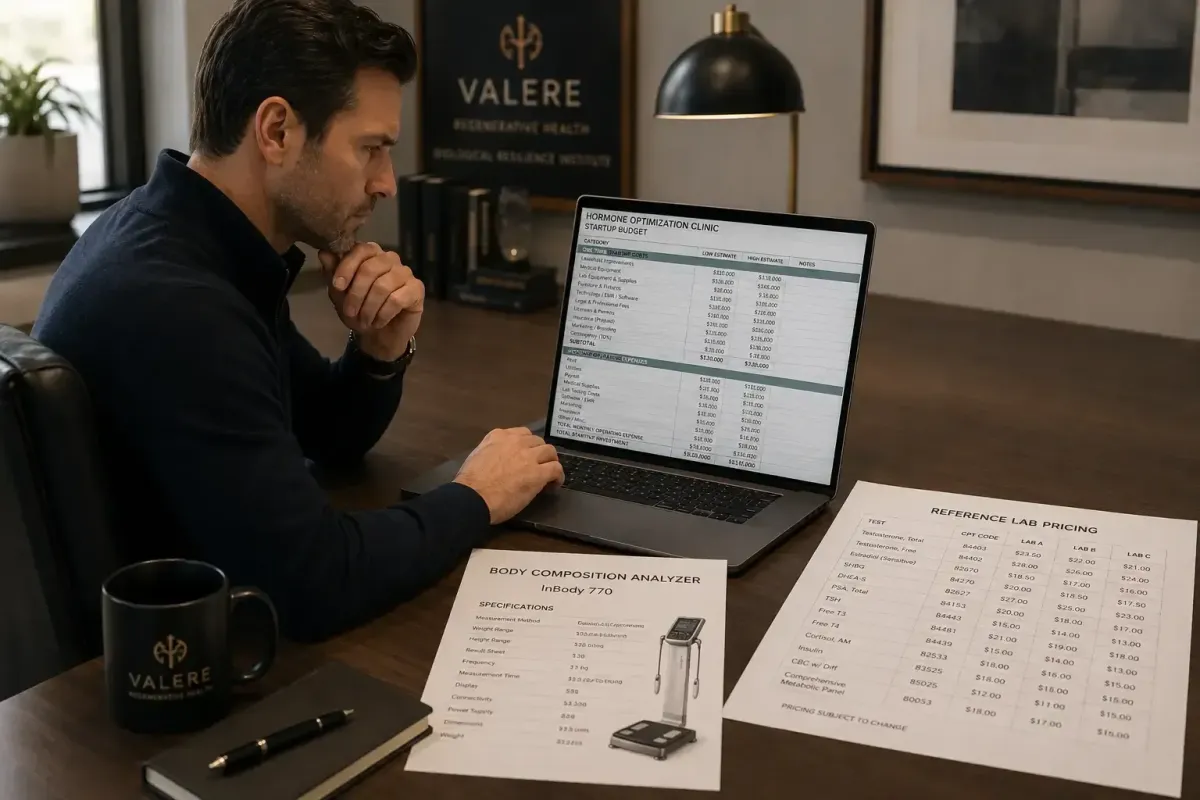
How Much Does It Cost to Open a Medical Weight Loss Clinic in 2026?
A Startup Investment Breakdown Built on Current Sourcing Economics, Not 2024 Assumptions
Why Most Budgets for This Clinic Type Are Now Wrong
Startup budgets circulating for medical weight loss clinics were largely built during the compounding era, when product cost sat at $150 to $300 per patient per month and margins on a GLP-1 program were extraordinary. Those numbers no longer describe the business.
A budget built on compounded sourcing economics will misstate both the working capital requirement and the breakeven patient count. The categories below reflect current conditions.
For the full business model context, see The Metabolic Weight Loss Clinic Business Opportunity.
Legal Structure and Entity Formation
The MSO structure enabling non-physician ownership must be drafted by healthcare counsel in the clinic's state. For a weight loss clinic, the Management Services Agreement should account for prescribing arrangements and, if the clinic intends to pursue an investigational study pathway, the research site structure that sits alongside it.
Budget $5,000 to $12,000 depending on state complexity. Clinics planning the IRB route should budget legal review of the research arrangement separately.
Medical Director and Prescribing Infrastructure
Medical director compensation for a weight loss clinic typically runs $1,500 to $3,000 per month. The scope matters more here than in some clinic types, because GLP-1 prescribing under current rules places documentation burden squarely on the prescribing provider — a medical director who treats the role as a signature is a genuine liability in this category.
Budget the first two to three months of compensation as startup capital, since it accrues before meaningful patient revenue.
The IRB Pathway, If You Are Pursuing It
Clinics planning to offer compounded semaglutide through an investigational study should budget this as a discrete startup category. The pathway exists because the ordinary compounding route narrowed sharply once the FDA determined the shortages resolved and removed the legal basis for producing copies of commercially available GLP-1s.
•IRB fees of roughly $5,000 to $8,000, depending on state and number of locations
•ACG filing fee of $10,000 to prepare and submit the application
•Contingency for the possibility of denial or substantial protocol revision — ACG has not had an application denied to date, but this is not a guaranteed outcome and the budget should not assume it is
Clinics should also account for the ongoing operational cost of research conduct after approval, including documentation time and continuing review obligations.
Body Composition and Clinical Equipment
This is the equipment category that separates a metabolic health clinic from a prescription mill, and it is frequently underbudgeted.
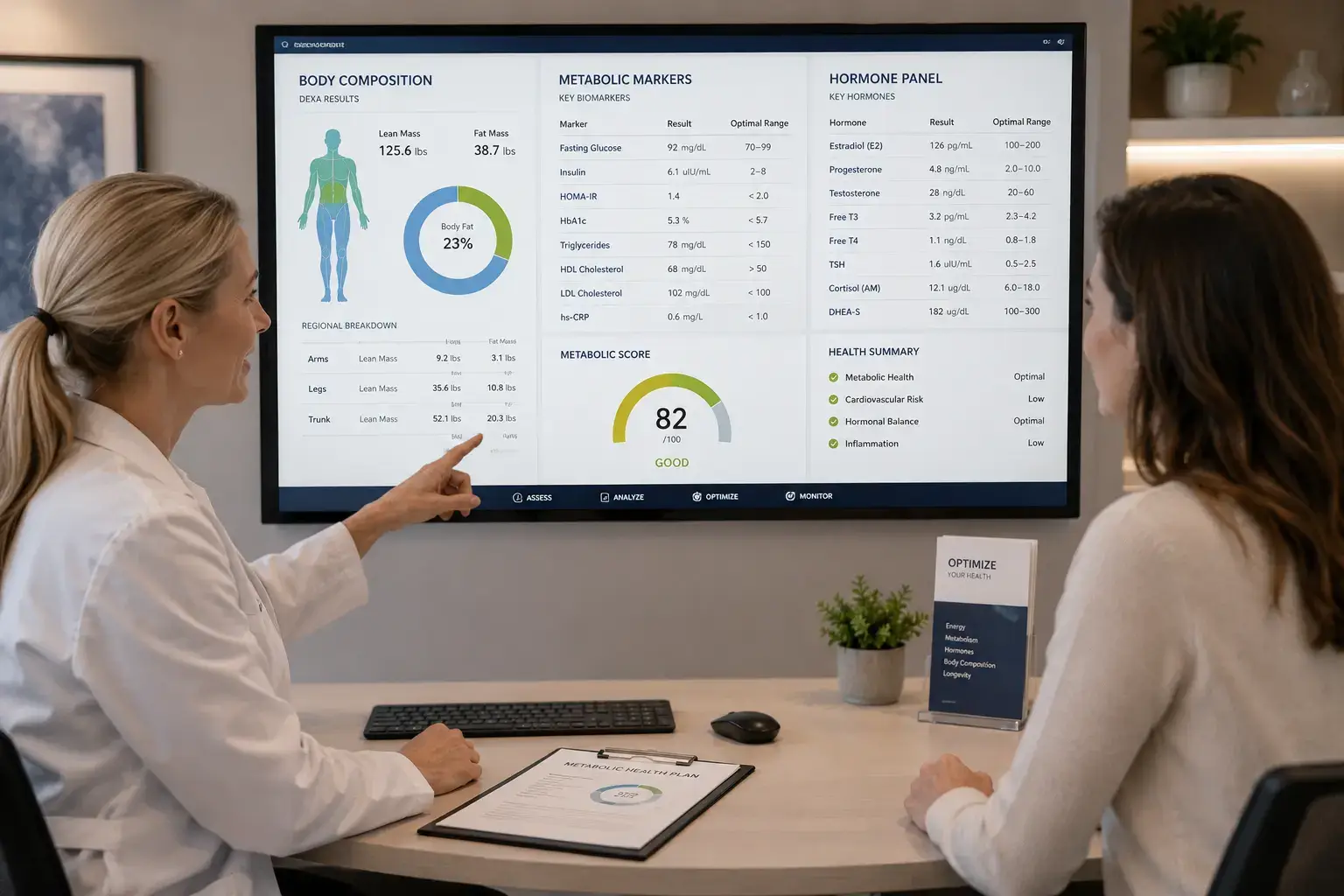
A clinical-grade body composition analyzer — bioelectrical impedance systems suitable for clinical use — typically runs $8,000 to $20,000 depending on capability. Some clinics instead partner for DEXA access, which shifts the cost to a per-scan basis. Either approach provides what scale weight cannot: the fat mass versus lean mass distinction that determines whether a patient's weight loss is actually a good clinical outcome.
In-office phlebotomy capability — draw chair, centrifuge, refrigeration, supply inventory — runs $3,000 to $7,000 and pays for itself through monitoring compliance and specimen control.
Initial Product Inventory
This line varies more than any other depending on sourcing path. Clinics purchasing FDA-approved branded product through authorized distributors face materially higher per-unit cost than clinics operating under an approved study protocol or filling narrow patient-specific compounded prescriptions.
Rather than a single figure, model this as a per-patient monthly cost against your specific sourcing arrangement, then multiply by the patient volume you expect in months one through three. A clinic that budgets inventory as a fixed startup number and then discovers its actual sourcing cost is triple the assumption has a working capital problem, not an inventory problem.
Technology, Space, and Launch Marketing
A HIPAA-compliant EMR configured for longitudinal metabolic tracking and prescription documentation runs $1,500 to $3,000 for first-year setup. A weight loss clinic operates efficiently in 900 to 1,400 square feet, putting first and last month plus deposit at $7,000 to $11,000 in most mid-size markets. Pre-launch marketing to populate the opening consultation schedule runs $3,000 to $6,000.
The Total Investment Picture
A medical weight loss clinic built with correct legal structure, engaged medical director, body composition and lab capability, technology, space, and pre-launch marketing requires a total startup investment in the range of $110,000 to $150,000, excluding the IRB pathway. Entrepreneurs organizing this across one-time versus recurring categories may find the SBA's startup cost planning framework useful as a structure, though the healthcare-specific compliance items above will not appear in any general small business template.
Clinics pursuing the IRB route should add $15,000 to $18,000 for IRB and filing fees combined.
Working capital sits above that figure and should cover three to five months of fixed operating costs.
Staffing the Clinic
A medical weight loss clinic needs, at minimum, a prescribing clinician, a clinical staff member capable of running body composition assessments and lab draws, and a patient coordinator managing intake and the consultation-to-enrollment conversation.
The role most often underestimated is the coordinator. GLP-1 patients arrive with more prior research and more price sensitivity than most cash-pay health patients, and the consultation frequently involves explaining why the clinic's sourcing and monitoring approach differs from a telehealth alternative they have already priced. A coordinator who can hold that conversation credibly converts materially better than one reading from a script.
Budget the first two to three months of staffing as startup capital alongside medical director compensation, since payroll begins before the patient panel is built.
What the Breakeven Math Actually Looks Like
Fixed monthly operating costs for a clinic of this type typically run $11,000 to $16,000 — rent, medical director, clinical and administrative staffing, technology, and baseline marketing.
Revenue per patient depends heavily on program structure. A prescription-only program generates the medication margin plus a modest management fee. A comprehensive metabolic program with quarterly biomarker panels, body composition tracking, and hormone assessment where indicated generates meaningfully more per patient per month and retains longer.
The practical consequence is that breakeven patient count varies widely by model. A clinic running a thin prescription program against branded product pricing needs substantially more patients to cover the same fixed costs than a clinic running a comprehensive program. This is the clearest financial argument for the diversified service model, and it is why the sourcing decision and the service design decision cannot be made independently of each other.
These are illustrative planning benchmarks — actual results depend on market conditions, sourcing arrangement, pricing, retention, and execution.
To discuss the investment picture for your specific market and sourcing strategy, visit altosconsultinggroup.com/survey.
Frequently Asked Questions
How does sourcing choice affect the startup budget?
Substantially. Product cost per patient per month is the largest variable in the entire model, and it differs by a multiple across sourcing paths. Build the budget against a specific, confirmed sourcing arrangement rather than a category average, and confirm pricing in writing before finalizing working capital requirements.
Is a body composition analyzer necessary or optional?
Clinically it is close to necessary for a practice positioning itself as metabolic health rather than weight loss. GLP-1 therapy produces meaningful lean mass loss alongside fat loss in patients without an active preservation protocol, and a clinic that cannot measure the distinction cannot manage it. Commercially, it is also the clearest differentiator against telehealth prescription services.
Should a new clinic pursue the IRB pathway from the start?
Only if genuinely prepared to operate as a research site with the documentation and continuing review obligations that entails. It adds roughly $15,000 to $18,000 to startup cost and carries approval uncertainty. Many clinics launch on FDA-approved branded product and a broader metabolic service menu first, then evaluate the study pathway once operations are stable.
How does this compare to opening a hormone or longevity clinic?
Startup investment is broadly comparable to a hormone optimization clinic and somewhat below a longevity clinic with IV infrastructure. The distinguishing cost drivers here are body composition equipment and the product inventory line, which is more variable in this category than in any other clinic type ACG works with.