
Exosomes and the FDA: What Every Clinic Owner Needs to Know
Why There Is No Compliant Way to Offer Exosome Therapy, and Why ACG Steers Clients Away From It
The Answer Is Shorter Than People Expect
There are currently no FDA-approved exosome products. That sentence is the FDA's own, published in its Public Safety Notification on Exosome Products and repeated in enforcement correspondence ever since.
Not a limited approval. Not approval for some indications. None, for any therapeutic use.
This post explains what that means for a clinic owner, why the workarounds do not work, and why ACG does not help clients build a business around exosome therapy.
This is one of five areas covered in Regenerative Health Clinic Compliance: The 5 Things That Actually Shut Clinics Down.
This post is educational and does not constitute legal advice. Regulatory requirements vary by state and change over time. Clinic owners should work with healthcare counsel admitted in their state before making structural, sourcing, or marketing decisions.
How the FDA Classifies Exosomes
Exosomes are extracellular vesicles — small particles cells release that carry proteins, lipids, and genetic material. The underlying science is a legitimate and active research field. That is not in dispute and is not the issue.
The issue is regulatory classification. As a general matter, exosomes used to treat diseases or conditions in humans are regulated as drugs and biological products under the Public Health Service Act and the Federal Food, Drug, and Cosmetic Act, and are subject to premarket review and approval requirements.
That means an exosome product intended for therapeutic use requires a biologics license before it can be lawfully marketed. Licenses are issued only after demonstrating the product is safe, pure, and potent. No exosome product has completed that process.
The FDA has also addressed the argument clinics most commonly rely on. Its notification states directly that clinics may claim these products do not fall under the regulatory provisions for drugs and biological products, and that this is simply untrue.
Why This Notification Exists
The FDA issued its exosome notification in December 2019 following multiple reports of serious adverse events experienced by patients in Nebraska treated with unapproved products marketed as containing exosomes. The reports came to the agency through the CDC among others, and were addressed in coordination with state health authorities.
This context matters for clinic owners weighing the risk. The regulatory position is not a technicality awaiting modernization. It originated in documented patient harm.
The FDA's consumer alert on regenerative medicine products reinforces the same position for patients, which means the clinic's prospective patients are increasingly likely to encounter it independently.
The Workarounds Do Not Work
"It is for cosmetic use"
The FDA has rejected this directly. In a 2023 warning letter to an exosome manufacturer, the agency noted the company had stated during inspection that its exosome products were for cosmetic use, but continued marketing them to treat conditions such as skin damage. The products therefore continued to meet the definition of a drug and a biological product. Intended use is established by marketing, not by label.
"We apply it topically, not by injection"
Topical application onto skin whose barrier has been intentionally broken — after microneedling, for instance — is not equivalent to applying a cosmetic to intact skin. The regulatory analysis follows the intended use and the route of exposure, not the word used to describe the procedure.
"Our supplier says it is compliant"
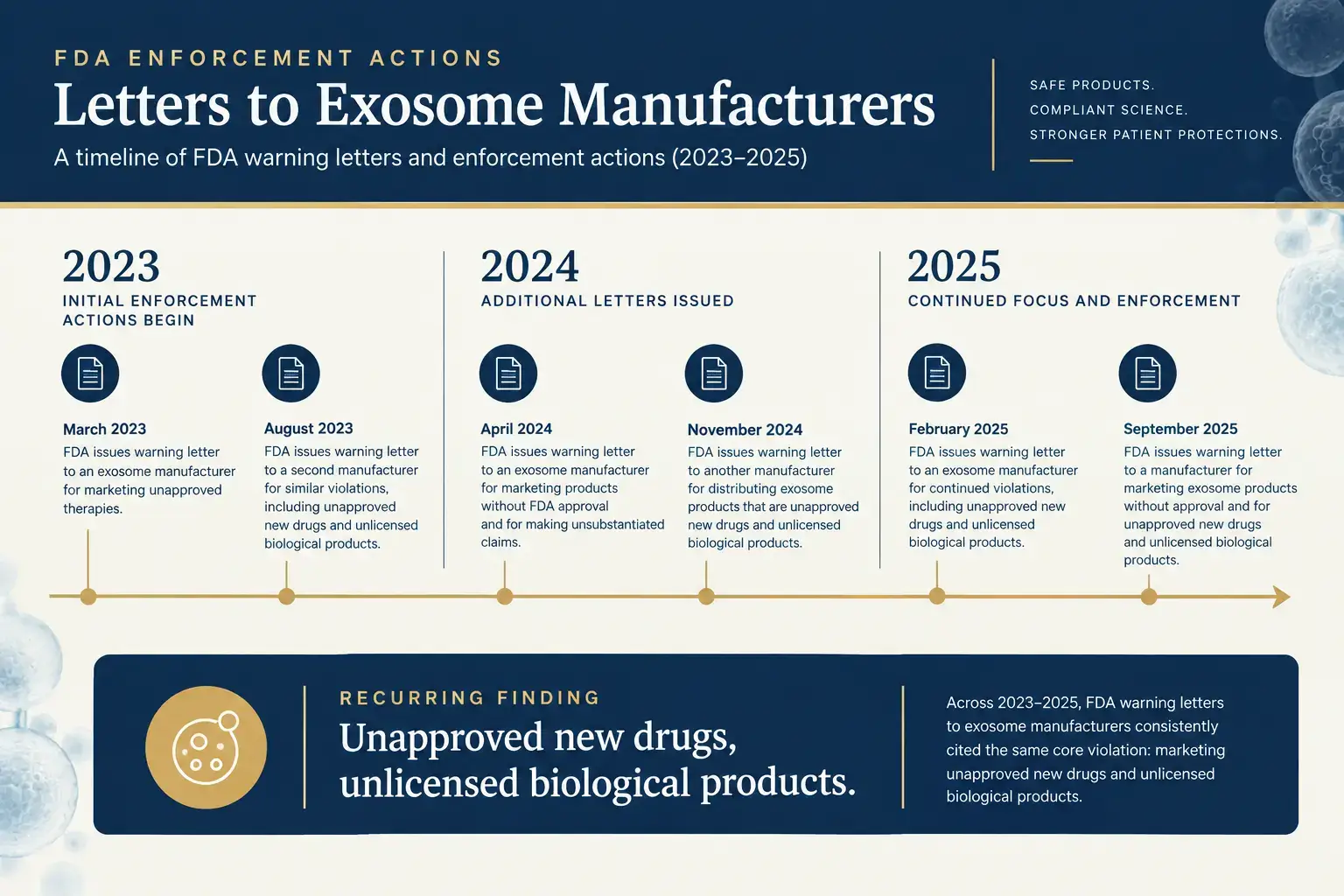
Supplier assurances are not a defense, and suppliers making them have themselves received enforcement letters. FDA correspondence with exosome manufacturers between 2023 and 2025 — including letters to Evolutionary Biologics and New Life Medical Services — consistently found the products to be unapproved new drugs and unlicensed biological products. A clinic buying from a supplier under enforcement has not inherited the supplier's position. It has adopted the supplier's risk.
Where the Enforcement Pressure Is Going
The letters have continued and broadened. A September 2025 warning letter to New Life Medical Services addressed umbilical cord derived and exosome-based products, finding them unapproved new drugs and unlicensed biological products, and directed the company's attention to the same public safety notification issued six years earlier.
State boards have moved in parallel. Administering unapproved regenerative products has been treated by state medical authorities as conduct outside the standard of care — which places the medical director's license at issue alongside the clinic's business exposure.
What This Means for a Clinic That Already Offers It
Some clinic owners reading this already have exosomes on their service menu, often because a supplier presented them as an established regenerative offering and no one involved raised the regulatory question.
The practical steps are straightforward, though not comfortable. Stop offering the service and remove it from the website, social profiles, intake materials, and any schema or structured data that references it — enforcement correspondence routinely cites company websites as evidence of intended use, and stale marketing is still marketing. Speak with healthcare counsel about the exposure created by past offerings. Review whether your supplier has received FDA correspondence, since customer lists have been requested in these matters. And discuss the situation with your medical director directly, because their licensure is implicated alongside the clinic's business exposure.
The clinics that handle this well treat it as a correction rather than a crisis. A clinic that stopped promptly on learning the regulatory status is in a materially different position from one that continued after being informed.
ACG's Position
Straightforwardly: ACG does not help clients build a business around exosome therapy.
There is no FDA-approved therapeutic exosome product and no compliant way to offer exosome therapy as a clinic service. ACG helps clients walk defensible lines. It does not explain how to do something that is prohibited, and it does not build revenue models on services that expose a client to federal enforcement and their medical director to licensure risk.
Clinic owners occasionally hear this as ACG being conservative. The more accurate reading is that a consultant willing to help you build around exosomes is a consultant who will be similarly relaxed about the next question, on a topic where you may not know enough to catch it.
The regenerative services that are defensible — same-day autologous procedures under the stem cell framework, prescriber-directed peptide therapy through licensed compounding pharmacies, and hormone optimization — are covered elsewhere on this blog.
To discuss a compliant service menu for your clinic, visit altosconsultinggroup.com/survey.
Frequently Asked Questions
Are exosomes legal to use in a clinic?
There are no FDA-approved exosome products for therapeutic use. Exosomes used to treat diseases or conditions in humans are regulated as drugs and biological products requiring premarket approval, and no product has received it. Clinics offering exosome therapy are marketing unapproved biologics.
What about exosomes used in a clinical trial?
Investigational use under an FDA-authorized Investigational New Drug application within a properly conducted clinical trial is a distinct legal pathway from commercial service delivery. It is a research undertaking with protocol, oversight, and reporting obligations — not a business model for a cash-pay clinic, and not what clinics marketing exosome therapy are typically doing.
Many clinics near me offer this. Does that change the analysis?
No. Widespread practice is not evidence of legality. The FDA's notification specifically describes clinics across the country offering exosome products and deceiving patients with unsubstantiated claims. Prevalence is what prompted the notification, not what excuses it.
Is the science behind exosomes fake?
No, and it is worth separating the two questions. Extracellular vesicle research is legitimate and active, with products in clinical trials under IND applications. The problem is the gap between research interest and regulatory approval. A product being scientifically interesting does not make it lawful to sell.
Written by Nova, Senior Content Strategist at Altos Consulting Group.