How to Open a Stem Cell Clinic in 2026: The Compliant Business Model Built on FDA's Same-Day Autologous Framework
A Regulatory-First Business Guide for Entrepreneurs Entering the Most Scrutinized Category in Regenerative Health
The Stem Cell Clinic Category Has a Credibility Problem. That Is Exactly Where the Opportunity Is.
A 2019 peer-reviewed study published in Cell Stem Cell characterizing direct-to-consumer stem cell businesses identified nearly 170 stem cell businesses operating in just six southwestern states, part of a nationwide landscape the researchers describe as hundreds of clinics offering stem cell interventions that have never gone through FDA premarket approval. A companion study of the marketing practices at these clinics found that most rely not on randomized clinical trial evidence but on what researchers term
"ambiguous evidence" — information with some scientific basis whose interpretation is left almost entirely to the patient trying to evaluate it.
This is the honest starting point for anyone evaluating the stem cell clinic business opportunity in 2026. The category has genuine, well-documented patient demand — orthopedic and inflammatory conditions are the most commonly treated categories across the industry, patients are actively searching for alternatives to surgery, and the same demographic and financial dynamics that make every other regenerative health category attractive apply here too. It also has a well-earned reputation problem, built by operators who blur the line between a narrow, genuinely compliant clinical model and a much broader, much riskier one that regularly draws FDA warning letters and state medical board scrutiny.
The opportunity in 2026 and beyond is not to compete with the operators contributing to that reputation problem. It is to build the version of this business that operates unambiguously within the compliant framework, communicates that distinction clearly to patients, and captures the demand that exists specifically because so few local operators are doing this correctly. Altos Consulting Group is aware of the regulatory requirements this category carries and structures every stem cell clinic engagement to operate within them, not around them.
What 'Stem Cell Clinic' Actually Means Under FDA Regulation
The FDA regulates cell-based products under a framework called Human Cells, Tissues, and Cellular and Tissue-Based Products, commonly abbreviated HCT/P. Every stem cell product a clinic might offer falls into one of two regulatory paths under this framework, and the distinction between them is the single most important thing a new clinic owner needs to understand before making any other business decision.
The first path is Section 351 of the Public Health Service Act — the same regulatory pathway that governs drugs and biologics. Products regulated this way require an Investigational New Drug application, formal clinical trials, and premarket approval before they can be legally administered to patients outside a research setting. This is not a pathway a cash-pay clinic pursues. It is the multi-year, multi-million-dollar process that pharmaceutical and biotech companies use to bring an approved cell therapy to market.
The second path is Section 361 of the Public Health Service Act, paired with the regulations in 21 CFR Part 1271. Products that qualify for regulation solely under Section 361 do not require premarket FDA approval. This is the path every legitimate, cash-pay stem cell clinic in the United States operates under — and qualifying for it depends on meeting specific, narrow criteria that this post covers in detail below.
The Same-Day Surgical Procedure Exception — the Pathway That Makes This Business Model Possible
The specific regulation that governs most compliant stem cell clinics is 21 CFR 1271.15(b), commonly called the same surgical procedure exception. In the FDA's own language, an establishment is not required to comply with the broader requirements of Part 1271 if it "removes HCT/P's from an individual and implants such HCT/P's into the same individual during the same surgical procedure."
The FDA has published detailed guidance clarifying exactly how this exception applies, and it sets out three specific criteria that must all be met. First, the tissue must be autologous — removed from and implanted back into the same individual, with no donor material involved. Second, removal and implantation must occur within the same surgical procedure, not stored for later use in a separate visit. Third, and most technically important, the tissue must remain "such HCT/P" throughout processing — meaning the only steps performed are rinsing, cleansing, sizing, or shaping. The FDA has been explicit that this is a narrower standard than the general "minimal manipulation" test used elsewhere in the same regulation, which is why the specific processing method a clinic uses matters enormously to whether it genuinely qualifies for the exception.
This is not a technicality a clinic owner can safely skip past. It is the entire legal foundation the compliant stem cell clinic business model is built on. Get it right, and a clinic can offer same-day autologous procedures without the premarket approval burden that makes the drug and biologic pathway commercially impossible for a cash-pay practice. Get it wrong — by using processing methods that go beyond rinsing, cleansing, sizing, or shaping, or by sourcing material from a donor rather than the patient — and a clinic is operating outside the exception entirely, exposed to exactly the enforcement risk that has defined this category's reputation problem.

The Compliant Service Model — What Actually Qualifies
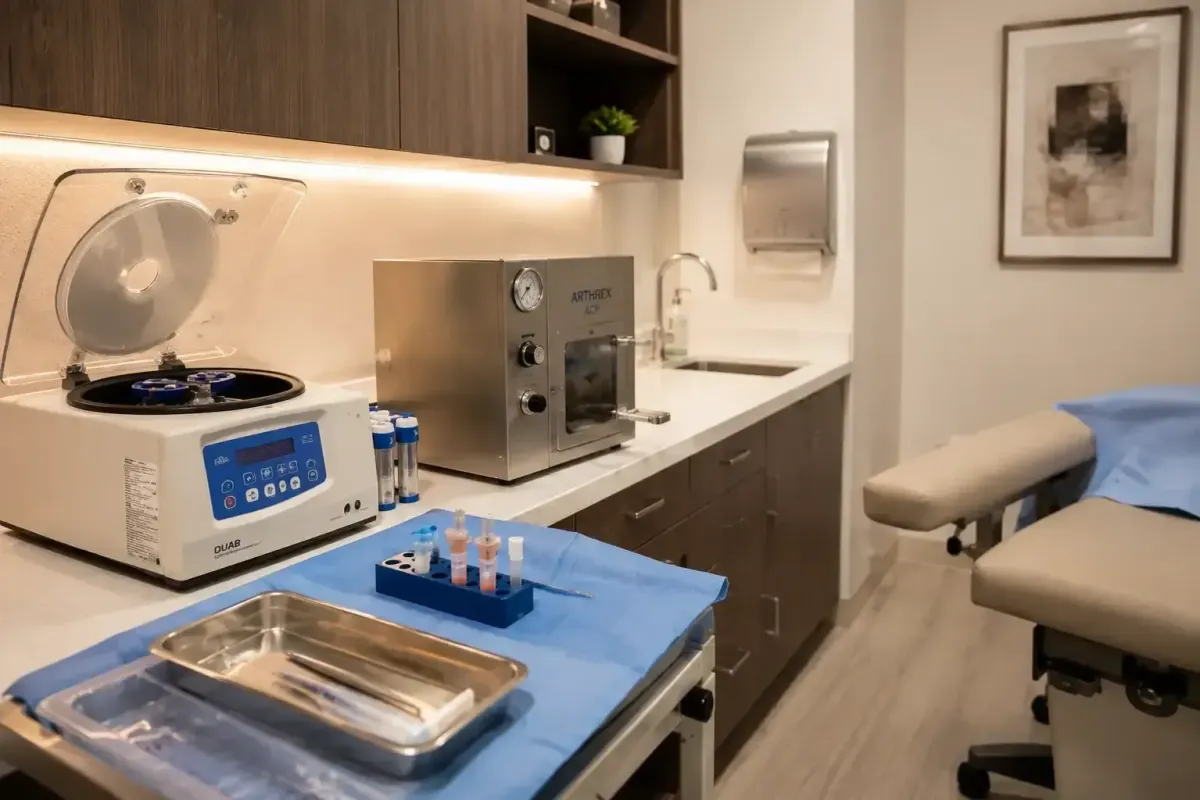
Two modalities account for the overwhelming majority of compliant, same-day autologous procedures offered at legitimate stem cell and orthobiologics clinics in the United States. Both are sourced from the patient's own body, processed minimally through centrifugation to concentrate the relevant cell populations, and reimplanted within the same procedure — the exact model the same surgical procedure exception was written to accommodate.
Bone Marrow Aspirate Concentrate
Bone marrow aspirate concentrate, commonly abbreviated BMAC, is drawn from the patient's iliac crest, processed through centrifugation to concentrate the mesenchymal stem cells, growth factors, and platelets present in bone marrow, and reinjected into the target joint or tissue within the same visit. BMAC has the deepest clinical research base of any autologous orthobiologic product available in a same-day cash-pay setting and is the modality most commonly associated with legitimate, FDA-compliant stem cell clinics treating orthopedic conditions.
Adipose-Derived Concentrate
Adipose-derived concentrate, sometimes called mini lipoaspirate or referenced by the cell fraction it yields, stromal vascular fraction, is harvested through a small-volume liposuction procedure, processed through mechanical or enzymatic methods to concentrate the regenerative cell population present in fat tissue, and reinjected in the same procedure. Adipose tissue yields a higher concentration of mesenchymal stem cells per volume than bone marrow, which is part of why this modality has grown in popularity — but it also carries more regulatory scrutiny around processing method, because certain enzymatic digestion techniques can push a procedure beyond what the same-day exception's narrow "rinsing, cleansing, sizing, or shaping" standard allows. This is a technical distinction that requires genuine legal and clinical expertise to navigate correctly, not a judgment call made at the equipment vendor level.
Both modalities serve largely the same patient population and clinical indications covered in depth in the article Joint and Musculoskeletal Clinic — chronic joint degeneration, tendon injury, and the active recovery patient population seeking a non-surgical alternative. A stem cell clinic and a joint restoration clinic are, in practice, frequently the same business with overlapping service menus.
What Does Not Qualify — and Why It Is the Single Biggest Risk in This Category
The same academic research cited earlier in this post documents that a meaningful share of the clinics operating in this space source material that does not meet the autologous, same-day standard at all. Independent laboratory testing referenced in orthopedic industry analysis has repeatedly found that many commercially marketed "amniotic" and "umbilical cord" stem cell products — donor-derived, allogeneic material sold to clinics for injection — contain no living stem cells at all by the time they reach the patient, despite being marketed under the same terminology as genuine autologous procedures.
This distinction is not academic. It is the exact fault line the FDA's enforcement activity in this category has concentrated on. Allogeneic products — anything sourced from a donor rather than the patient being treated — do not qualify for the same surgical procedure exception under any circumstances, because that exception explicitly requires autologous use. A clinic offering donor-derived amniotic or umbilical cord products as "stem cell therapy" is operating under the Section 351 drug and biologic pathway whether it intends to or not, without the premarket approval that pathway requires.
Culture-expanded cells — material grown and multiplied in a lab setting before reimplantation — carry the same exposure. So does any marketing claim that a procedure treats, cures, or reverses a specific named disease, since homologous use and appropriate labeling are independent criteria the FDA evaluates separately from the same-day processing question. A clinic that processes tissue correctly but then markets it as a cure for autoimmune disease, neurological conditions, or any indication beyond the structural, homologous use the tissue is naturally suited for has created a second, entirely separate compliance problem regardless of how clean the clinical procedure itself is.
The compliant version of this business is narrower than the version most gray-market marketing suggests exists. It is autologous. It is same-day. It is processed through rinsing, cleansing, sizing, or shaping only. It is marketed around structural, homologous applications — primarily orthopedic and musculoskeletal — without disease-cure language. Every clinic ACG helps launch in this category is built to operate precisely within those boundaries.

The Patient and Market Opportunity
The patient who seeks out a compliant stem cell clinic overlaps substantially with the joint and musculoskeletal clinic patient covered elsewhere on this blog — an adult managing chronic joint degeneration, a tendon or ligament injury, or persistent inflammatory pain who has exhausted conservative management and is evaluating options short of surgery. What distinguishes the stem cell-specific segment of this patient population is the degree of research they have already done. This patient has typically encountered the term stem cell therapy repeatedly, has some awareness that the category includes both legitimate and questionable operators, and is actively trying to distinguish between them before committing to treatment.
This creates a genuine competitive opening for a clinic willing to lead with its compliance posture rather than treating it as fine print. A website, consultation framework, and informed consent process that explicitly explains the same-day autologous model, cites the specific regulatory framework the clinic operates under, and draws a clear contrast with donor-derived or lab-expanded alternatives is speaking directly to the skepticism this patient already carries. That transparency is a conversion advantage, not a liability, precisely because so few competitors in this specific category are willing to be this specific about how their procedures are regulated.
Even the largest branded presence in this category has struggled with exactly this transparency question — a pattern examined in Stem Cell Clinic vs. Franchise, which looks at what happened when marketing decisions made at the network level exposed dozens of affiliated locations at once. It is precisely the kind of exposure an independently owned, compliance-forward clinic does not carry, and it is a genuine differentiator worth making explicit to a patient who is already trying to tell the legitimate operators apart from the rest.
Building the Compliance Infrastructure Before You See a Patient
The medical director relationship carries more weight in a stem cell clinic than in almost any other regenerative health category covered on this blog, because the medical director's clinical judgment is what determines whether a given processing protocol genuinely stays within the narrow same-day exception standard. A medical director for this clinic type needs specific, demonstrable comfort with the HCT/P regulatory framework — not simply a willingness to sign a supervision agreement. ACG facilitates introductions to medical directors with this specific background, rather than treating the role as interchangeable across clinic types.
Informed consent documentation for a stem cell clinic needs to address the investigational and unapproved status of the specific procedure being offered, in language that is accurate to the regulatory category the clinic is actually operating under. Same-day chain-of-custody documentation — proving that the tissue implanted was in fact removed from and returned to the same patient within the same procedure — is not optional record-keeping. It is the evidentiary basis for the entire regulatory exception the clinic depends on.
Marketing materials require a level of discipline that goes beyond the general no-efficacy-claims standard ACG applies across every clinic type. Language implying that a procedure will regenerate cartilage, reverse a diagnosed condition, or produce a guaranteed outcome creates liability specific to this category's heightened FDA enforcement posture. Every stem cell clinic ACG launches has its marketing materials reviewed against this standard before anything goes live.
What ACG Provides
ACG's launch engagement for a stem cell clinic covers costs, market validation for the specific orthopedic and musculoskeletal patient demographic in the target market, entity structure, medical director introduction to a practitioner with genuine HCT/P regulatory experience, equipment sourcing for BMAC and adipose-derived processing systems at preferred pricing, same-day procedure protocol documentation built to the specific standard the same surgical procedure exception requires, informed consent and compliance-reviewed marketing materials, and 60 days of post-launch advisory support.
To learn more about the full ACG launch process, visit altosconsultinggroup.com/new-clinic-launch. To start the conversation about the stem cell clinic opportunity in your specific market, visit altosconsultinggroup.com/survey.
Frequently Asked Questions
Is it legal to open a stem cell clinic in the United States?
Yes, when the clinic operates within the same surgical procedure exception under 21 CFR 1271.15(b) — autologous tissue, processed through rinsing, cleansing, sizing, or shaping only, and reimplanted within the same procedure. This is the pathway that allows a cash-pay clinic to offer these procedures without the premarket FDA approval required for drugs and biologics. Operating outside this narrow standard — through donor-derived material, lab-expanded cells, or processing methods beyond what the exception allows — moves the clinic into the drug and biologic regulatory pathway, which requires FDA approval that a cash-pay clinic realistically cannot pursue.
What is the difference between BMAC and amniotic or umbilical cord stem cell products?
BMAC and adipose-derived concentrate are autologous — sourced from and returned to the same patient in the same procedure, which is what allows them to qualify for the same-day exception. Amniotic and umbilical cord products are allogeneic, meaning they are sourced from a donor rather than the patient being treated. Allogeneic products do not qualify for the same surgical procedure exception under any circumstances. Independent research has also found that many commercially available amniotic and umbilical cord products marketed as stem cell therapy contain no living stem cells by the time they reach the patient, which is part of why this category has drawn significant regulatory scrutiny.
Do I need FDA approval to offer stem cell therapy at my clinic?
Not if the clinic's procedures qualify for the same surgical procedure exception — autologous tissue, minimal processing limited to rinsing, cleansing, sizing, or shaping, reimplanted within the same procedure. Procedures that fall outside this standard require the same premarket approval pathway used for drugs and biologics, which involves an Investigational New Drug application and formal clinical trials — a process that is not commercially viable for a cash-pay clinic. This is precisely why the specific tissue source and processing method a clinic uses is the single most important compliance decision it makes.
Can I claim that stem cell therapy cures or treats a specific condition?
No. Marketing language claiming that a procedure cures, reverses, or guarantees improvement in a diagnosed medical condition creates significant regulatory exposure, independent of whether the underlying procedure itself is compliant. Homologous use — using the tissue for the structural function it naturally serves in the body — is a separate regulatory requirement from the same-day processing standard, and marketing claims that go beyond this appropriate use are one of the most common triggers for FDA warning letters in this category. ACG reviews all marketing materials against this standard for every stem cell clinic it helps launch.