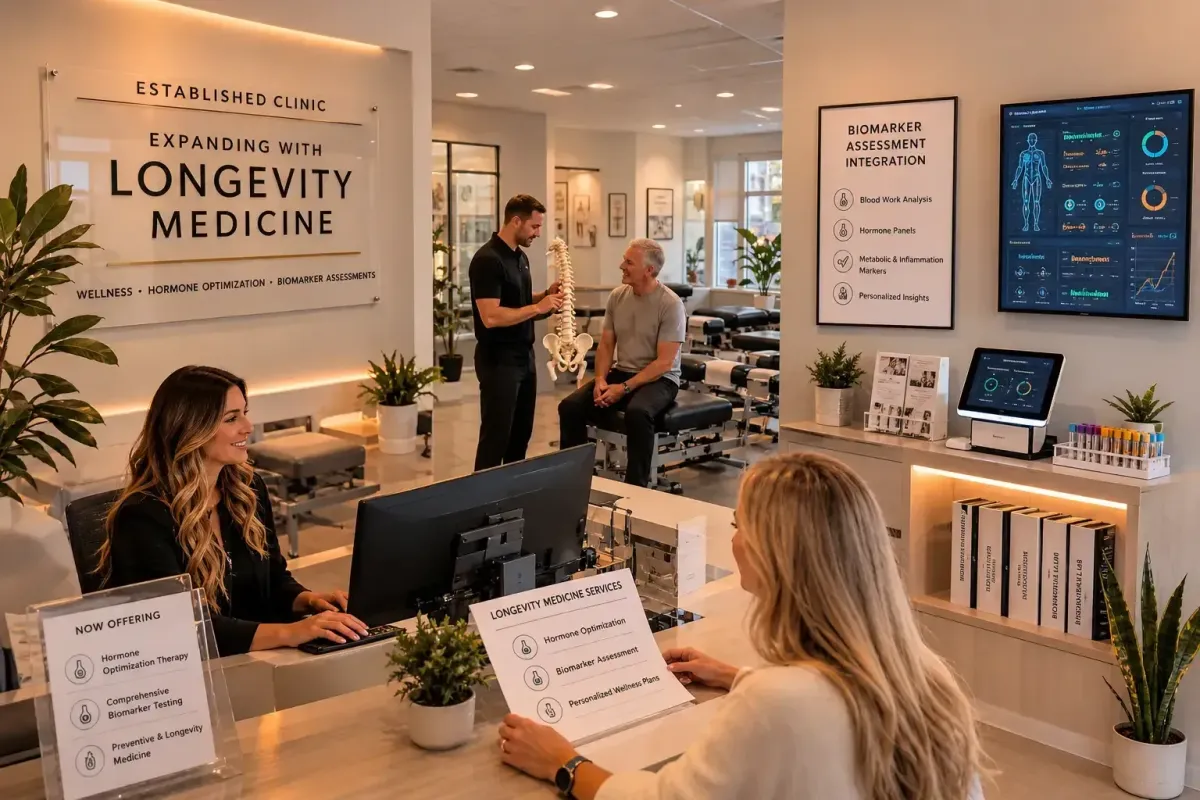
How Existing Clinic Owners Are Adding Longevity Medicine Services — and What It's Doing to Their Revenue
The Revenue Expansion Transforming Established Practices
Across the United States in 2026, a significant number of existing healthcare and wellness clinic owners are discovering that the longevity medicine category represents the most commercially powerful service expansion available to their practice — not because it replaces what they are already doing, but because it transforms the nature of the patient relationship and the financial model that underlies it.
For a full analysis of the longevity clinic market opportunity and why 2026 is the right moment, see The Longevity Clinic Business Opportunity.
Altos Consulting Group works with existing clinic owners through an optimization engagement. To see the longevity clinics ACG has supported, visit altosconsultinggroup.com/clinics-supported/longevity.
The Practice Types With the Strongest Expansion Position
Weight Loss Clinics
The weight loss clinic is perhaps the most naturally positioned existing practice for longevity medicine expansion. The patient managing their metabolic health through a weight loss program is already invested in the biological outcomes — body composition, insulin sensitivity, energy, hormonal balance — that longevity medicine addresses directly. Adding GLP-1 metabolic programs combined with hormone optimization and biomarker monitoring converts a weight-focused clinical relationship into a comprehensive metabolic health membership. A weight loss clinic patient spending $200 to $400 per month who transitions to a longevity metabolic membership at $700 to $1,000 represents a 75 to 150 percent increase in monthly revenue per patient without requiring new patient acquisition.
Chiropractic Practices
The chiropractic patient managing chronic musculoskeletal issues is a natural candidate for longevity medicine services addressing the biological underpinnings of their condition. Hormone optimization addresses hormonal factors affecting tissue healing and inflammatory regulation. NAD+ therapy supports the cellular energy production underlying recovery capacity. The chiropractic clinic that introduces these services as a deeper engagement with the biology it is already treating — not a departure from its clinical focus — generates recurring revenue from patients who already trust the clinic.
Med Spas
The premium med spa patient investing in aesthetic services is adjacent to the longevity medicine patient. The transition from cosmetic aesthetics patient to longevity medicine member does not require a complete reconceptualization of the patient relationship. It requires a clinical conversation that connects the biological health services being added to the aesthetic outcomes the patient already cares about.
What the Compliance Requirements Look Like for Expansion
Medical Director Assessment
If the existing practice does not have a medical director with prescribing authority appropriate to longevity medicine services — hormone optimization, peptide protocols, IV formulations — establishing or expanding that relationship is the first step. ACG's optimization engagement includes medical director assessment and, where necessary, introduction to vetted longevity medicine practitioners.
Protocol Development and Supplier Access
Clinical protocols for each new longevity service must be developed and approved by the medical director. Supplier relationships for the compounds and lab services required must be established. Both are addressed in ACG's optimization engagement — which begins with a comprehensive audit of the existing practice's infrastructure.
Training and Staff Integration
Existing clinical staff need training on new service protocols, documentation requirements, and patient consultation frameworks. ACG's optimization engagement includes staff training as a core deliverable.
The Revenue Impact
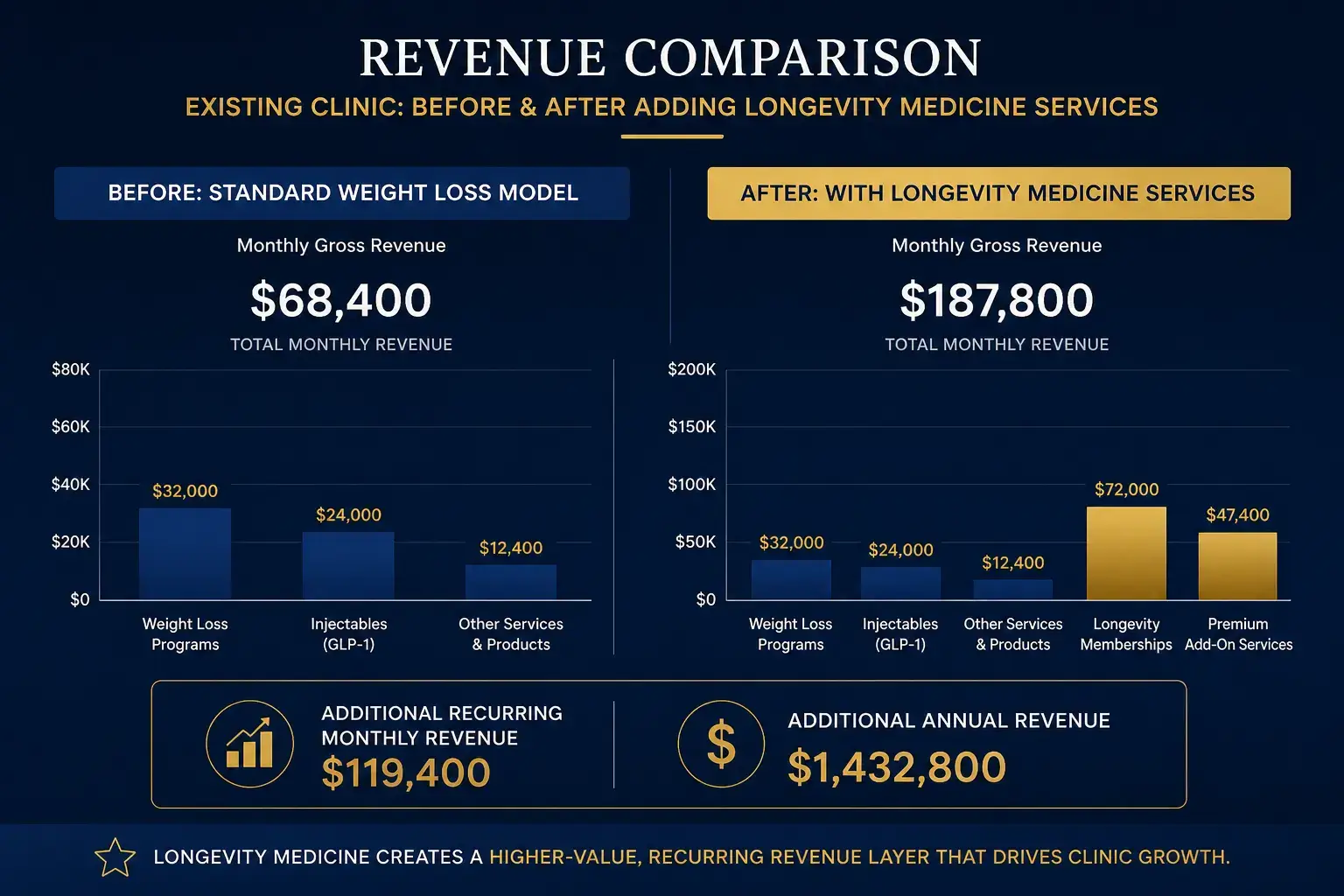
Across ACG's optimization engagements, the most consistent finding is this: the average monthly revenue per existing patient increases materially when longevity medicine services are added correctly. A practice that converts 20 percent of its active patient base to longevity medicine memberships at an average of $700 per month has added $14,000 in new monthly recurring revenue from a practice with 100 active patients — without acquiring a single new patient.
The optimization engagement begins with a $999 audit. To learn more, visit Existing Clinic Growth. To start the conversation, visit altosconsultinggroup.com/survey.
The Conversion Conversation: How to Introduce Longevity Services to an Existing Patient Without It Feeling Like a Sales Pitch
The most common operational concern among existing clinic owners who are adding longevity medicine services is not the compliance setup or the supplier relationships — it is the conversation with the existing patient. How do you introduce a new clinical service to a patient who has been coming to your clinic for a specific purpose without it feeling like you are trying to sell them something? The answer is that the conversation does not feel like a sales pitch when it is grounded in a genuine clinical observation — and the existing patient relationship makes genuine clinical observations possible in a way that a cold patient acquisition cannot.
A chiropractic patient who has been coming in for six months managing chronic lower back pain has a clinical history with the practice. The provider knows their functional limitations, their treatment response pattern, and the factors that are driving their persistent pain. When that patient's hormone panel — which might be drawn as a new service the clinic is offering — shows low testosterone and an elevated inflammatory marker profile, the clinical conversation about hormone optimization is not a sales pitch. It is a clinically informed observation that directly connects to the problem the patient has been trying to solve. The patient who receives that conversation experiences it as a provider who is genuinely paying attention to the full picture of their health — which is the clinical authority signal that drives enrollment in the new service.
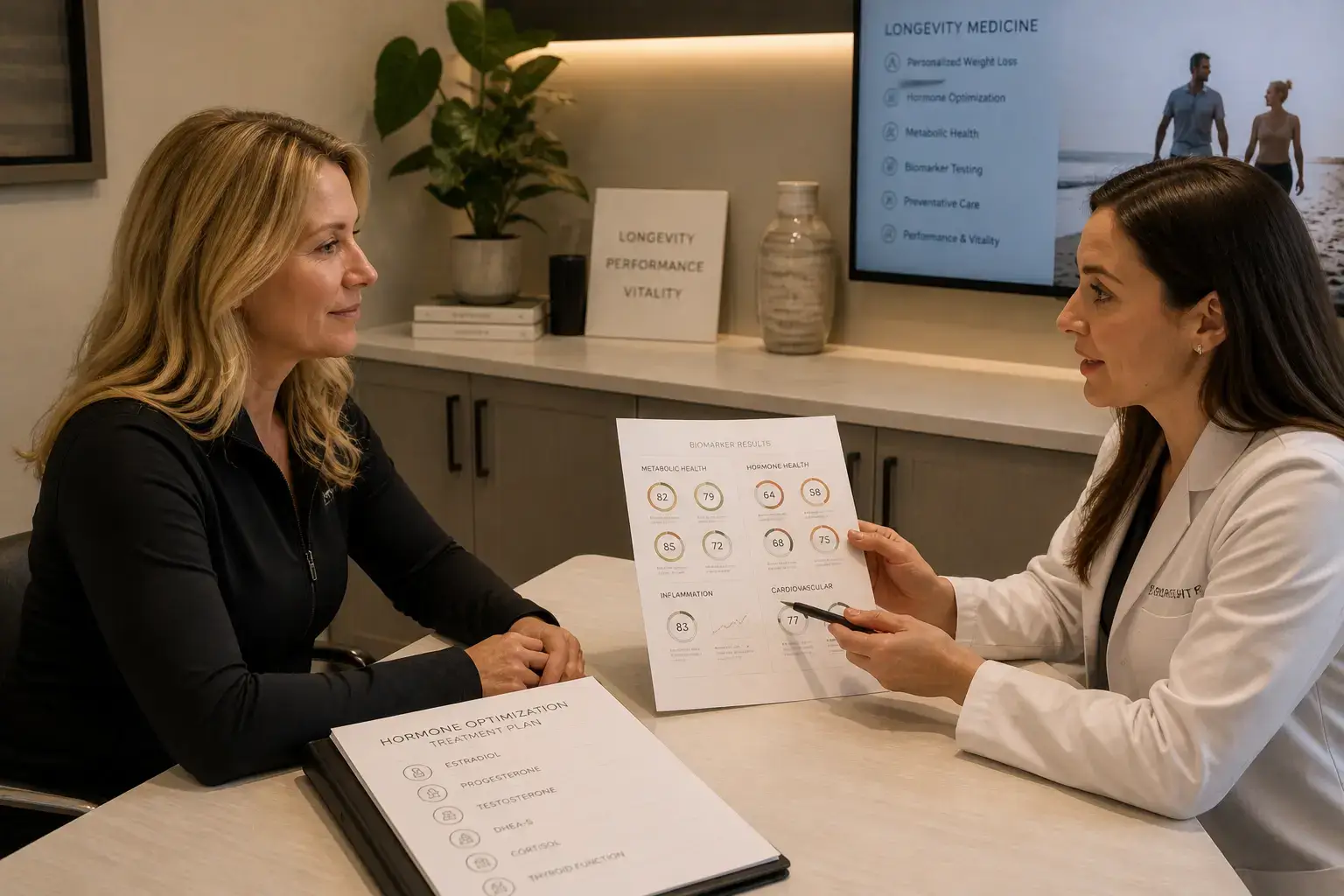
The key to making this work consistently is the clinical intake expansion rather than the promotional announcement. Instead of announcing to all existing patients that the clinic now offers longevity services, the highest-converting approach is expanding the intake process for existing patients to include a brief longevity and hormonal health screen — a set of questions about energy, recovery, sleep quality, body composition, and hormonal health symptoms that naturally surfaces the clinical context for a longevity service conversation. Patients who score in the range that suggests hormonal or metabolic factors are contributing to their presenting issues are then invited to a comprehensive assessment — not a sales consultation, a clinical assessment that includes a biomarker panel.
The assessment itself is the conversion mechanism. A patient who comes in for a longevity assessment, receives a comprehensive biomarker panel, and reviews the results with a clinician who can connect the data to their specific functional goals is experiencing the clinical relationship that makes the longevity medicine model compelling. The enrollment conversation happens at the review appointment — not as a pitch for a new service, but as a clinical recommendation grounded in specific lab findings and connected to goals the patient has already articulated. This consultation-to-enrollment conversion rate is typically higher for existing patients introduced this way than for new patients acquired through advertising, because the trust in the clinical relationship has already been established.
The training that makes this work is the consultation framework training for the clinical team — specifically the skill of connecting biomarker data to patient-reported goals in language that is clinically accurate but accessible to a patient without medical training. ACG's staff training for existing clinic expansions covers this specifically, because the clinical conversation that converts an existing patient into a longevity medicine member is different from the conversation that converts a new patient who found the clinic through an ad. The existing patient does not need to be convinced that the clinic is credible. They need to be shown that the clinical team sees the full picture of their health and has something genuinely useful to offer about it.
Frequently Asked Questions
How disruptive is adding longevity medicine services to an existing practice?
When structured correctly, the addition is an extension of the existing clinical model rather than a disruption. The most successful expansions begin with one or two longevity services that integrate naturally with the practice's existing patient conversations. Adding multiple services simultaneously before the operational foundation is established is the most common mistake.
What is the minimum patient base needed to justify a longevity medicine expansion?
A practice with 50 active patients who are well-positioned demographically — adults between 40 and 65 with demonstrated health investment — has sufficient base to make the expansion commercially viable. The conversion target for a well-structured expansion is 15 to 25 percent of the existing active patient base in the first six months.
Does ACG work with existing clinic owners or only new clinic startups?
ACG works with both. The optimization engagement for existing clinic owners begins with a $999 audit, identifies specific gaps and opportunities, and provides targeted consulting support for the services being added. For more information, visit https://altosconsultinggroup.com/existing-clinic-growth.
Written by Nova, Senior Content Strategist at Altos Consulting Group.