
Building a Weight Loss Clinic That Does Not Depend on Compounded GLP-1s
The Metabolic Service Stack That Survives Regulatory Change
Single-Product Businesses Are Fragile Businesses
The past eighteen months made a structural point that many weight loss clinic owners learned expensively. A clinic whose entire model rests on one drug, sourced through one regulatory exception, is one FDA determination away from a crisis.
The clinics that navigated the compounding transition well were not the ones with better pharmacy relationships. They were the ones where GLP-1 prescribing was one service among several, and where losing access to cheap compounded product was a margin problem rather than an existential one.
For the full business model, see The Metabolic Weight Loss Clinic Business Opportunity.
Muscle Preservation: The Clinical Gap Nobody Is Filling
Patients on GLP-1 therapy lose meaningful lean muscle mass alongside fat when no preservation protocol is in place. This is well documented and increasingly well understood by patients themselves, who are arriving at consultations already asking about it.
A clinic that addresses this systematically — resistance training guidance integrated into the program, protein intake targets set against lean mass goals, growth hormone secretagogue protocols where clinically appropriate, and body composition tracking that measures the fat-to-lean ratio of weight lost — is delivering something the telehealth prescription platforms structurally cannot.
This is also a marketing position that is both compliant and differentiating. It does not require an efficacy claim. It requires accurately describing a documented limitation of unmanaged GLP-1 therapy and explaining what the clinic does about it.
Tesamorelin and the Visceral Fat Distinction
Tesamorelin is worth understanding precisely, because it is frequently described inaccurately in clinic marketing.
Tesamorelin is a growth hormone releasing factor analog that is FDA-approved under the brand names Egrifta SV and Egrifta WR, with a specific indication: reduction of excess visceral abdominal fat in adults with HIV-associated lipodystrophy. In the pivotal trials, visceral adipose tissue decreased significantly from baseline at 26 weeks. The FDA-approved labeling also states plainly that it is not indicated for weight loss management, as it has a weight neutral effect.
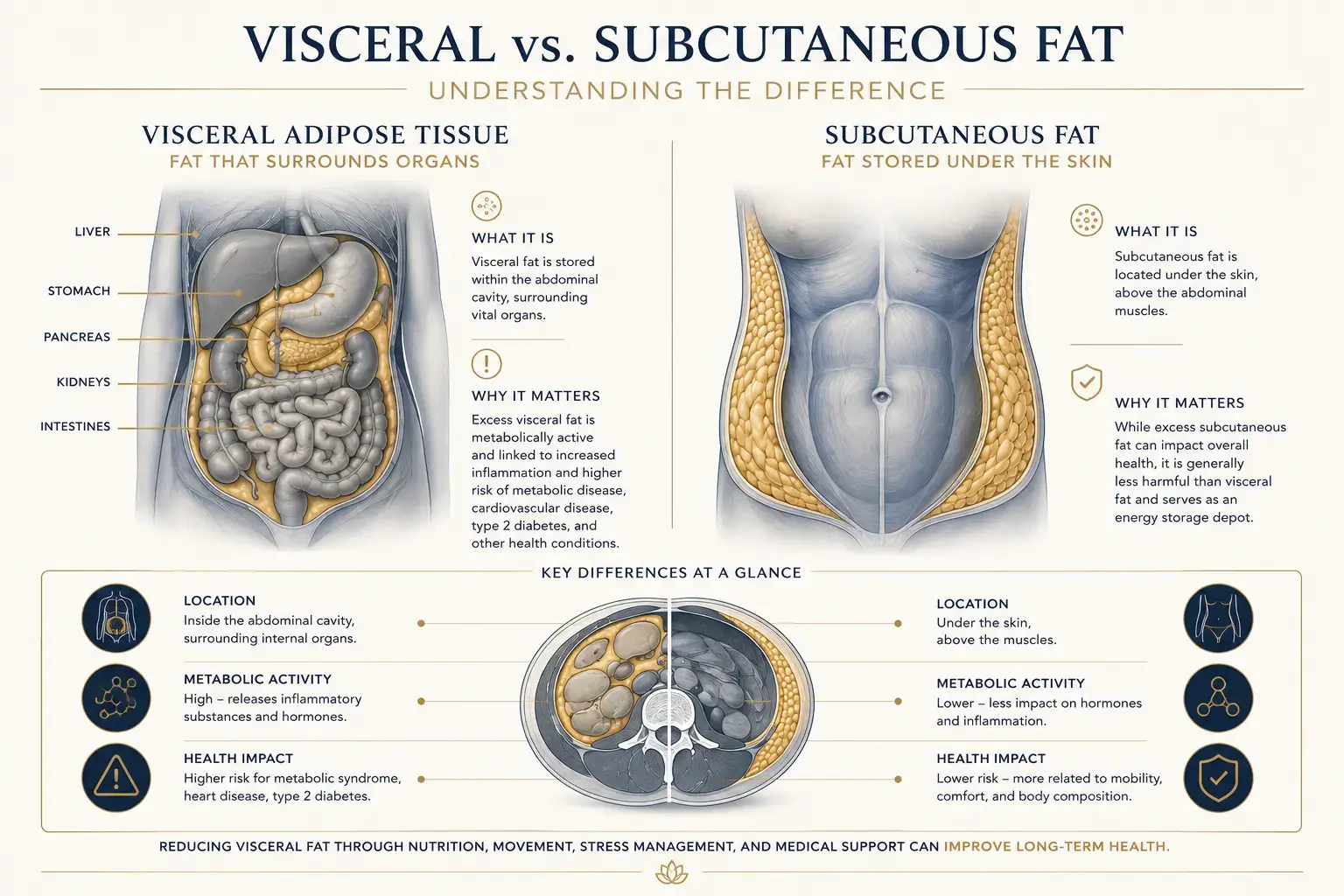
That last point is the clinically interesting one, and it is exactly why the compound belongs in a metabolic conversation rather than a weight loss one. Tesamorelin targets visceral adipose tissue — the metabolically active fat surrounding the organs that drives insulin resistance and inflammatory burden — without moving scale weight. For a clinic that has built its assessment around body composition rather than the scale, that is a coherent clinical target. For a clinic still selling pounds lost, it is incomprehensible.
Clinics considering this compound should also understand the label's cautions: effects were not sustained after discontinuation, long-term cardiovascular safety has not been established, the long-term implications of sustained IGF-1 elevation are unknown, and it is contraindicated in patients with active malignancy. Use outside the approved HIV-lipodystrophy indication is an off-label clinical decision that belongs to the medical director, made patient by patient with documented rationale.
Hormone Optimization as Metabolic Infrastructure
Metabolic dysfunction and hormonal imbalance are not separate clinical problems. Low testosterone contributes to insulin resistance and impaired body composition in men. Estrogen and thyroid dysregulation affect metabolic rate and fat distribution in women. A weight loss program that never assesses the hormonal environment is treating a symptom while ignoring a driver.
Adding hormone assessment and optimization to a metabolic clinic serves the clinical picture and creates a second recurring revenue stream from the same patient panel. See the ACG hormone optimization page for the service infrastructure this requires.
The Broader Peptide Adjunct Conversation
Growth hormone secretagogues and tissue repair peptides have a role in a metabolic practice, particularly for the muscle preservation objective described above. The regulatory framework governing these compounds differs from the GLP-1 situation and is covered in depth in The Peptide Therapy Clinic Business Model.
The relevant point for a weight loss clinic is that these compounds operate under a different and currently more stable regulatory pathway than compounded GLP-1s, which is precisely why they contribute to a more durable service mix.
What the Diversified Model Looks Like Commercially
A patient enrolled only in a GLP-1 program generates one revenue line and terminates when the medication stops. A patient enrolled in a comprehensive metabolic program — GLP-1 or alternative pharmacotherapy, quarterly biomarker monitoring, body composition tracking, hormone optimization where indicated, and peptide support for lean mass preservation — generates several, and remains clinically engaged after any single component ends.
The retention difference is more consequential than the revenue-per-patient difference. A comprehensive program has multiple reasons for a patient to continue. A prescription program has one.
The Maintenance Patient Nobody Planned For
There is a patient population arriving now that the industry did not anticipate three years ago: people who achieved their weight goal on a GLP-1, discontinued, and are watching the weight return.
For a prescription-only clinic, this patient is a churn statistic. For a metabolic health practice, they are among the most valuable patients available — highly motivated, already trusting of clinical guidance, and specifically seeking something the original program did not provide. A structured maintenance program built around body composition preservation, metabolic marker monitoring, hormonal support where indicated, and nutritional and resistance training guidance addresses a genuine clinical need that a prescription alone never did.
Clinics that build a defined maintenance track rather than treating discontinuation as the end of the relationship convert a meaningful share of their graduating patients into ongoing members.
Sequencing the Build
Attempting to add every service at once produces the same problem it produces in any clinic type — attention spread thin across too many new workflows during the period when execution matters most.
The sequence that works for most existing weight loss clinics: body composition assessment and muscle preservation protocol first, since it requires modest capital, addresses a gap patients are already asking about, and improves outcomes for the panel the clinic already has. Hormone assessment second, once prescribing authority and lab workflow support it. Peptide adjuncts third, once compounding pharmacy relationships and medical director protocol sign-off are established.
Most clinics run this over two to three quarters. Clinics that compress it into a single quarter typically end up with several services running at mediocre quality rather than two running well.
To discuss building a diversified metabolic service model, visit altosconsultinggroup.com/survey.
Frequently Asked Questions
Can a clinic offer Tesamorelin for general weight loss?
The FDA-approved indication is reduction of excess visceral abdominal fat in adults with HIV-associated lipodystrophy, and the labeling explicitly states it is not indicated for weight loss management because it has a weight neutral effect. Any use outside that indication is off-label, is a clinical decision belonging to the prescribing provider, and should be documented accordingly. Marketing it as a weight loss treatment would misrepresent both the label and the compound's actual effect.
What is the strongest non-GLP-1 service to add first?
For most weight loss clinics, body composition assessment paired with a structured muscle preservation protocol. It requires modest capital, addresses a documented clinical gap that patients are already asking about, differentiates against telehealth competitors, and improves outcomes for the GLP-1 patients the clinic already has.
Does diversifying dilute the clinic's positioning?
Only if framed as an unrelated service list. Positioned as metabolic health optimization — where GLP-1 therapy, hormone assessment, body composition management, and peptide support all address components of the same clinical picture — it strengthens positioning rather than diluting it. The framing distinction matters more than the service list itself.
How quickly can an existing weight loss clinic add these services?
Body composition assessment can be operational within weeks of equipment acquisition. Hormone optimization typically takes four to eight weeks depending on existing prescribing authority and lab workflow. Peptide protocols depend on compounding pharmacy relationships and medical director sign-off. Most clinics sequence these over two to three quarters rather than attempting simultaneous implementation.