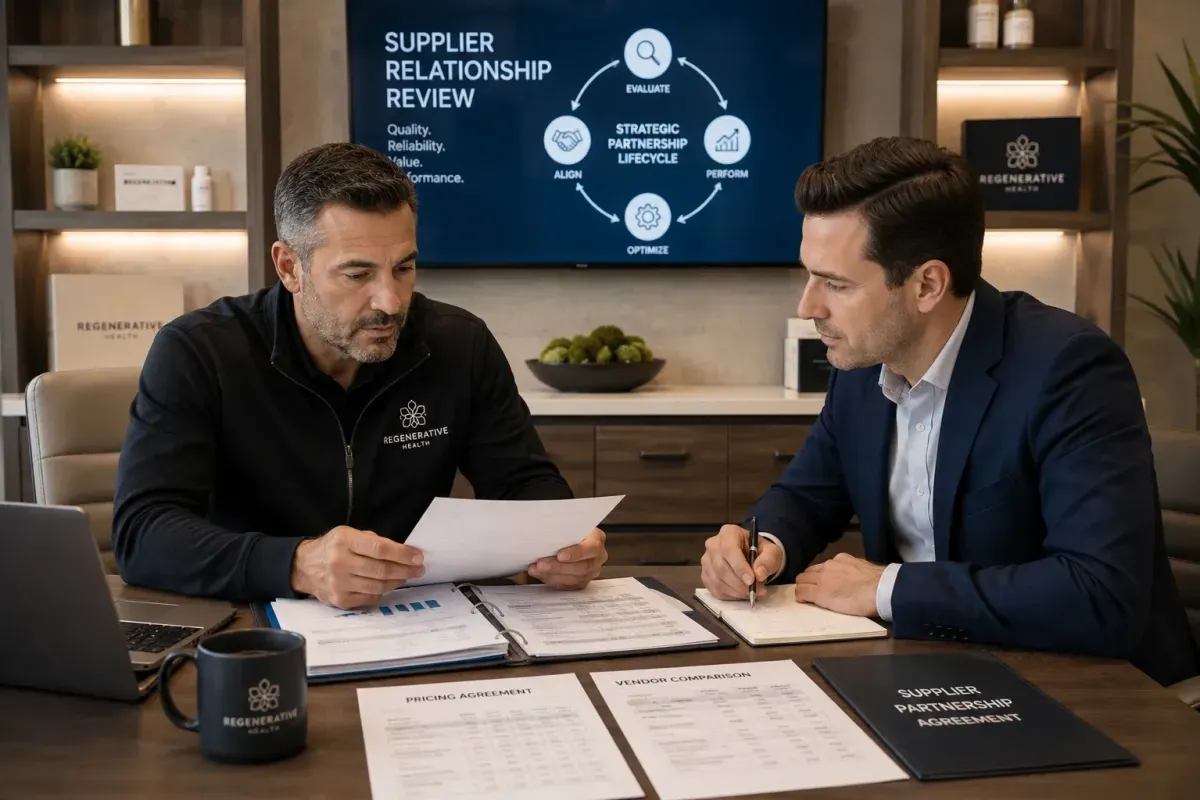
Supplier Access for Regenerative Health Clinics: Why the Vendor Relationships You Have on Day One Determine Your Margins for Years
A 2026 Supplier Strategy Guide for Entrepreneurs Opening and Operators Growing a Regenerative Health Clinic
The Most Underestimated Variable in Clinic Economics
Most entrepreneurs evaluating a Regenerative Health Clinic opportunity spend the majority of their due diligence on the market opportunity, the service menu, and the legal structure. These are important decisions. But the variable that most directly determines whether the clinic's gross margins support a profitable business from its first month of operation is one that gets far less attention: the pricing available from the suppliers who provide the compounds, materials, and equipment the clinic depends on.
The gap between what an independent operator pays for compounded peptides, hormone compounds, IV formulations, PRP kits and clinical equipment through retail or direct-to-vendor channels versus what a clinic with established, pre-negotiated supplier relationships pays for the same products can be significant enough to mean the difference between a clinic that is profitable at 30 patients and one that needs 60 patients to reach the same outcome. Getting supplier access right from day one is one of the highest-leverage decisions in the entire clinic launch.
To see how ACG structures supplier access for new clinic owners and existing clinics, visit altosconsultinggroup.com/supplier-connections.
The Supplier Categories Every Regenerative Health Clinic Depends On
Compounding Pharmacies — The Clinical Supply Foundation
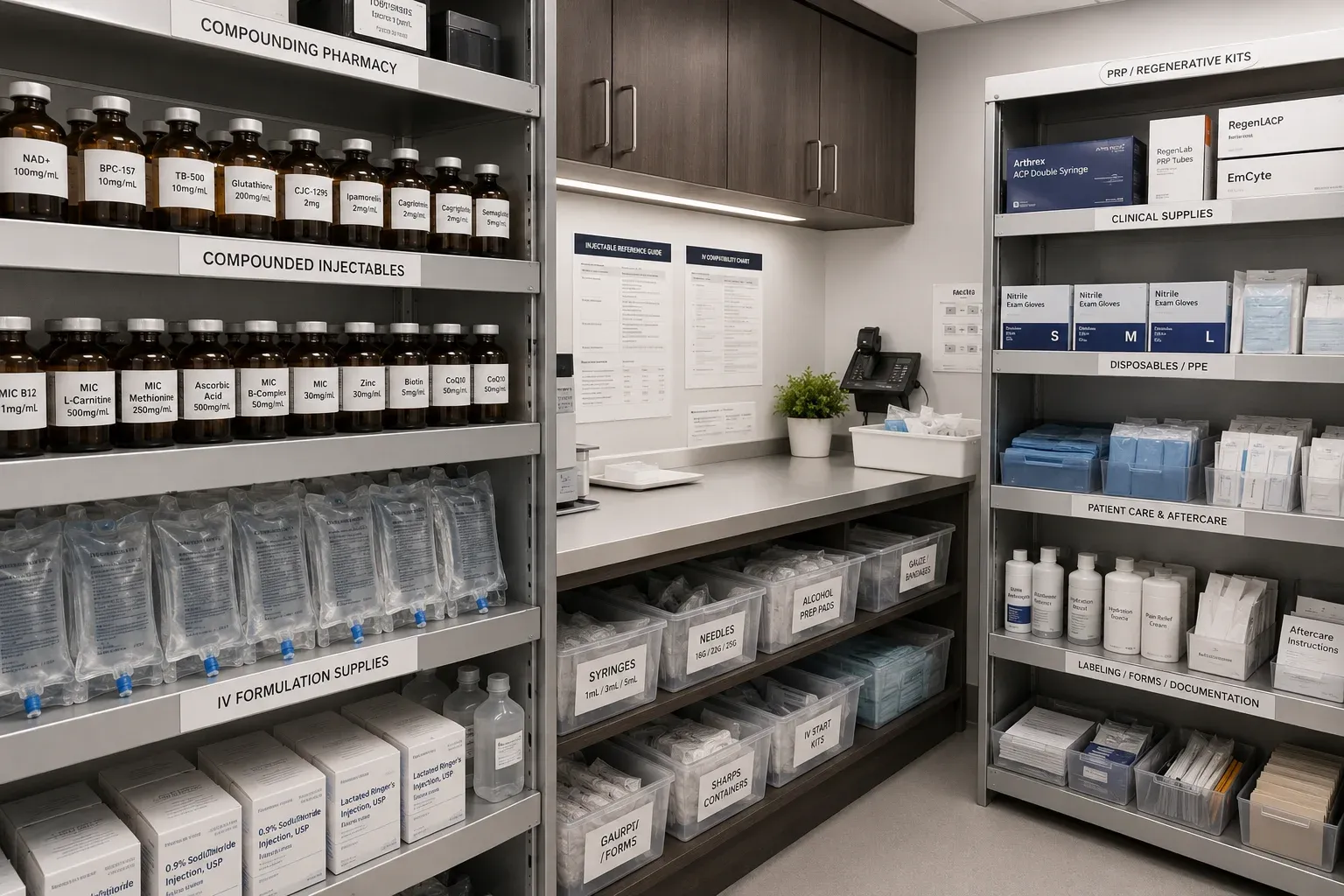
Every compounded product a Regenerative Health Clinic offers to patients — testosterone, BHRT compounds, peptide protocols, GLP-1 formulations, NAD+ infusion solutions, IV formulations — must be sourced through licensed 503A or 503B compounding pharmacies. The pricing available from a licensed compounding pharmacy to a new clinic account versus an established, high-volume clinic account differs significantly — and the difference compounds across the life of the business.
ACG has established supplier relationships with vetted compounding pharmacies that provide ACG clinic clients access to pricing that reflects the combined volume of ACG's 350+ clinic client base rather than the leverage of any individual new account. A clinic opening through ACG on day one accesses compound pricing that an independent operator would typically need twelve to eighteen months of established volume history to reach.
Regenerative Material Suppliers
PRP kits, growth factor concentrates, and other regenerative biological materials are sourced through specialized vendors who operate in a complex regulatory environment — particularly for regenerative products, which are subject to specific FDA requirements about manufacturing practices and marketing claims. Vendor vetting in this category requires both quality and compliance verification. ACG's pre-vetted supplier network includes regenerative material vendors who have been reviewed for both product quality and regulatory compliance.
Equipment Vendors — Shockwave, HBOT, Laser, and IV Infrastructure
Shockwave therapy devices. Hyperbaric oxygen chambers. IV therapy poles and infusion infrastructure. Low-level laser therapy equipment. Each of these equipment categories has a range of vendors with significant variation in product quality, service support, and pricing. An independent operator approaching these vendors without established buying relationships pays retail or near-retail prices. A clinic purchasing through ACG's vendor network accesses preferred pricing negotiated on the basis of the combined volume of ACG's clinic client base.
Lab Partners
Blood draw services for in-office specimen collection, lab panel ordering at preferred pricing, and result delivery integration with the clinic's EMR represent the lab infrastructure that supports biomarker monitoring across every regenerative health service category. Lab partner pricing for biomarker panels varies significantly based on order volume and relationship tenure. ACG's lab partner connections give new clinic owners access to panel pricing at rates that reflect ACG's combined client order volume.
The Pricing Differential and What It Means for Clinic Economics
A compounding pharmacy pricing differential of 15 to 25 percent on the compounds a clinic uses for its highest-volume protocols — peptides, hormones, IV formulations — translates directly into a corresponding improvement in gross margin at every patient volume. At 30 enrolled patients, a 20 percent compound pricing advantage might produce $3,000 to $6,000 per month in additional gross margin. At 75 enrolled patients, that same advantage produces $7,500 to $15,000 per month in additional gross margin.
This is capital that in the ACG-connected clinic stays in the business — available for marketing investment, operational improvement, or owner income. In the independently sourced clinic, it goes to the pharmacy at the higher retail rate. The long-term financial impact of day-one supplier access versus building that access independently over twelve to eighteen months is one of the most concrete and quantifiable advantages the ACG engagement provides.
Supplier Vetting: Why Source Matters Beyond Price
Not all suppliers in the regenerative health space are equal in quality or compliance. The compounding pharmacy that offers the lowest per-unit pricing on peptide compounds may be sourcing bulk drug substance through channels that create compliance exposure. The exosome vendor with the most compelling marketing may not have the manufacturing documentation required by the FDA for the products it sells. The shockwave device manufacturer with the most competitive pricing may not provide the service support that keeps the equipment operational when a component fails.
ACG's supplier network is built on relationships that have been validated for product quality, regulatory compliance, service reliability, and pricing fairness — not just the lowest price available at any given moment. Every supplier introduced to an ACG clinic owner has been vetted through the lens of the clinic owner's long-term interests, not the supplier's short-term marketing incentive.
What ACG Provides
ACG's supplier connections engagement introduces clinic owners to vetted vendors in every supply category relevant to their specific clinic type — compounding pharmacies, regenerative material vendors, equipment suppliers, and lab partners — at pre-negotiated pricing that reflects ACG's combined client volume. For existing clinics whose current supplier relationships are underperforming on price or quality, ACG's supplier audit identifies the gaps and introduces alternative vendors where better options exist.
To discuss the supplier access available for your specific clinic type, visit altosconsultinggroup.com/survey.
The Quality Dimension That Pricing Comparisons Consistently Miss
Every conversation about compounding pharmacy supplier relationships eventually focuses on pricing — and pricing matters, as established earlier in this post. But the clinic that optimizes exclusively for the lowest per-unit compound cost without equal attention to quality consistency, batch documentation standards, and delivery reliability is making a decision that will eventually produce a patient care problem more expensive than any per-unit savings it generated.
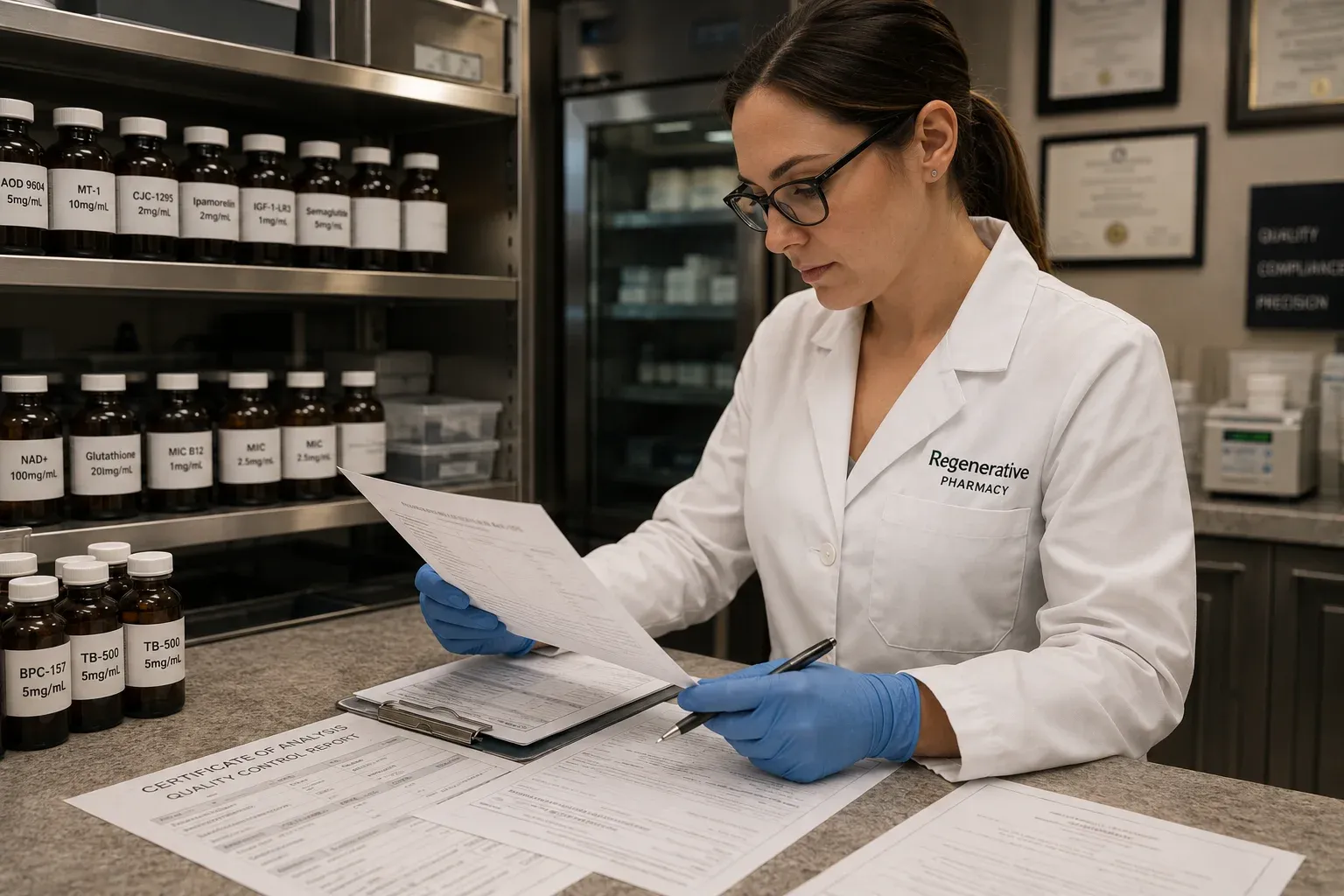
Compounding pharmacy quality in the regenerative health space is not uniform. The difference between a pharmacy operating at the minimum standards required to maintain its state license and one operating to the voluntary quality benchmarks established by NABP's accreditation programs is significant — in potency consistency, in batch testing documentation, in sterility assurance, and in the traceability of bulk drug substance sourcing. These differences are invisible in a pricing comparison and only become visible when a patient reports an unexpected response, when a batch test returns an anomalous result, or when an FDA inspection of the pharmacy produces findings that affect the clinic's ability to continue sourcing from that supplier.
The clinic that sources from NABP-accredited pharmacies with consistent batch testing documentation and transparent bulk substance sourcing is not just protecting its patients. It is protecting its medical director, whose prescribing authority and professional reputation are directly implicated in the quality of the compounded products dispensed under their supervision. A medical director who discovers that the clinic has been sourcing from a pharmacy with a history of quality complaints or unresolved FDA inspection findings has legitimate grounds to terminate the medical director agreement — which is an operational catastrophe that no per-unit pricing advantage can justify.
ACG's supplier vetting process evaluates quality and compliance alongside pricing for exactly this reason. Every compounding pharmacy in the ACG supplier network has been reviewed for current NABP accreditation status, state licensing in good standing, FDA inspection history, and batch testing documentation standards before an introduction is made to a new clinic client.
Understanding the Full Cost of Your Supplier Relationships — Beyond the Invoice
The pricing a clinic pays to its compounding pharmacy appears on an invoice. The full cost of the supplier relationship includes several factors that do not appear on any invoice but directly affect the clinic's financial performance and operational stability.
Delivery reliability is one of the most underestimated supplier relationship factors. A compounding pharmacy that consistently delivers compounds within its stated turnaround window allows the clinic to manage its inventory efficiently — ordering at the frequency that minimizes carrying cost without risking stockouts. A pharmacy with unpredictable delivery timelines forces the clinic to carry excess inventory as a buffer against delays, which ties up working capital and creates the risk of waste when compounds approach their beyond-use dating before being dispensed. According to MGMA's medical practice benchmarking data, supply chain reliability is one of the most consistently cited operational challenges among cash-pay health practices — and it is one that can be substantially mitigated by establishing supplier relationships with pharmacies whose delivery performance has been validated across multiple clinic engagements.
Account management quality is the second invisible supplier relationship cost. A new clinic account at a pharmacy that assigns a dedicated account representative — someone who knows the clinic's formulary, understands its patient volume patterns, flags relevant regulatory updates proactively, and escalates supply concerns before they become operational problems — generates significantly lower management overhead than an account at a pharmacy that treats the clinic as a ticket number in a queue. The per-unit pricing difference between these two pharmacy relationships is rarely large enough to justify the operational cost difference.
The regulatory monitoring dimension is the third. The FDA's 503A bulk drug substances framework is subject to ongoing regulatory change — Category 1 and Category 2 designations shift as FDA evaluates nominated substances and as policy guidance is updated. A pharmacy supplier that proactively communicates regulatory changes affecting the clinic's formulary — alerting the clinic when a compound's status changes, when a new guidance document affects prescribing requirements, or when a supply disruption is anticipated — provides a compliance monitoring function that has real commercial value. A pharmacy that communicates only through invoices and shipping confirmations provides none of that value regardless of how competitive its pricing is.
The adds another layer of consideration for clinics sourcing high-volume compounds. Outsourcing facilities are registered with the FDA, subject to current Good Manufacturing Practice requirements, and able to compound in larger batches without patient-specific prescriptions — which can offer supply consistency advantages for clinics with predictable high-volume compound needs. Understanding when 503B sourcing is appropriate versus 503A pharmacy sourcing is part of the supplier strategy conversation that ACG facilitates for each new clinic engagement based on the specific clinic's formulary and patient volume profile.
Frequently Asked Questions
Can I negotiate my own supplier pricing as a new clinic?
Yes, but with significantly limited leverage. New accounts without established volume history, relationship tenure, or buying group affiliation are quoted standard new-client rates by most compounding pharmacies and regenerative material vendors. The ceiling on what an independent new clinic can negotiate is significantly lower than what is available through an established consulting partner with existing pharmacy relationships and a combined client volume base.
How do I know if my current compounding pharmacy is the right choice?
The key indicators to evaluate: NABP accreditation status for 503A pharmacies, FDA registration for 503B outsourcing facilities, current state licensing in good standing, batch testing documentation available for the compounds being dispensed, and pricing that reflects your order volume fairly. ACG's supplier audit for existing clinic owners reviews each of these indicators and identifies whether better alternatives exist.
What happens when a new supplier relationship does not work out?
The most common supplier relationship problems are quality inconsistency, delivery reliability issues, and pricing creep over time. ACG's supplier network provides alternatives in each category — which means a clinic that encounters a problem with one pharmacy or vendor relationship is not without options while an alternative is established. The depth of the vendor network is as important as the initial pricing advantage.