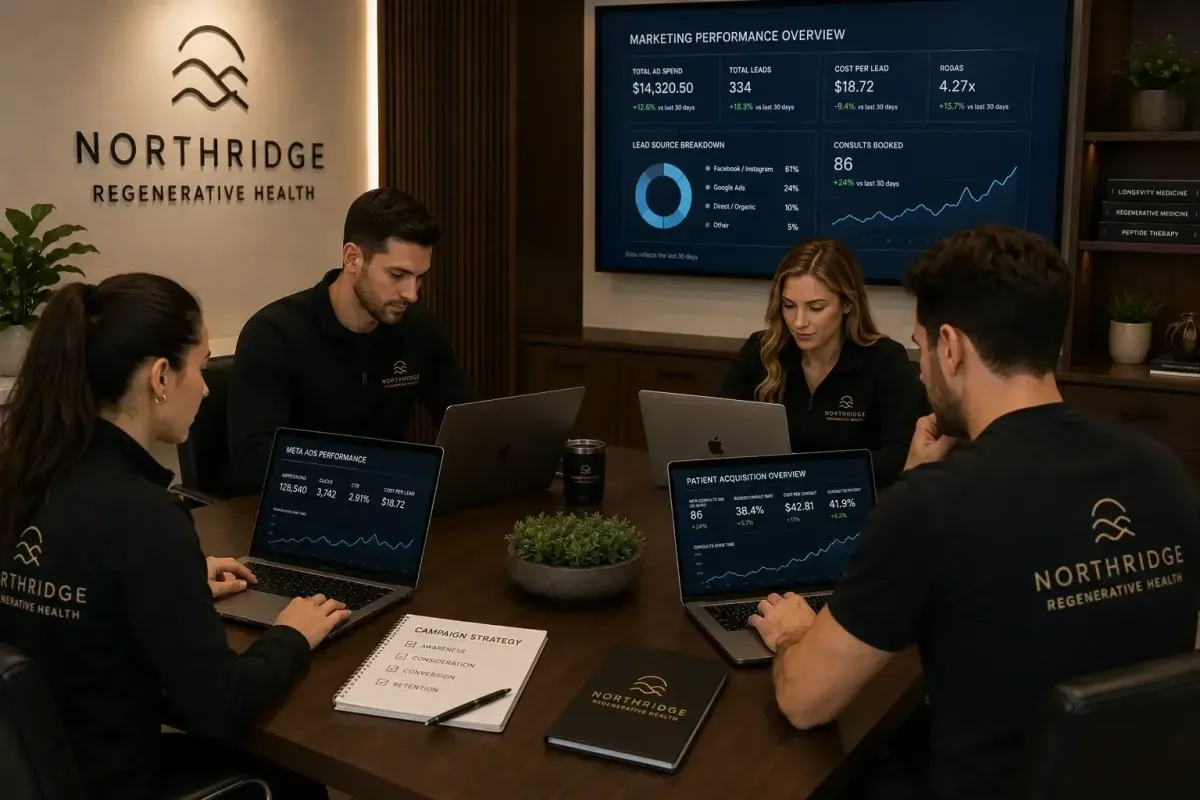
Patient Acquisition for Regenerative Health Clinics: The Marketing Framework That Fills Schedules and Builds Membership Revenue
Why Most Regenerative Health Clinics Struggle With Marketing — And Why It Is Not About the Budget
The most common marketing problem at Regenerative Health Clinics is not a budget problem. It is a targeting problem. Clinics that spend money driving generic health and wellness traffic to a website that does not clearly communicate what they offer, who they serve, and why they are the right choice in their market consistently underperform the same budget spent on correctly targeted, compliantly structured campaigns.
The Regenerative Health patient is not a typical consumer. They are a motivated, research-literate adult who has often been searching for months before they find the clinic that earns their consultation. They do not respond to generic wellness language. They respond to clinical credibility, specific protocol information, and the trust signals that tell them this clinic understands their specific condition or goal.
This post covers the complete patient acquisition framework for Regenerative Health Clinics in 2026 — the channels, the compliance requirements, the conversion architecture, and the trust-building approach that separates clinics with full consultation schedules from those chasing their next patient.
For clinics that want a professional diagnosis of their current marketing performance, ACG offers a marketing audit and strategy engagement — visit altosconsultinggroup.com/marketing-audits for more information.
The Regenerative Health Patient: Who They Are and How They Search
Understanding the patient before building a single ad or writing a single piece of content is the foundational step in Regenerative Health Clinic marketing. The patient profile varies by clinic type but shares several consistent characteristics:
•Age 35 to 65 — with the highest concentration between 42 and 58
•Above-median household income — cash-pay premium services require a patient who can afford them
•Health-invested — they are not starting from zero; they have tried other approaches and are looking for something that actually works
•Research-literate — they arrive at the consultation having already researched the treatment category; they are not being educated for the first time
•Outcome-oriented — they are not shopping on price; they are evaluating whether this clinic can deliver the specific result they are seeking
This patient profile has specific implications for marketing. Generic health and wellness messaging does not move them. Condition-specific, outcome-oriented content does. A clinic that communicates exactly what it offers, who it helps, and what results patients have experienced — with the clinical credibility to back the claims — attracts this patient. A clinic that says it is a premium wellness destination without specificity does not.
The Four Core Acquisition Channels in 2026
Channel 1: Paid Social Media — Facebook and Instagram
Meta advertising — Facebook and Instagram combined — is the primary paid acquisition channel for most Regenerative Health Clinics. The platform's targeting capabilities allow clinics to reach adults in specific age, income, and interest demographics within a defined geographic radius. For a cash-pay health clinic targeting a 35-to-65 patient demographic, Meta targeting delivers an accessible and measurable patient acquisition channel when the campaigns are structured correctly.
The compliance landscape for health-related advertising on Meta has tightened significantly. Clinics cannot make specific medical efficacy claims, cannot target based on health conditions in ways that imply knowledge of the viewer's health status, and cannot use before-and-after imagery in ways that imply guaranteed outcomes. Campaigns must be structured around outcomes and patient stories rather than clinical treatment claims. ACG's marketing engagement builds campaigns within this compliance framework — which is why ACG's campaigns do not get shut down while competitors' do.
The creative angle that performs best for most Regenerative Health Clinics is the independence frame — the patient who was managing their health through conventional medicine with unsatisfying results and found a clinic that actually addressed the underlying biological issue. This is not a medical efficacy claim. It is a patient story. And it is the creative angle that most consistently produces cost-effective consultation bookings.
Channel 2: Google Search — Intent Capture at the Moment of Decision
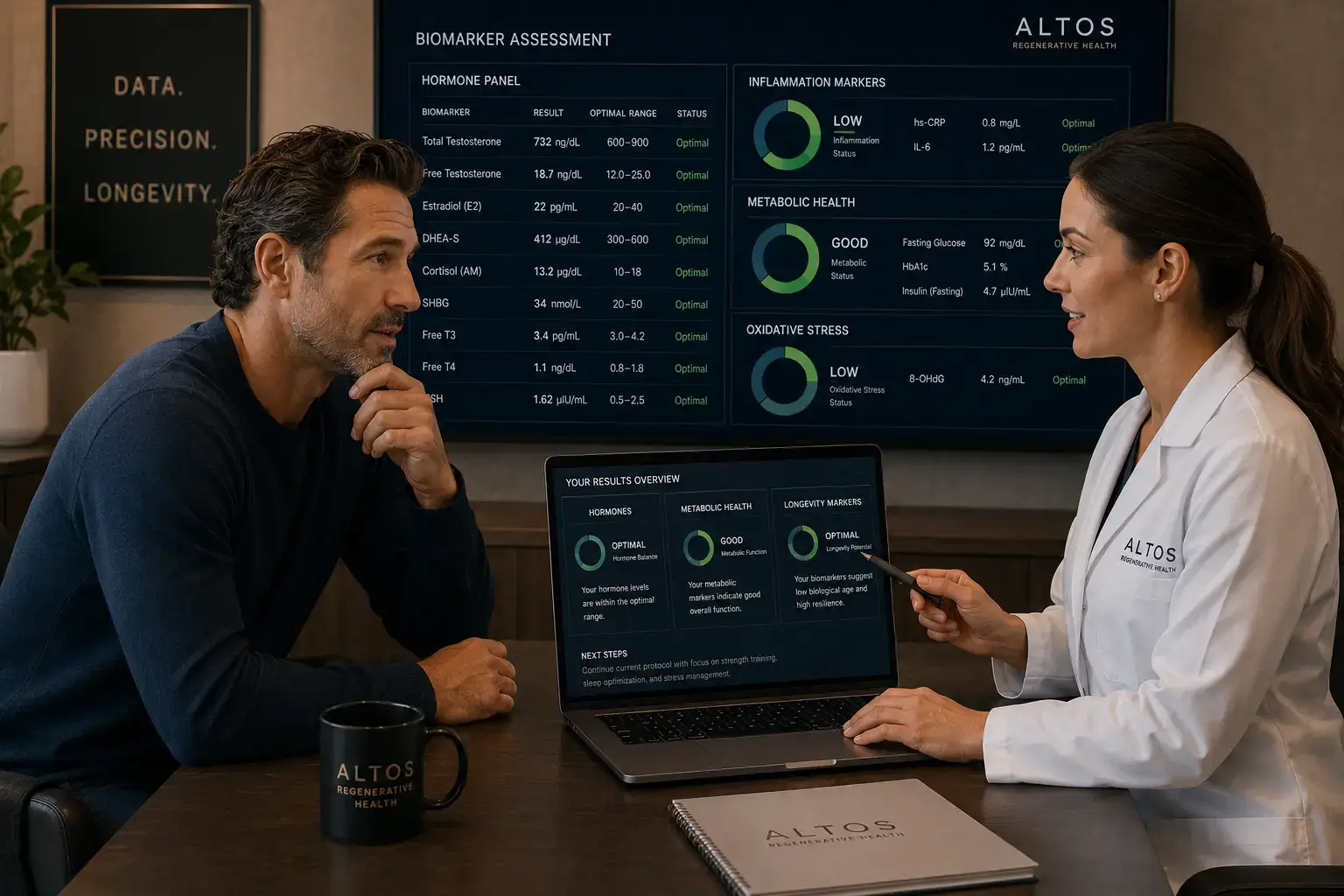
A patient who searches 'TRT clinic near me' or 'NAD therapy clinic' is not browsing. They are actively looking for a specific service in a specific market. Google Search advertising and organic SEO both capture this patient at the moment of highest intent — when they are ready to book a consultation, not just considering whether to explore options.
The keyword categories that drive the highest-converting traffic for Regenerative Health Clinics: clinic-type searches in the local market, condition or symptom searches related to the clinic's core services, and specific treatment name searches for high-awareness modalities like testosterone replacement therapy, NAD+ therapy, and GLP-1 programs. These searches convert at significantly higher rates than awareness-stage keywords because the patient has already made the decision to seek treatment — they are choosing between providers, not deciding whether to pursue care.
Channel 3: Local SEO — The Long-Term Organic Asset
Local search optimization — Google Business Profile optimization, local directory presence across 100+ platforms, and blog content targeting the specific longevity and regenerative health keywords being searched in the clinic's market — builds organic patient acquisition that compounds over time and does not require ongoing advertising spend to maintain.
The clinics that built local SEO authority in 2023 and 2024 are now receiving consistent organic consultation bookings without proportional advertising spend. The clinics opening in 2026 that invest in local SEO from day one will have the same advantage by 2027. The clinics that treat SEO as optional are permanently dependent on paid advertising to fill their schedules.
ACG's blog content architecture — pillar posts and cluster posts targeting the specific keywords the target patient searches when evaluating regenerative health clinic options in the entrepreneur's market — is the organic patient acquisition infrastructure that local SEO is built on.
Channel 4: Referral Systems — The Highest-Converting Patient Source
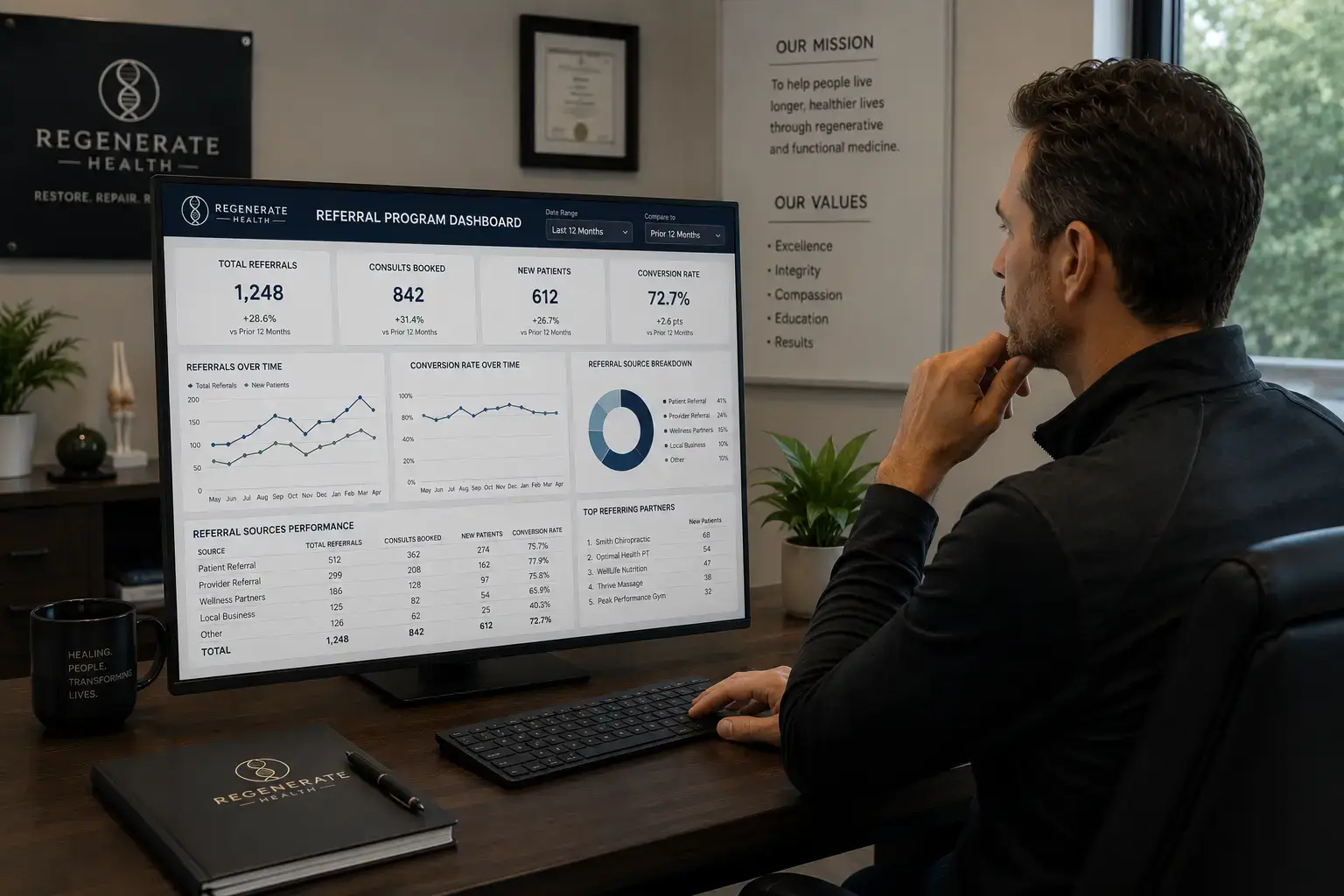
A referred patient arrives at the consultation having already heard that the clinic works from someone they trust. The conversion rate for referred patients is significantly higher than for any paid acquisition channel, and the lifetime value of referred patients tends to be higher because they arrived with pre-existing trust rather than skepticism.
A structured referral system — not an informal 'please tell your friends' but a formal mechanism with a defined referral incentive, a patient referral process, and a tracking system that closes the loop when a referred patient converts — produces a compounding source of new patients that becomes the most cost-efficient acquisition channel over time. Clinics with 350+ enrolled patients who have never been asked for a referral through a systematic process are leaving their most valuable marketing channel untapped.
The Consultation Conversion Framework
Driving consultation bookings is not the endpoint of patient acquisition — it is the entry point to the conversion process. A consultation that does not result in a membership enrollment is a marketing cost with no return. The consultation framework that converts inquiries into enrolled members is the highest-leverage element in the entire patient acquisition system.
The Regenerative Health consultation that converts consistently has five components. First, a qualified pre-consultation — the patient has answered questions before the appointment that confirm they are a realistic candidate for the clinic's services. Second, an opening that establishes genuine interest in the patient's specific situation rather than launching into a sales presentation. The question that consistently opens high-converting consultations: what specifically brought them here, and what have they already tried. Third, a clinical presentation that connects the patient's specific situation to the specific protocols the clinic offers — not a general overview of everything the clinic does. Fourth, a clear, confident presentation of the membership program and the investment it represents — without apology and without pressure. Fifth, a follow-up sequence for patients who do not enroll at the consultation that keeps the clinic present as the patient continues evaluating options.
Compliance Requirements Every Clinic Marketer Must Know
Regenerative Health Clinic marketing operates in one of the most compliance-intensive advertising environments in consumer health. Every platform has specific restrictions. Every claim has a legal standard. Every testimonial has FTC requirements. Getting this wrong does not just waste marketing budget — it creates legal exposure and the account suspensions that can wipe out months of advertising infrastructure.
•No medical efficacy claims — the claim that a treatment treats, cures, or improves any named medical condition requires FDA approval. Cash-pay Regenerative Health Clinics do not operate under FDA approval for most services. Marketing must be framed around patient stories, goals, and outcomes — not treatment claims.
•FTC-compliant testimonials — all patient results used in marketing must include disclaimers that results are not typical and individual outcomes vary. Income and outcome claims require specific qualification language.
•Meta advertising restrictions — health and wellness advertising on Facebook and Instagram has specific creative requirements that evolve frequently. Before-and-after imagery, claims implying personal health data knowledge, and specific medical terminology can trigger ad disapproval or account flags.
•Google healthcare advertiser verification — certain healthcare advertising categories require Google's healthcare advertiser verification before ads can run. Hormone therapy, GLP-1 programs, and some compounded medication categories fall under this requirement.
•PHI filtering for retargeting — any paid advertising that could use patient health data for retargeting must use HIPAA-compliant middleware that filters PHI before it reaches advertising platforms.
ACG's marketing engagement includes compliance-structured campaign builds for all of these requirements. The campaigns that fill schedules without creating compliance exposure are the ones built by people who understand both marketing performance and healthcare advertising law.
To get a professional diagnosis of your clinic's current marketing performance and identify the highest-ROI adjustments available, visit altosconsultinggroup.com/marketing-audits.
Frequently Asked Questions
How much should a Regenerative Health Clinic spend on marketing?
A new clinic in launch phase typically invests $3,000 to $6,000 per month in paid advertising during the first 90 days to build initial patient volume. An established clinic targeting growth typically invests $3,000 to $8,000 per month across paid social and search channels. The right budget depends on the clinic's market, competitive density, and the cost per consultation booking that the campaigns produce. Clinics with strong organic SEO and referral systems can sustain patient volume at lower paid advertising levels than those dependent entirely on paid channels.
Can a Regenerative Health Clinic advertise on Facebook?
Yes, with specific compliance requirements. Meta advertising for health-related services requires campaigns structured around patient stories and outcomes rather than medical efficacy claims. Certain treatment categories have additional restrictions. ACG's marketing engagement builds campaigns within this compliance framework — which means the campaigns do not get shut down while competitors' non-compliant ads do.
What is the most cost-effective patient acquisition channel for a new clinic?
For a new clinic in the first 90 days, paid social media — specifically Meta advertising targeting the clinic's demographic in the local market — typically produces the most consistent volume of consultation bookings at a manageable cost per lead. Google Search captures higher-intent traffic but requires time to optimize. Local SEO builds over months and compounds. Referrals become the most cost-effective channel once a meaningful enrolled patient base exists. The highest-performing clinics use all four channels in combination rather than relying on any single source.
What is a good cost per consultation booking for a Regenerative Health Clinic?
Cost per booked, qualified consultation for a Regenerative Health Clinic targeting the right patient demographic typically ranges from $150 to $350 depending on the market, the clinic type, and the advertising channel. Below $150 often signals unqualified traffic. Above $400 consistently signals either poor targeting, poor creative, or a landing page that is not converting traffic into bookings. ACG's target for new clinic launch campaigns is under $300 per booked qualified consultation.
Written by Nova, Senior Content Strategist at Altos Consulting Group.