
The Regenerative Health Clinic Marketing Audit: How to Diagnose What Is Costing You Patients and Fix It Before It Costs You More
The Problem with Most Clinic Marketing Is Not the Budget
The most consistent finding across ACG's marketing audits for Regenerative Health Clinics is that the clinics spending more are not consistently outperforming those spending less. The variable that determines patient acquisition performance is not budget — it is the coherence of the entire marketing system, from the targeting decisions at the top of the funnel through the landing page experience, the consultation booking process, the pre-call confirmation sequence, and the consultation framework that converts inquiries into enrolled members.
A marketing audit examines every component of this system and identifies the specific points where performance is leaking. Not theoretically — with actual data from the clinic's campaigns, website analytics, booking rates, show rates, and consultation-to-enrollment conversion rates. The audit produces a clear, prioritized set of interventions: what to fix first because it is costing the most, what to test next because it has the highest potential upside, and what is working that should be protected and scaled.
To learn more about ACG's marketing audit and strategy engagement for Regenerative Health Clinics, visit altosconsultinggroup.com/marketing-audits.
The Five Components of a Regenerative Health Clinic Marketing Audit
1. Campaign Structure and Targeting
The first question a marketing audit asks is whether the clinic's paid advertising campaigns are structured to reach the right patient at the right moment. This means evaluating the demographic and behavioral targeting of Meta and Google campaigns against the actual profile of the enrolled patient base — do the patients who are converting look like the patients the campaigns are targeting? It means reviewing the creative angles being used and whether they are positioned to attract the motivated, research-literate patient who enrolls in a membership versus the casual browser who books a consultation and does not show up.
Common campaign structure problems: too broad targeting that drives low-quality inquiry volume, creative that communicates generic wellness rather than specific clinical credibility, campaigns optimized for form fills rather than qualified bookings, and ad accounts spending budget on platforms or placements that produce high cost-per-click with low qualified booking rates.
2. Landing Page and Website Conversion
A significant percentage of clinic marketing underperformance is attributable not to the campaigns that drive traffic but to the landing page experience that either converts or loses the visitor the campaign paid to attract. Audit components: the clarity of the above-the-fold communication — does the visitor understand immediately what the clinic offers, who it serves, and why they should book a consultation? The social proof and credibility signals — are patient testimonials, team credentials, and clinical specificity communicated in a way that moves the research-literate health patient toward the booking action? The booking friction — how many steps does the patient encounter between deciding to book and successfully scheduling a consultation?
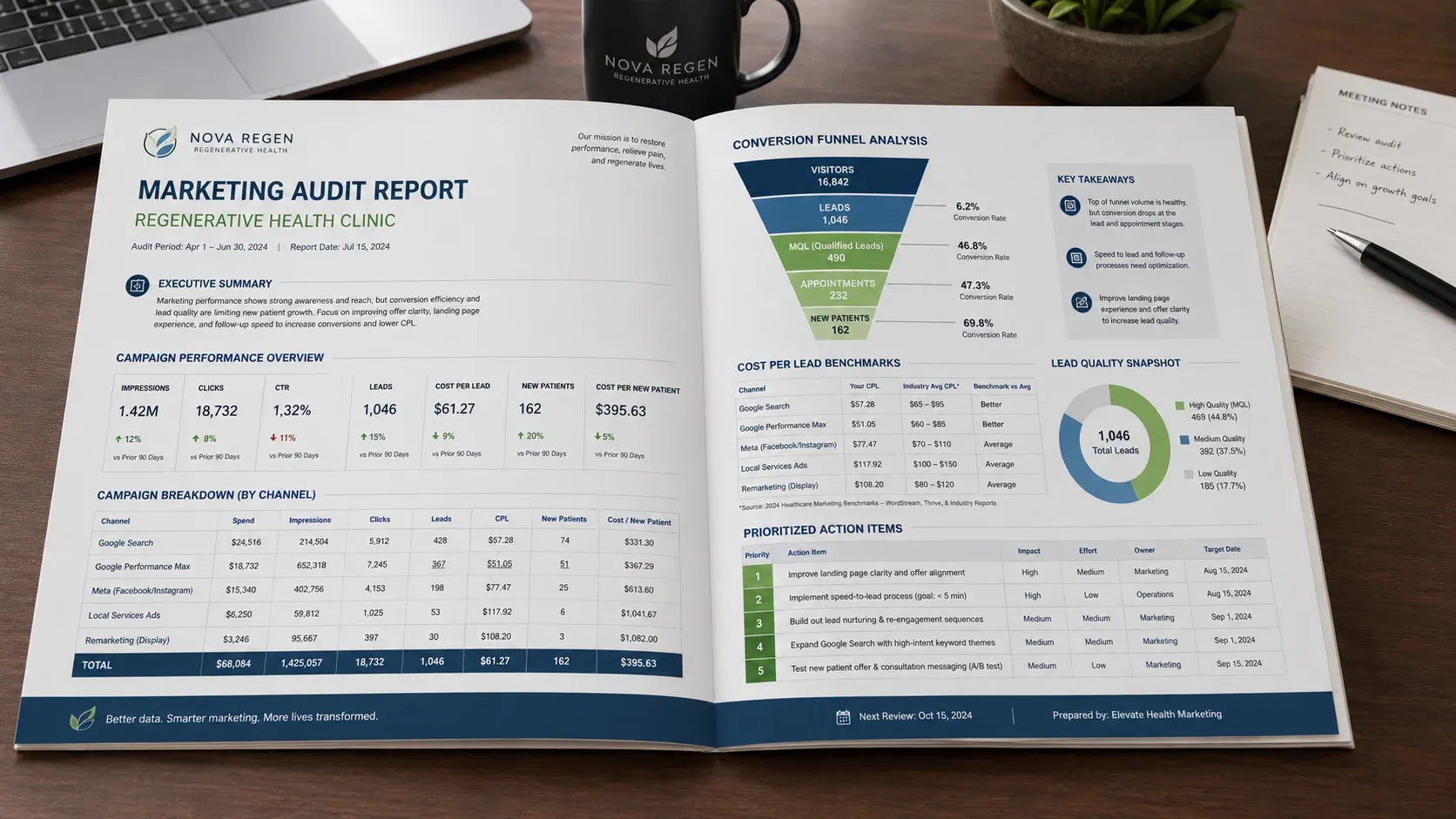
3. Booking Rate and Pre-Consultation Drop-Off
The booking rate — the percentage of website visitors or lead form submitters who actually schedule a consultation — is one of the most revealing metrics in the Regenerative Health Clinic marketing system and one of the least frequently reviewed. A clinic driving significant traffic and generating lead forms but losing 60 percent or more of those leads before a consultation is booked has a pre-consultation system problem that no increase in advertising spend will solve. Common causes: too much friction in the scheduling process, insufficient follow-up for leads who do not immediately book, qualification questions that are off-putting rather than filtering, and confirmation sequences that do not adequately prepare and motivate the prospective patient for the consultation appointment.
4. Show Rate and No-Show Patterns
The show rate — the percentage of scheduled consultations that actually occur — directly determines the revenue generated from any given consultation booking volume. A clinic booking 30 consultations per month with a 60 percent show rate is seeing 18 patients. The same clinic with an 85 percent show rate is seeing 25.5 patients from the same booking volume — a 42 percent increase in consultation volume without spending any additional marketing budget. The difference between a 60 percent and an 85 percent show rate is almost entirely explained by the pre-consultation engagement sequence — the confirmation messages, reminder communications, and pre-call content that keeps the prospective patient engaged and committed to attending the consultation they scheduled.
5. Consultation-to-Enrollment Conversion Rate
The consultation-to-enrollment conversion rate is the ultimate performance metric of the entire marketing funnel — the percentage of consultations that result in a patient enrolling in a membership or protocol package. For a well-structured Regenerative Health Clinic consultation with a prepared consultation coordinator, a qualified patient, and the right protocol and pricing presentation, the conversion rate should be between 35 and 55 percent. Clinics below this range have a consultation process problem: either in how the consultation is structured, how the protocol is presented, how the pricing is communicated, or how the follow-up is handled with patients who do not enroll at the first meeting.
What the Audit Produces
A Regenerative Health Clinic marketing audit from ACG produces a specific, prioritized action plan based on the clinic's actual performance data — not generic marketing advice applied without context. The deliverable identifies the one to three highest-leverage interventions available based on where the most patient acquisition is being lost in the funnel, what the data shows is working that should be protected and scaled, and what the realistic impact of the identified interventions is based on industry benchmarks and the clinic's specific market context.
From there, ACG can implement the identified adjustments — campaign restructuring, landing page updates, booking sequence improvements, consultation framework training — or provide the guidance for the clinic's internal team to implement them. The choice depends on the clinic's team capacity and preference.
Common Findings Across Regenerative Health Clinic Marketing Audits
•Cost per consultation booking above $350 — almost always indicates targeting problems, poor creative performance, or a landing page that is not converting traffic into bookings at expected rates
•Show rate below 65 percent — almost always attributable to inadequate pre-consultation engagement sequences and confirmation communications
•Consultation-to-enrollment conversion below 25 percent — almost always indicates a consultation process problem: untrained coordinator, unclear protocol presentation, pricing communicated apologetically, or inadequate follow-up with non-enrollers
•Marketing spend not tracking to consultation bookings — often a tracking setup problem that leaves the clinic flying blind about which campaigns and channels are actually producing results
•Organic and referral traffic significantly below paid traffic — indicates an underdeveloped local SEO and referral program that could be producing cost-free consultation volume with targeted attention
What ACG Provides
ACG's marketing audit and strategy engagement for Regenerative Health Clinics begins with a complete review of the clinic's campaign data, website analytics, booking performance, show rates, and consultation conversion metrics. The audit produces a prioritized action plan. Implementation support for the identified adjustments is available through the ACG team and the sister marketing agency United One Media Group, which handles all marketing execution for ACG clients.
To start the marketing audit process for your clinic, visit altosconsultinggroup.com/marketing-audits or book a conversation with the ACG team at altosconsultinggroup.com/survey.
The Technical Marketing Infrastructure Most Clinics Have Never Audited
The five-component audit framework described earlier in this post covers the performance dimensions visible in campaign dashboards and CRM reports. There is a sixth dimension that most clinic marketing audits never reach — the technical infrastructure layer that determines whether the measurement data the clinic is relying on to make marketing decisions is accurate in the first place.
A clinic that has been optimizing its Facebook campaigns based on the conversions Meta is reporting may have been making decisions on incomplete data for months if its pixel is not firing correctly, if PHI-filtering middleware is blocking conversion signals, or if the Meta CAPI integration is not reconciling server-side events with browser-side events accurately. The reported cost per lead looks acceptable because the measurement system is only counting a fraction of actual conversions — but the true cost per lead, when measured against actual consultation bookings rather than pixel-reported events, may be significantly different.
The Google Search Console URL Inspection tool is the starting point for the technical audit on the organic side — it reveals whether the clinic's blog posts and service pages are being indexed correctly, whether structured data is being parsed, and whether there are crawl errors affecting the visibility of content that the clinic is investing in producing. A clinic that has published 20 blog posts and sees only 12 indexed in Google Search Console has a technical indexing problem that is silently reducing the return on its content investment. The organic traffic those 8 unindexed posts could be generating does not appear anywhere in the performance data — it simply does not exist, not because the content is poor but because Google cannot see it.
The Core Web Vitals report in Google Search Console reveals whether page experience issues — loading speed, visual stability, interactivity responsiveness — are affecting how Google ranks the clinic's pages relative to competitors with faster, more stable pages. These are not abstract technical metrics. They are documented ranking signals that Google applies to search results, and a clinic whose primary landing pages are in the Poor category on Core Web Vitals is competing at a disadvantage against comparable content on faster pages regardless of how well the content itself is written.

What to Do With the Audit Findings — The Prioritization Framework That Prevents Paralysis
A comprehensive marketing audit of a Regenerative Health Clinic will almost always produce more findings than the clinic can address simultaneously. The common response to an overwhelming audit finding list is either paralysis — attempting to address everything at once and executing nothing well — or arbitrary prioritization — fixing what feels most urgent rather than what will produce the most measurable impact on patient acquisition cost and consultation volume.
The prioritization framework ACG uses when delivering audit findings to Regenerative Health Clinic clients is built on a single question applied to each finding: what is the cost of not fixing this per month, expressed in terms of lost consultations or excess patient acquisition spend? This question converts every audit finding from a technical observation into a commercial decision with a measurable opportunity cost.
A broken tracking setup that is causing the clinic to over-bid on Meta campaigns that are actually underperforming costs the clinic real money every month the problem continues. Fix it first. A landing page with a 4 percent conversion rate versus the 8 percent industry benchmark for similar clinic offers costs the clinic approximately half of every dollar it spends on paid advertising in excess traffic that converts nowhere. Fix it second. A consultation framework that converts 20 percent of bookings into enrollments versus the 40 percent that a well-structured framework produces costs the clinic two enrolled patients for every five consultations it runs. Fix it third.
The https://www.ftc.gov/business-guidance/resources/health-products-compliance-guidance is the regulatory document that should inform the compliance review component of every Regenerative Health Clinic marketing audit. Health product advertising claims — including outcome language, testimonial framing, and the distinction between permissible patient stories and impermissible efficacy claims — are governed by standards that have evolved significantly since the FTC updated its Health Products Compliance Guidance in 2022. A clinic whose marketing materials were built without reference to these updated standards may be generating compliance exposure on every ad it runs without knowing it. The compliance review in the marketing audit is not optional housekeeping. It is the component that protects the marketing infrastructure itself from the regulatory events that shut down advertising accounts and force clinic owners to rebuild their entire paid media presence from scratch.
The output of a well-executed marketing audit is not a list of problems. It is a prioritized commercial action plan — with each action ranked by its monthly revenue impact, the estimated effort required to implement it, and a clear owner responsible for execution. ACG delivers the audit findings and the action plan together because a finding without a clear commercial priority and an assigned owner is information, not intelligence. The distinction between the two is what separates audits that produce change from audits that produce reports that sit on a shelf.
To start the marketing audit process for your Regenerative Health Clinic visit altosconsultinggroup.com/marketing-audits or book a strategy conversation at altosconsultinggroup.com/survey.
Frequently Asked Questions
How much does a Regenerative Health Clinic marketing audit cost?
ACG's marketing audit pricing is discussed based on the scope of the existing marketing infrastructure being reviewed and the specific questions the audit is designed to answer. For existing clinic owners considering an optimization engagement, the marketing audit is typically integrated into the broader optimization engagement process.
How long does a marketing audit take?
A comprehensive marketing audit covering campaign performance, website conversion, booking and show rates, and consultation conversion data typically takes two to three weeks to complete — including the data gathering, analysis, and action plan development phases. The output is a written deliverable with specific findings and prioritized recommendations.
What data does ACG need access to in order to conduct a marketing audit?
The most useful data for a marketing audit includes Meta and Google Ads account access for campaign performance review, Google Analytics or website analytics platform access for traffic and conversion data, CRM or booking system data for booking rate, show rate, and consultation-to-enrollment tracking, and operational data on monthly new patient volume and patient source attribution. Clinics without formal attribution tracking often discover during the audit process that one of the highest-impact improvements available to them is simply establishing the measurement infrastructure that allows them to know what is actually working.