
What Does It Cost to Open a Peptide Therapy Clinic in 2026?
The Cost Question That Stops Most Entrepreneurs Before They Start
The first thing most entrepreneurs ask when they begin researching the peptide therapy clinic space is straightforward: what does it actually cost to get one open? The honest answer is that the total investment to open a professionally structured, compliantly operated peptide therapy clinic is lower than most people expect — and the ongoing economics are more favorable than most cash-pay healthcare businesses of comparable revenue potential.
For a full market analysis of why 2026 is the right moment to enter the peptide therapy clinic space, see The Peptide Therapy Clinic Business Model (altosconsultinggroup.com/post/peptide-therapy-clinic-business-2026). This post focuses specifically on the investment breakdown.
Altos Consulting Group has helped launch peptide therapy clinics across the United States. To see examples of the clinics ACG has supported, visit altosconsultinggroup.com/clinics-supported/peptide-therapy.
The Core Cost Categories
Consulting and Structured Launch Guidance
For entrepreneurs opening their first peptide therapy clinic, structured consulting support is not optional — it is the investment that determines whether every other dollar in the startup budget is spent correctly. A consulting engagement that covers market validation, entity structure, medical director introduction, supplier access, compliance navigation, and post-launch support compresses the learning curve that would otherwise cost an independent operator twelve to eighteen months of trial and error. The ACG consulting engagement for a new peptide therapy clinic is a single flat fee with no upsells, no ongoing royalties, and no percentage of revenue.
Entity Formation and Legal Structure
A peptide therapy clinic requires the MSO model in most states — a management services organization owned by the non-physician entrepreneur working with a clinician-owned professional entity through a Management Services Agreement. Legal costs associated with healthcare entity formation and the MSA vary by state and service mix but are a non-negotiable part of the startup budget. Getting this wrong is significantly more expensive than getting it right from day one.
Medical Director Relationship
A licensed medical director is required to provide clinical oversight, review and approve protocols, and maintain compliance standards for legal clinic operation. Medical director compensation for a peptide therapy clinic typically runs between $1,250 and $2,500 per month depending on the state, the scope of clinical involvement, and the service mix. This is an ongoing operating cost — not a one-time startup expense.

Compounding Pharmacy Relationships and Initial Supply
Peptide compounds are sourced through licensed 503A or 503B compounding pharmacies under medical director prescription authority. Establishing pharmacy relationships and initial protocol supply is one of the most variable cost items in a peptide clinic startup — because compound pricing varies significantly based on sourcing relationships. Clinics opening through ACG benefit from pre-negotiated supplier access at pricing that independent operators typically cannot match, which materially affects gross margin from day one.
Technology Infrastructure
A HIPAA-compliant EMR system, scheduling platform, payment processing at rates appropriate for cash-pay health services, and patient communication tools represent the core technology stack. For a peptide therapy clinic, the EMR must support the specific documentation standards for peptide prescriptions and the protocol tracking that underpins recurring patient engagement. Total technology setup costs typically fall between $1,500 and $3,000 for the first year.
Physical Space
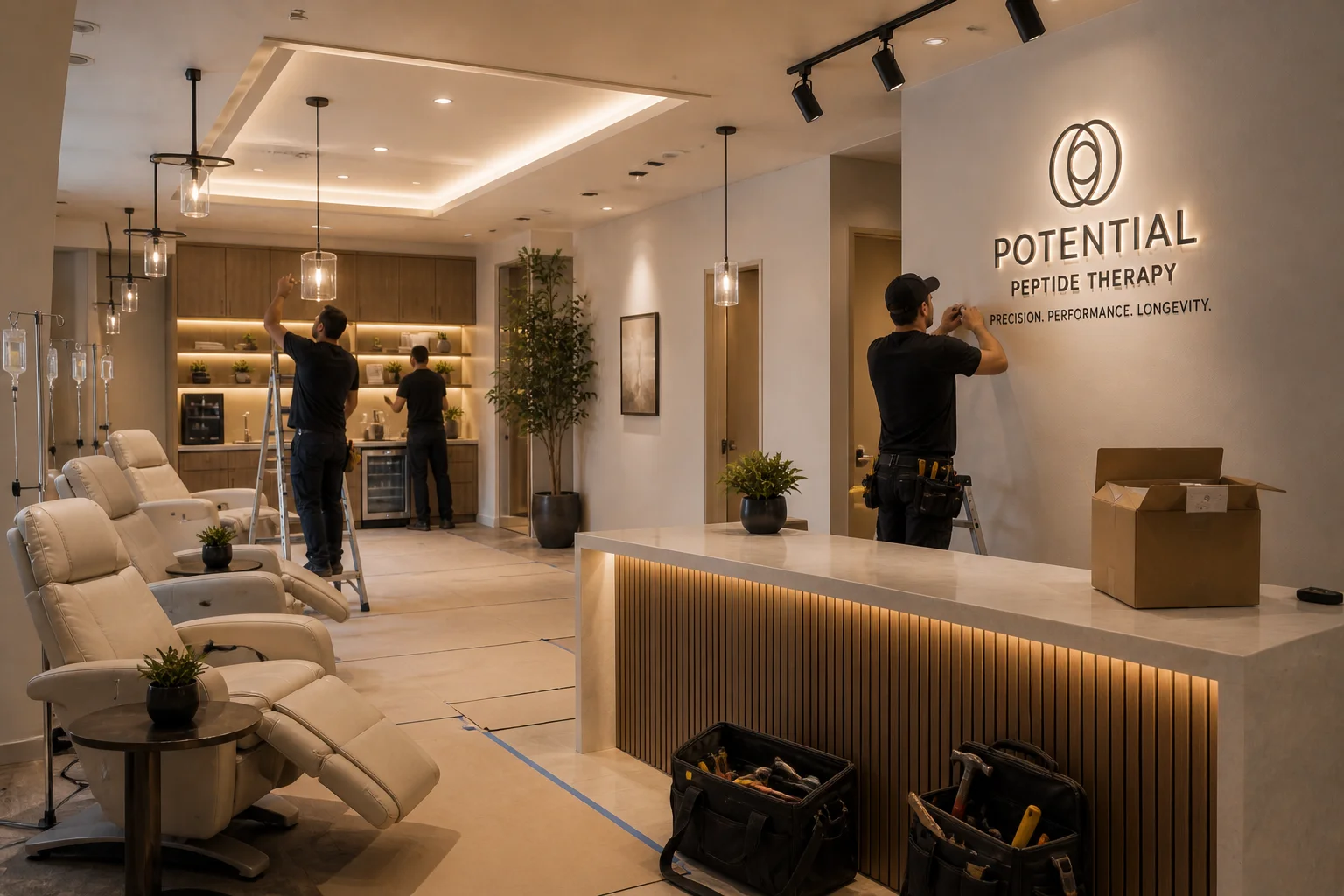
Peptide therapy clinics can operate efficiently in a relatively small footprint — typically 800 to 1,500 square feet depending on the service mix and whether IV therapy is included. First and last month rent plus a security deposit in a Class B medical or professional retail space in a mid-size U.S. market typically runs between $6,000 and $9,000 as a startup cost.
Build-Out and Launch Marketing
Build-out costs range from $10,000 to $30,000 depending on the condition of the space and the service scope. Through ACG's engagement, the website and brand identity are built as part of the consulting fee. The initial advertising budget for the launch period typically runs between $3,000 and $6,000 depending on the market.
The Full Investment Picture
A peptide therapy clinic opened through a structured consulting engagement requires a total startup investment in the range of $107,000 to $130,000 before build-out and equipment. Above this, entrepreneurs should plan a working capital reserve of three to five months of fixed operating costs — typically $10,000 to $15,000 per month. A clinic that opens with only enough capital to cover startup costs and no reserve for the ramp period is operating with zero margin for error.
To discuss your specific market, capital position, and goals, visit altosconsultinggroup.com/survey.
Building a Startup Budget That Reflects What a Peptide Clinic Actually Costs to Open — Not What You Hope It Will
The most common financial mistake in peptide clinic startups is not overspending on a single line item. It is undercounting the number of line items that belong in the budget in the first place. Most entrepreneurs who build their own startup budget from scratch miss three to five cost categories that become significant when they arrive — because they have no frame of reference for what a compliant, professionally operated peptide clinic actually requires before it sees its first patient.
Start with the compliance infrastructure. The MSO legal structure — entity formation, Management Services Agreement, informed consent frameworks for compounded peptide protocols — requires healthcare counsel, not a general business attorney. The cost difference between using healthcare-specific legal counsel and using a generalist attorney is real: healthcare counsel costs more per hour but gets the structure right the first time. A generalist who drafts an MSA without understanding how state CPOM doctrine applies to the specific service mix the clinic is offering creates a document that appears to work until it is scrutinized by a medical board or a pharmacy that asks for the agreement before establishing a prescribing relationship. Budget $4,000 to $10,000 for legal structure depending on state complexity.
Next is the compounding pharmacy account establishment process. Licensed 503A pharmacies typically require documentation packages before opening a new prescribing account — medical director license verification, DEA registration where applicable, MSA documentation, and sometimes a site visit or clinical attestation. This process takes two to four weeks in most cases and must be completed before the clinic can receive its first compound order. The timeline implication is significant: if pharmacy account establishment is not started in week one of the launch process, it becomes the bottleneck that delays opening.
Then there is equipment for the clinical environment that is easy to underestimate when it is not listed in a single equipment line item. A peptide therapy clinic offering injectable protocols needs a clinical-grade exam table or procedure chair, a sharps disposal system, appropriate refrigeration for temperature-sensitive compounds, a specimen collection area if in-office lab draws are offered, and the basic clinical supply inventory — needles, syringes, alcohol swabs, gloves, biohazard disposal — that consumes ongoing supply budget from day one. None of these are dramatic line items individually. Together, they add $3,000 to $8,000 to the startup budget that most first-pass estimates do not include.
Payment processing is another underestimated startup cost for peptide clinics specifically. Payment processors who work with health and wellness businesses have become more selective about peptide-related services following the FDA's regulatory actions in 2023 and 2024. Getting approved by a processor who understands cash-pay health clinic billing — rather than a generic small business processor who may flag peptide-related charges — takes time to research, apply for, and sometimes re-apply after an initial rejection. ACG's payment processor introductions at pre-negotiated rates eliminate this friction, but independent operators who try to solve this on their own after opening discover that payment processing issues are among the most operationally disruptive problems a new clinic can face.
Finally, there is the staff training investment that most startup budgets do not capture as a discrete line item. The nursing team must be trained on the specific peptide protocols the clinic will offer before the first patient. Clinical training for a peptide clinic covering administration methods, documentation standards, adverse event recognition, and informed consent procedures typically requires a full day of dedicated training time — which has a real cost in staff hours and preparation materials regardless of who delivers it. Budget this explicitly rather than treating it as absorbed into general staff onboarding.
The entrepreneurs who open peptide therapy clinics with the fewest financial surprises are those who built their startup budgets from a model that reflects the actual cost of compliance, clinical infrastructure, and operational readiness — not just the physical space and the consulting fee. The gap between a rough estimate and a realistic budget is where most early-stage financial stress comes from, and it is entirely preventable with the right guidance before the budget is set.
Frequently Asked Questions
What is the biggest startup cost mistake new peptide clinic owners make?
Underestimating the working capital requirement for the ramp period. Opening with startup capital covered but no working capital reserve creates cash pressure that forces premature decisions about pricing, staffing, and marketing.
Can I open a peptide therapy clinic for less than $100,000?
A minimal-footprint peptide consultation practice can be structured for lower startup costs. However, a clinic built to the service depth, compliance standards, and brand quality that produces durable patient retention typically requires the investment ranges described above. Cutting corners on legal structure or compliance documentation creates risks significantly more expensive to fix after the fact.
Are peptide therapy clinics profitable?
Yes, when correctly structured. The cash-pay model, high gross margins on compounded protocols, and recurring revenue from protocol-based patient relationships produce favorable unit economics. A clinic with 30 to 50 enrolled patients generating $600 to $1,200 per month each in recurring protocol revenue covers fixed costs comfortably. These figures are illustrative planning benchmarks — actual results depend on market conditions, patient volume, pricing, and execution.
Written by Nova, Senior Content Strategist at Altos Consulting Group.