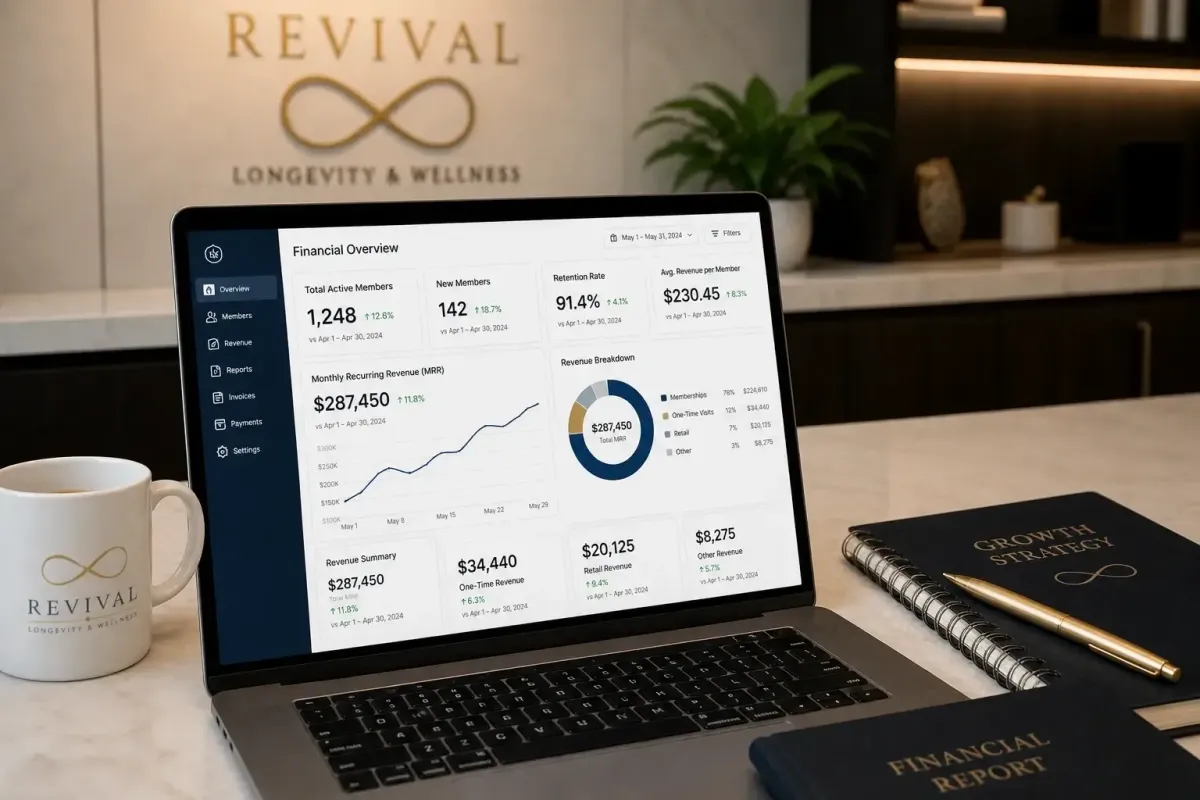
The Peptide Therapy Clinic Revenue Model: How Membership Programs and Protocol Packages Generate Recurring Income
Why the Revenue Model Is the Most Important Decision in Peptide Clinic Design
Most entrepreneurs evaluating the peptide therapy clinic space spend the majority of their due diligence on the services — which compounds to offer, what the clinical protocols look like, which patient demographics are attracted to the category. The decision that determines whether the business generates predictable, scalable income — or volatile, exhausting transactional revenue — is the revenue model.
For the full business case for the peptide therapy clinic, including market data, compliance framework, and the service categories driving the most patient demand, see The Peptide Therapy Clinic Business Model.
Altos Consulting Group helps new peptide clinic owners build the revenue model into the clinic's design before opening day. To see the peptide clinics ACG has helped launch, visit altosconsultinggroup.com/clinics-supported/peptide-therapy.
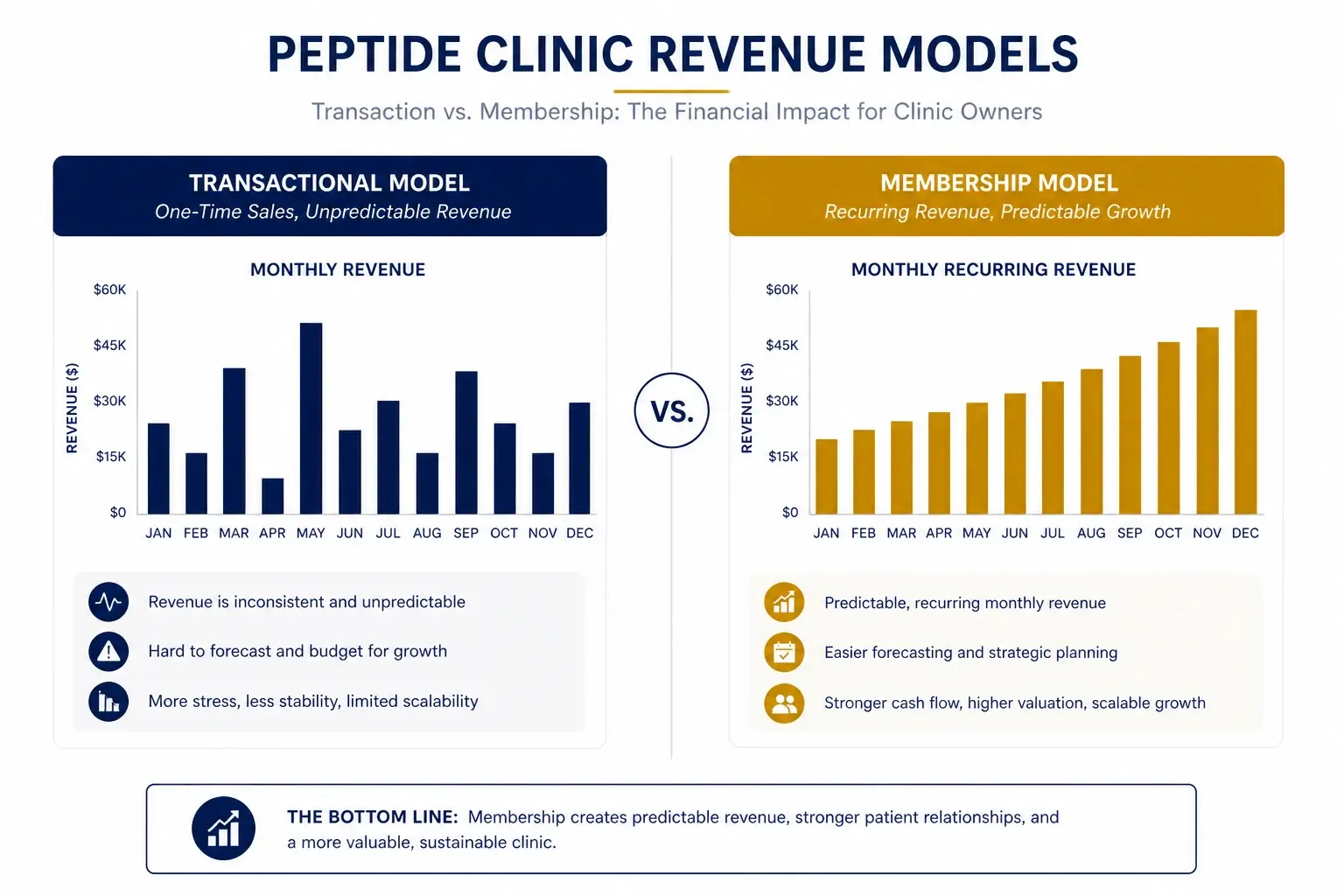
The Transactional Model vs. the Membership Model
Why the Transactional Model Underperforms
A transactional peptide clinic sells individual services at individual prices. A patient books a Sermorelin injection cycle, pays per appointment, and returns when they decide to. The revenue profile is highly variable — subject to no-shows, cancellations, seasonal slowdowns, and the inherent churn of a patient base not structurally committed to ongoing care. The transactional model also underperforms clinically: peptide protocols work best when they run consistently over defined cycles with regular biomarker monitoring.
How the Membership Model Works
A membership-based peptide clinic structures revenue around ongoing protocol enrollment rather than individual appointments. A patient joins a program that includes a defined peptide protocol cycle, monthly monitoring, quarterly assessment panels, and clinical check-ins — at a fixed monthly fee. The clinic's revenue from that patient is predictable. The clinical relationship that produces the best outcomes is structurally built into the business model.
Unit Economics
A well-structured peptide therapy membership generates between $400 and $1,000 per enrolled patient per month:
•Basic protocol membership — single compound cycle plus monthly clinical check-in: $400 to $600 per month
•Intermediate membership — stacked peptide protocol plus quarterly lab panel and clinical review: $600 to $800 per month
•Comprehensive membership — full protocol stack combined with hormone optimization or NAD+ therapy plus biomarker panel: $800 to $1,200 per month
At 30 enrolled patients at the midpoint of the intermediate range, a peptide therapy clinic generates approximately $21,000 in monthly recurring revenue. At 50 enrolled patients approximately $35,000. At 75 enrolled patients approximately $52,500. These figures are illustrative planning benchmarks — actual results depend on market conditions, pricing structure, patient volume, and execution.
The Protocol Stack That Maximizes Revenue Per Patient
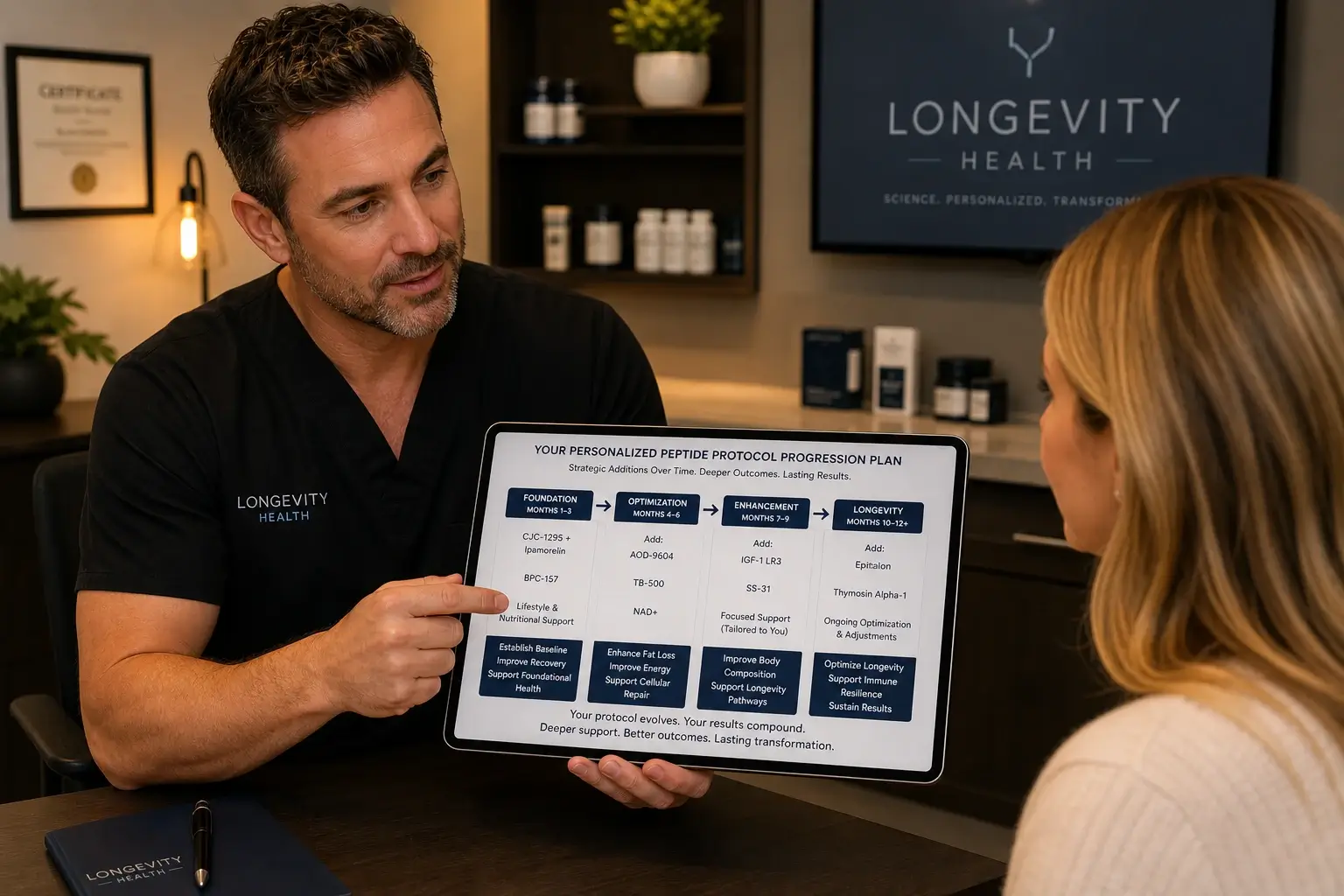
The most effective revenue structure in a peptide therapy clinic comes from creating natural protocol progression pathways that deepen the clinical relationship and expand the service mix over time. A patient who enters for a Sermorelin growth hormone secretagogue protocol is a natural candidate for a quarterly IGF-1 and hormone panel. That monitoring creates findings that open the conversation for hormone optimization. Hormone optimization creates the natural context for a NAD+ IV therapy conversation. Each service deepens the clinical relationship and creates a new recurring revenue stream — not through upselling, but through clinical coherence.
To understand how ACG structures the protocol and pricing architecture for new peptide clinics, visit altosconsultinggroup.com/survey.
The Protocol Progression That Turns a First Enrollment Into a Multi-Year Clinical Relationship
The peptide therapy clinic that structures its service menu as a set of independent products — each one priced and presented as a standalone offering — creates a transactional patient relationship that requires the patient to re-decide whether to continue at every renewal. The peptide therapy clinic that structures its service menu as a progression of clinical depth — each service tier building on the previous one in a way that is clinically coherent and commercially natural — creates a relationship where continuation feels like the obvious next step rather than a purchasing decision.
The distinction matters commercially because the second model produces dramatically better retention rates without requiring any additional marketing spend. A patient who entered on a Sermorelin protocol and progressed to a Sermorelin plus Ipamorelin/CJC-1295 combination at month four did not make a new purchasing decision. They made a clinical progression decision — one that was guided by their lab results, informed by their clinical team, and presented as the next logical step in a program they were already committed to. That patient does not evaluate whether to renew. They evaluate whether to progress further.
The protocol progression framework that produces the strongest revenue compounding in a peptide therapy clinic has three stages. The entry stage is a single-compound protocol — typically Sermorelin or BPC-157 depending on the patient's primary goal — with monthly clinical check-ins and a baseline lab panel at the start and at 90 days. This stage has a lower monthly price point and a lower commitment barrier. Its commercial purpose is to produce results that make the conversation about deepening the protocol easy at the three-month check-in.
The intermediate stage adds a second compound — the Ipamorelin/CJC-1295 combination if the patient entered on Sermorelin, or Sermorelin for tissue repair patients who entered on BPC-157 — with a quarterly comprehensive lab panel replacing the simpler baseline assessment. The monthly price increases proportionally to the expanded protocol scope. The clinical conversation that moves a patient from entry to intermediate is not a sales conversation. It is a monitoring review — the lab results at 90 days typically show enough IGF-1 response on Sermorelin to open the natural conversation about optimizing the growth hormone axis further with the Ipamorelin combination. The clinical rationale leads the recommendation.
The comprehensive stage is the full protocol stack — growth hormone secretagogues, tissue repair peptides, and an immune or longevity adjunct like Thymosin Alpha-1 — with quarterly comprehensive monitoring that covers hormonal status, inflammatory markers, metabolic function, and the specific biomarkers most relevant to the patient's protocol. The monthly price at this stage reflects the clinical depth of the program and the monitoring infrastructure required to manage it responsibly. Patients at the comprehensive stage have a clinical relationship with the practice that is materially more durable than any other patient type in the business — because the monitoring data, the clinical history, and the protocol investment create switching costs that go beyond financial considerations.
The revenue progression across these three stages is significant. A patient who entered at $500 per month and progressed to the comprehensive stage at $950 per month has nearly doubled their monthly revenue contribution without requiring any new patient acquisition spend and without any sales pressure that could damage the clinical relationship. Across a patient base of 50 enrolled patients with a realistic distribution across the three stages, the average monthly revenue per patient should be between $650 and $800 — producing between $32,500 and $40,000 in monthly recurring revenue from a patient base that is not leaving. These are illustrative planning benchmarks — actual results depend on market conditions, pricing structure, patient volume, and execution.
Frequently Asked Questions
How many patients does a peptide clinic need to be profitable?
At a membership price point of $600 to $800 per enrolled patient per month, a peptide clinic with 20 to 25 enrolled patients generates enough recurring revenue to cover fixed monthly operating costs of $10,000 to $15,000 and begin generating owner income. These are illustrative benchmarks based on the revenue structures described above.
Should a new peptide clinic start with memberships or transactional services?
Start with memberships. Structuring the revenue model as a membership-based practice from day one is significantly easier than converting a transactional patient base to membership pricing after the fact. Patients who join as membership patients expect an ongoing clinical relationship — and that expectation produces better retention outcomes than transactional patients who later encounter a pricing model shift.
What peptide protocols generate the strongest patient retention?
Protocols that produce measurable, trackable results supported by biomarker monitoring generate the strongest retention. Sermorelin and Ipamorelin protocols for growth hormone optimization, paired with IGF-1 monitoring, consistently produce results patients can see in body composition, sleep quality, and recovery — which makes continuation feel obvious rather than optional.
Written by Nova, Senior Content Strategist at Altos Consulting Group.