How to Source Peptides for Your Clinic: What Entrepreneurs Need to Know About Supplier Access, Compounding Pharmacies, and Pricing
The Supply Chain Decision That Determines Your Margins
An entrepreneur opening a peptide therapy clinic in 2026 will spend significant time making decisions about services, location, staffing, and patient experience. The decision that most directly determines whether the clinic's gross margins support a profitable business from the first month of operation is one that many operators underestimate until after they have made it: where and how they source their compounds.
For a complete overview of the peptide therapy clinic business model — market data, compliance framework, and financial structure — see The Peptide Therapy Clinic Business Model (altosconsultinggroup.com/post/peptide-therapy-clinic-business-2026).
To see the peptide clinics ACG has launched with this supply chain infrastructure in place, visit altosconsultinggroup.com/clinics-supported/peptide-therapy.
The Only Legal Sourcing Framework: 503A and 503B Compounding Pharmacies
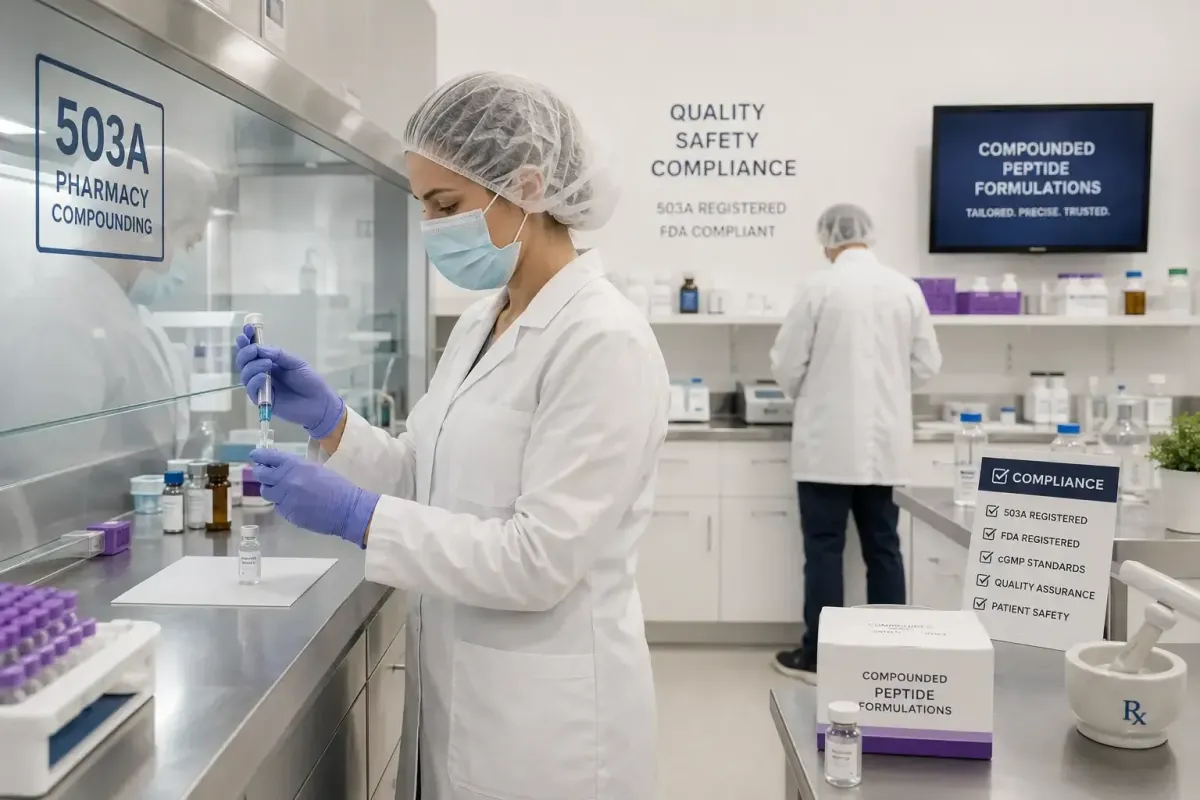
Every peptide compound offered to patients must be sourced through a licensed compounding pharmacy operating under Section 503A or 503B of the Federal Food, Drug, and Cosmetic Act. This is the legal baseline — not a recommendation.
503A Compounding Pharmacies
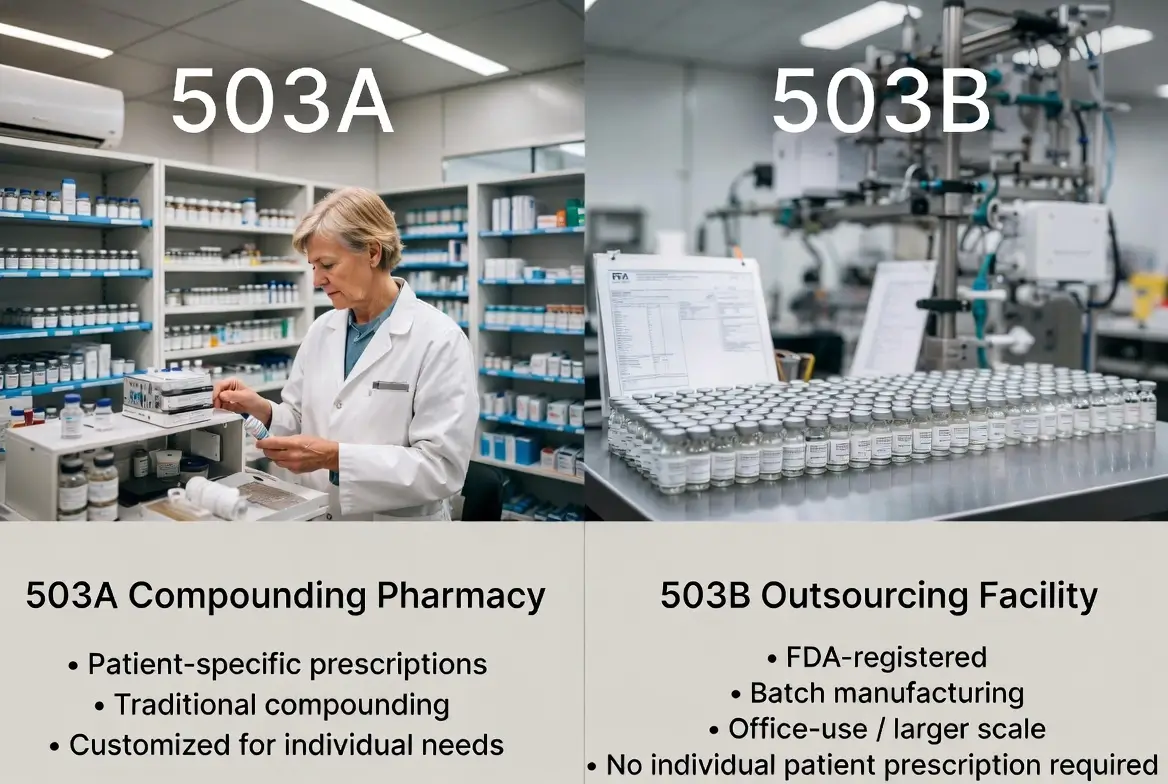
A 503A compounding pharmacy compounds medications for specific patients upon receipt of a valid prescription from a licensed practitioner. The compounded product is patient-specific. 503A pharmacies are regulated by state pharmacy boards and must comply with USP standards. For a peptide therapy clinic, 503A pharmacy relationships provide the prescription-by-prescription sourcing pathway for patient-specific compounds.
503B Outsourcing Facilities
A 503B outsourcing facility can compound in larger batches without patient-specific prescriptions and is regulated by the FDA rather than state pharmacy boards. 503B facilities must comply with Current Good Manufacturing Practices. For a clinic offering compounds to multiple patients, 503B relationships can provide greater supply consistency and quality assurance than 503A pharmacy sourcing at higher minimum order volumes.
Why Gray-Market Sourcing Is Not an Option
The gray market for research peptides — vendors selling compounds labeled for research use only — is not a legal sourcing option for a peptide therapy clinic offering compounds to patients for human use. The FDA has actively targeted gray-market peptide vendors, and clinics sourcing through these channels expose themselves, their medical directors, and their patients to significant legal and safety risk.
What Drives Pricing Variation in Compounding Pharmacy Sourcing
•Volume commitment — pharmacies offer lower per-unit pricing to clinics that can commit to minimum order volumes
•Relationship tenure — established relationships with consistent order histories produce better pricing than new accounts
•Compound category — Category 1 compounds available through multiple pharmacies are more competitively priced
•Payment terms — clinics paying within short invoice windows often access better pricing
An independent operator opening their first peptide clinic has none of these advantages on day one. They pay new-client rates — which are almost never the rates offered to established, high-volume clinic partners.
How ACG's Supplier Access Changes the Economics
Altos Consulting Group has established supplier relationships with vetted compounding pharmacies that provide ACG clinic clients access to pre-negotiated pricing — pricing that reflects the volume and tenure of ACG's combined client base rather than the volume of any individual new clinic. A new clinic opening through ACG on day one has access to compound pricing that an independent operator would typically take twelve to eighteen months of established volume to reach.
The commercial impact compounds across the life of the clinic. Better compound pricing means higher gross margins at the same patient volume, which means the clinic reaches profitability faster and has more capital available for growth.
To learn more about the full ACG launch engagement and the supplier access it provides, visit altosconsultinggroup.com/new-clinic-launch. To start the conversation, visit altosconsultinggroup.com/survey.

What the Pricing Differential Actually Means for Your Clinic's Financial Model
The abstract argument that better supplier pricing improves clinic economics is easy to agree with and easy to underweight when building a startup budget. The concrete version of the argument is more persuasive: the difference between what a new independent clinic pays for compounded peptides through a standard new-account relationship versus what a clinic with established, pre-negotiated supplier access pays for the same compounds can mean the difference between a business that breaks even at 30 patients and one that breaks even at 50 — and that 20-patient gap represents six to nine months of additional financial runway consumed before the business reaches profitability.
Here is a concrete illustration. A Sermorelin/CJC-1295/Ipamorelin combination protocol dispensed monthly at retail compounding pharmacy pricing might cost the clinic $95 to $115 per patient per month in compound cost. The same protocol through a pre-negotiated supplier relationship might cost $72 to $85 per patient per month. At 40 enrolled patients, that difference is between $920 and $1,200 per month in additional gross margin — every month, without doing anything differently clinically or operationally. Over twelve months, that is $11,000 to $14,400 in additional margin that either flows to the owner or gets reinvested in marketing, staff, or the next service expansion. This is not a trivial difference and it compounds as patient volume grows.
The compound pricing differential also affects the consultation conversation. A clinic that is paying high retail pricing for compounds is under pressure to price its protocols at a level that preserves acceptable margins — which may mean pricing at the top of the market or compromising on margin at the bottom. A clinic with pre-negotiated compound pricing has more flexibility to price competitively within the market while maintaining the margins that make the business financially healthy. In competitive markets where multiple providers are operating, pricing flexibility is a meaningful commercial advantage.
Beyond pricing, the quality and reliability of the compounding pharmacy relationship affects clinic operations in ways that show up in patient outcomes and patient satisfaction. A pharmacy that delivers compounds with consistent potency, reliable batch testing documentation, and predictable turnaround times enables the clinic to make clinical commitments to patients that it can consistently keep. A pharmacy with quality inconsistencies or delivery delays creates the worst kind of operational problem: one that affects patient care directly, damages the clinical relationship that is the foundation of the business, and is invisible until it has already created a problem.
The supplier relationship is therefore both a financial decision and a clinical decision — which is why it belongs in the same category as the medical director relationship and the legal structure in terms of how much due diligence it deserves before the clinic commits to a primary pharmacy partner. ACG's supplier introductions are vetted for both dimensions: the pricing reflects the combined volume leverage of the ACG client base, and the quality has been validated across multiple clinic engagements before an introduction is made. A new clinic owner accessing these introductions does not need to spend the first three to six months of operation discovering through experience which pharmacies are reliable and which are not.
Frequently Asked Questions
Can a new peptide clinic owner negotiate directly with compounding pharmacies?
Yes, but with limited leverage. New accounts without established volume history or relationship tenure will be quoted standard new-client rates. The ceiling on what an independent new clinic can achieve is significantly lower than what is available through an established consulting partner with existing pharmacy relationships and combined client volume.
How do I verify that a compounding pharmacy is legitimate?
NABP accreditation is the primary quality signal for compounding pharmacy legitimacy. A pharmacy operating under 503B outsourcing facility registration is subject to FDA oversight and cGMP requirements. Any pharmacy ACG introduces to a new clinic owner has been vetted for accreditation status, state licensing in good standing, and a history of compliant operation.
What happens to clinic sourcing when the FDA reclassification is finalized?
The formal reinstatement of Category 2 compounds to Category 1 expands the formulary that licensed 503A compounding pharmacies can legally prepare. Clinics already operating with established pharmacy relationships simply add the reinstated compounds to their prescription protocol as access restores — no restructuring of the supply chain required.
Written by Nova, Senior Content Strategist at Altos Consulting Group.