
The Men's Health and TRT Clinic Business Opportunity: Why 246,000 Monthly Searches Are Looking for a Local Provider That Isn't There
The Largest Search Category in Men's Health — Still Underserved in Most Markets
Testosterone replacement therapy generates over 246,000 U.S. searches per month. It is the single highest-volume search category in men's health — more than any other individual men's health treatment. And in most U.S. markets outside major coastal metros, the nearest in-person TRT provider is either a urologist who does not specialize in optimization medicine or a telehealth company offering prescriptions with no in-person relationship.
The telehealth TRT market grew rapidly between 2020 and 2024 because it solved an access problem: men who wanted TRT could not find a local provider who would give it to them without extensive conventional medicine gatekeeping. Telehealth removed that barrier. But it introduced new ones — no in-person lab draws, no consistent provider relationship, no physical community presence, and a patient experience that feels transactional rather than clinical.
The entrepreneur who opens a well-positioned, professionally operated men's health TRT clinic in an underserved market is not competing with other TRT clinics. They are capturing the patient population that telehealth cannot adequately serve — and that patient population, once enrolled in a properly managed TRT protocol, stays enrolled for years.
Altos Consulting Group has helped launch men's health and TRT clinics across 46 states. To see the clinics ACG has supported, visit altosconsultinggroup.com/clinics-supported/mens-health-trt.
Why TRT Patients Generate the Highest Lifetime Value in Men's Cash-Pay Health
A TRT patient who achieves clinical results stays enrolled. The mechanism is simple: testosterone replacement therapy requires ongoing prescription management and monitoring to remain safe and effective. Quarterly lab panels — comprehensive hormone panel, CBC, PSA, metabolic panel — are not optional clinical additions. They are required for responsible TRT management and represent recurring revenue that is built into the clinical necessity of the program.
A TRT patient enrolled at $200 per month for protocol management plus $300 per quarter for lab monitoring generates approximately $3,600 in annual recurring revenue. A clinic with 75 enrolled TRT patients at these rates generates approximately $270,000 per year in recurring revenue before additional service revenue. At 150 enrolled patients it generates approximately $540,000. These figures are illustrative planning benchmarks — actual results depend on market conditions, patient volume, and pricing structure.
The TRT patient also tends to be the highest-referring demographic in men's health. Men who experience significant improvements in energy, body composition, sexual function, and cognitive performance from TRT tell their friends — in the gym, at the office, in the social circles where the men who match the TRT patient demographic spend time. A well-run TRT clinic with high patient satisfaction has a self-sustaining referral engine that compounds patient acquisition over time.
The Service Stack: What a Men's Health TRT Clinic Offers
Testosterone Replacement Therapy — The Core Protocol
Injectable testosterone cypionate or enanthate is the most common TRT delivery method and the one that produces the most consistent clinical results for most patients. Pellet therapy offers a longer-duration alternative with a different patient experience. Topical gels and creams provide an option for patients who prefer needle-free administration. The protocol stack — which delivery methods to offer, at what starting doses, with what monitoring schedule — is designed by the medical director based on the clinic's patient population and clinical philosophy.
Lab Panel Monitoring
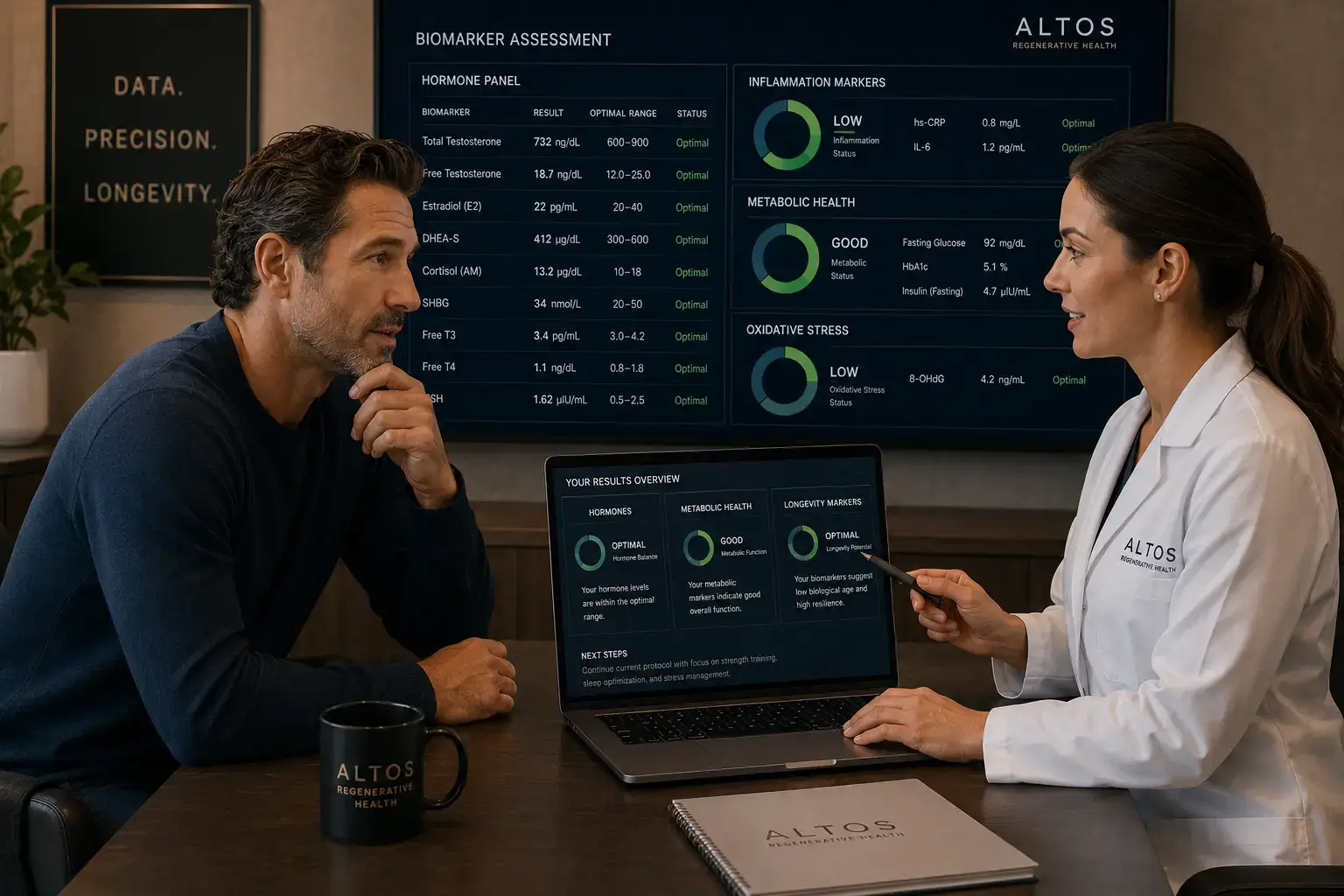
Baseline labs before the first prescription, then quarterly monitoring panels through the protocol — this is not optional. Testosterone monitoring requires tracking of total testosterone, free testosterone, estradiol, PSA (for men over 40), hematocrit, and a basic metabolic panel at minimum. More comprehensive panels add thyroid function, cortisol, and DHEA. Each monitoring event generates lab revenue and creates the clinical touchpoint that keeps the patient engaged and the protocol adjusted for optimal results.
Peptide Add-Ons for TRT Patients
The TRT patient is an ideal candidate for growth hormone secretagogue protocols — Sermorelin and the Ipamorelin/CJC-1295 combination — which address the growth hormone decline that occurs alongside testosterone decline in aging men. Adding peptide therapy to a TRT patient's protocol increases monthly revenue per patient, deepens the clinical relationship, and produces better overall clinical outcomes as the hormonal and growth hormone axes are optimized together rather than independently.
Sexual Wellness Integration
ED, low libido, and sexual performance concerns are among the most common reasons men begin researching TRT — even if testosterone optimization alone does not fully address all of these concerns. Shockwave therapy for ED, PT-141 peptide protocols for libido, and PRP for penile rehabilitation represent a natural service expansion from the TRT patient base that adds significant average revenue per patient without requiring a separate marketing campaign.
The Compliance Picture: TRT Is Schedule III
Testosterone is a Schedule III controlled substance under the Controlled Substances Act. This has specific operational implications that every TRT clinic owner must understand before the first prescription is written. DEA registration is required for the clinic to dispense or administer testosterone. Record-keeping requirements for Schedule III substances are specific and enforced. Medical director prescribing authority must be structured correctly for the specific state.
Compounding pharmacy relationships for testosterone require 503A pharmacy sourcing — compounded testosterone must be prescribed patient-specifically by a licensed practitioner and sourced through a licensed 503A compounding pharmacy. The pharmacy sourcing requirements for injectable testosterone, pellets, and topical formulations differ and must all be established correctly before the clinic begins seeing patients.
ACG has navigated TRT compliance requirements across all 46 states where it operates. The DEA registration sequence, prescribing structure, compounding pharmacy vetting, and record-keeping framework are all addressed in the standard ACG launch engagement for men's health TRT clinics.
Marketing a TRT Clinic: What Works and What Gets Accounts Shut Down
TRT clinic advertising on Meta and Google has specific compliance requirements that differ from general health advertising. Testosterone-related terms trigger healthcare category restrictions on both platforms. Ads that make specific efficacy claims about testosterone replacement — or that use imagery or language that implies guaranteed outcomes — face disapproval or account suspension.
The creative approach that consistently produces compliant, cost-effective consultation bookings for TRT clinics: patient stories about energy, recovery, and performance framed as individual experiences rather than clinical efficacy claims. The men who are searching for TRT already know what they are looking for — the marketing job is to demonstrate that your clinic is credible, your team understands the specific patient experience, and your protocol approach is clinically serious rather than a subscription peptide gimmick.
What ACG Provides
ACG's launch engagement for a men's health TRT clinic covers market validation for the TRT patient demographic, entity structure and DEA registration sequence, medical director introduction to a vetted practitioner with TRT clinic experience, compounding pharmacy supplier access at pre-negotiated pricing, clinical protocol setup including lab panel structure and monitoring schedules, brand and website development, compliance-structured marketing campaigns, and 60 days of post-launch advisory support.
To start the conversation about the TRT clinic opportunity in your specific market, visit altosconsultinggroup.com/survey.
The Patient Who Is Already on TRT and Looking for a Better Provider
One of the most underestimated patient acquisition opportunities for a new TRT clinic is not the patient who has never tried testosterone replacement therapy. It is the patient who is already on it — through a telehealth provider, through a primary care doctor who prescribes it reluctantly, or through a gym contact whose sourcing and clinical oversight situation is legally and medically problematic — and who is dissatisfied with the level of care they are receiving.
This patient exists in significant numbers in most U.S. markets. The telehealth TRT boom of 2021 through 2024 enrolled millions of men in programs that prioritized access and price over clinical depth. Many of those men are now twelve to eighteen months into a protocol and experiencing one of several common dissatisfactions: their labs show suboptimal estradiol management, their hematocrit has crept upward without meaningful clinical response, their provider changes at every check-in because the platform rotates coverage, or they simply want to have a relationship with a clinician who actually knows their case. These patients are not in the awareness phase of the buying journey. They are in the evaluation phase — actively looking for a local provider who can do what their current situation is not doing for them.
Marketing to this patient requires different creative than marketing to the TRT-naive prospect. The TRT-naive prospect needs to understand what testosterone optimization is and why it addresses the symptoms he is experiencing. The dissatisfied current patient needs to understand specifically what makes your clinic's clinical approach different from what he already has — the in-office lab draws, the consistent provider relationship, the estradiol and hematocrit management protocols, the quarterly comprehensive panel rather than a stripped-down TSH and total testosterone check. The specificity of this message is what converts him. Generic TRT clinic advertising does not move a patient who is already on a protocol. Clinical specificity does.
The competitive patient acquisition channel for this demographic is local SEO targeting the specific search terms dissatisfied TRT patients use — searches like "TRT clinic near me," "testosterone clinic with lab monitoring," and "better TRT provider" — combined with content that specifically addresses the clinical gaps in telehealth TRT management. A blog post titled "Why Your At-Home Testosterone Test Is Not Telling You the Full Picture" speaks directly to this patient and positions the clinic as the more clinically serious alternative before he has ever walked through the door. This is the content strategy that converts existing TRT patients into clinic patients — and those patients arrive pre-educated, pre-motivated, and significantly easier to enroll than a cold prospect who is still in the early stages of research.
Building the Physician Referral Network That Produces the Highest-Quality Patients
The highest-converting patient source for a men's health TRT clinic is not paid advertising. It is physician referrals — specifically, referrals from primary care physicians, urologists, and endocrinologists who encounter men with low testosterone regularly but either do not offer TRT themselves or do not have the clinical infrastructure to manage it optimally. Building this referral network deliberately and systematically is the most commercially durable patient acquisition investment a TRT clinic can make.
The primary care physician who identifies a patient with a total testosterone of 320 ng/dL, symptomatic fatigue, and declining libido has three options: prescribe TRT themselves with limited monitoring infrastructure, refer to a urologist with a six-week waiting list, or refer to a dedicated TRT clinic that the physician trusts to manage the patient well and communicate back to them about the clinical outcomes. For the primary care physician who is comfortable with the third option, the TRT clinic becomes a trusted extension of their own patient care — and that relationship produces a consistent, predictable referral stream that compounds over time without advertising cost.
Establishing physician referral relationships requires a specific outreach approach that is different from patient-facing marketing. The message to a primary care physician is not about the clinic's marketing or its membership pricing. It is about the clinical protocols the clinic uses, the monitoring standards the medical director has established, and the communication the clinic provides back to referring physicians when a shared patient's labs show meaningful changes. A one-page clinical overview of the clinic's TRT monitoring protocol — the specific lab panels, the monitoring intervals, the estradiol management approach, and the hematocrit threshold at which the clinic adjusts protocol or refers back — is more persuasive to a primary care physician than any patient-facing marketing material. It demonstrates clinical seriousness in the language primary care physicians use to evaluate whether a specialist or clinic is worth trusting with their patients.
The outreach process itself is straightforward: identify the primary care practices, urology practices, and men's health-adjacent practitioners within a ten-mile radius of the clinic, develop a brief clinical overview document and a simple referral process, and make direct outreach to introduce the clinic and its medical director. A personal introduction from the medical director — physician to physician — carries significantly more weight than a marketing email from the clinic's business development contact. In markets where the medical director has existing professional relationships with local practitioners, these introductions can produce referral relationships within weeks of the clinic opening. In markets where those relationships do not exist yet, building them takes three to six months of consistent outreach — but the referral relationships that result are significantly more durable than any paid advertising channel and do not require ongoing spend to maintain.
Frequently Asked Questions
How profitable is a TRT clinic?
At 75 enrolled TRT patients generating approximately $3,600 each in annual recurring revenue, a TRT clinic generates approximately $270,000 per year in recurring membership and monitoring revenue. At 150 enrolled patients approximately $540,000. These are illustrative benchmarks — actual results depend on market conditions, patient volume, pricing, and execution.
Do I need a medical background to open a TRT clinic?
No. Non-physician ownership is structured through the MSO model. The entrepreneur owns and manages the business. A licensed medical director provides the DEA registration basis, prescribing authority, and clinical oversight for the protocols. ACG facilitates medical director introductions across 46 states.
How is a TRT clinic different from a general hormone clinic?
A TRT-focused clinic positions specifically to the male patient demographic with service, imagery, language, and clinical protocols designed for men's testosterone optimization. A general hormone optimization clinic may serve both men and women under one brand. The choice between specialized positioning and combined practice depends on market demographics and the entrepreneur's preference.
Written by Nova, Senior Content Strategist at Altos Consulting Group.