Longevity Clinic vs. Med Spa: Why the Business Models Are Completely Different and Which One Wins in 2026
The Comparison Every Entrepreneur in the Cash-Pay Health Space Eventually Makes
Entrepreneurs evaluating cash-pay health clinic opportunities in 2026 frequently encounter both med spas and longevity clinics as potential business models. At first glance they appear to be in the same category — premium, cash-pay, health-adjacent, serving a similar demographic. Look more closely at the business models and the distinction becomes significant.
For a full analysis of the longevity clinic business opportunity — market size, service stack, financial model, and why 2026 is the right moment to enter — see The Longevity Clinic Business Opportunity (altosconsultinggroup.com/post/longevity-clinic-business-opportunity-2026).
Altos Consulting Group works exclusively with entrepreneurs opening Regenerative Health Clinics, including longevity medicine practices. To see the longevity clinics ACG has helped launch, visit altosconsultinggroup.com/clinics-supported/longevity.
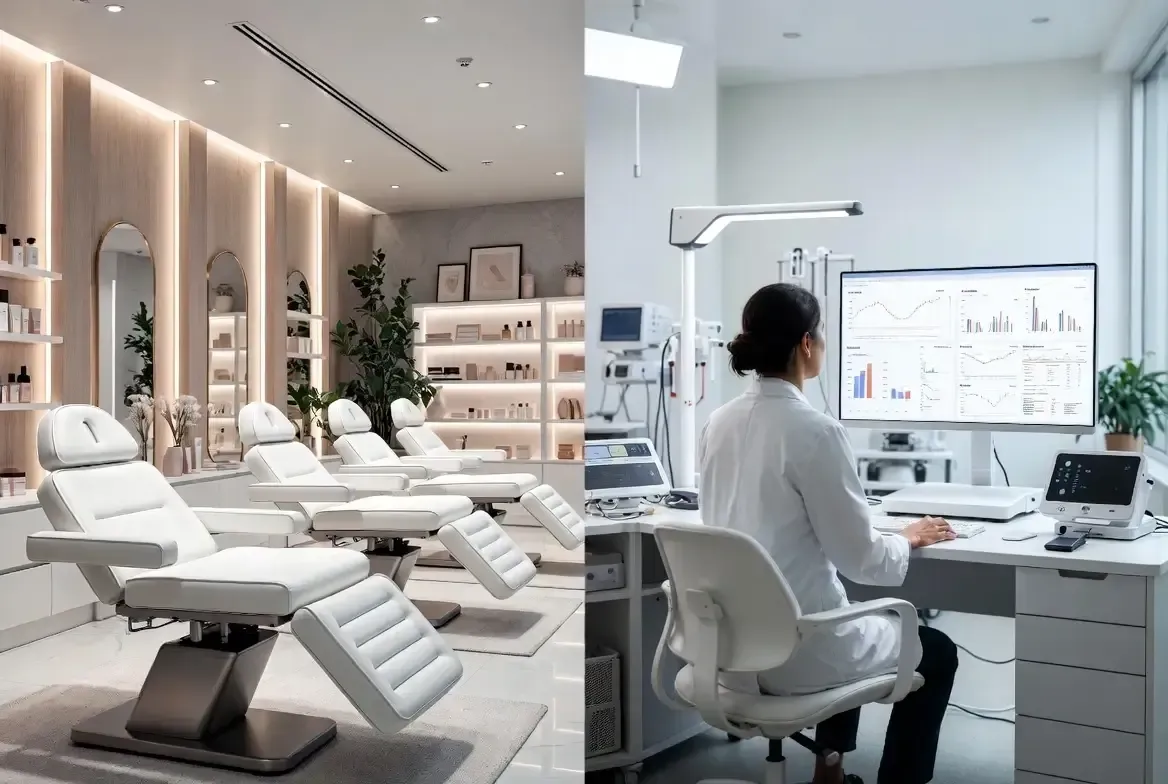
The Patient Profile: Who Walks Through the Door
The Med Spa Patient
The core med spa patient is motivated primarily by aesthetics — appearance enhancement, skin quality, body contouring, anti-aging treatments in the cosmetic sense. They are typically price-sensitive in ways the longevity patient is not — they compare prices between providers, respond to promotions, and are willing to travel for better pricing on the same service. The lifetime value of a med spa patient is meaningful but subject to significant churn when a competitor opens nearby.
The Longevity Clinic Patient
The core longevity clinic patient is motivated by biological performance — energy, cognitive function, hormonal health, metabolic optimization, and the measurable extension of their healthspan. They are outcome-oriented rather than appearance-oriented, data-driven rather than trend-following, and significantly less price-sensitive in the health category. The lifetime value of a well-enrolled longevity clinic patient in a properly structured membership program is substantially higher than the typical med spa patient and significantly more durable across economic cycles.
The Service Model: Transactions vs. Ongoing Relationships
The Med Spa Service Model
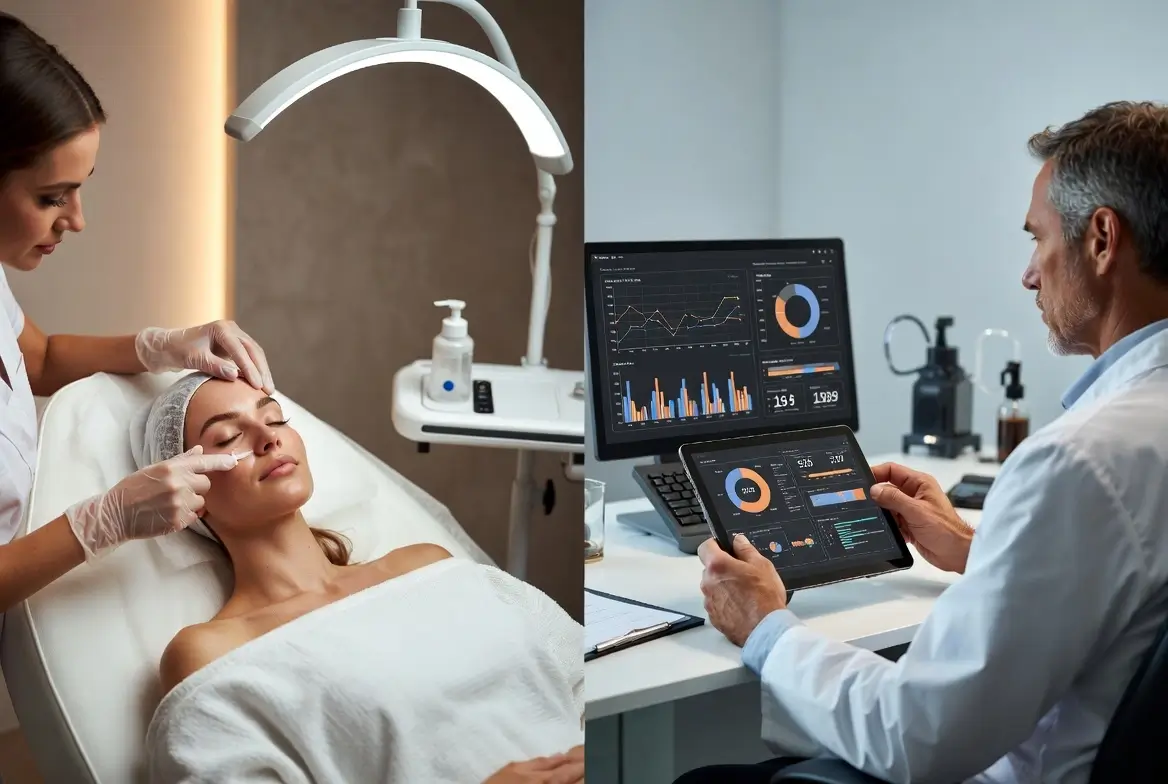
Most med spa services are transactional. A patient books a Botox appointment, receives the treatment, and returns when the effect wears off — typically three to four months later. The revenue structure is appointment-by-appointment, and the clinic's financial health is directly tied to its ability to fill treatment chairs consistently. The U.S. medical spa market reached approximately $11 to $13 billion in 2026 — large enough to indicate strong consumer demand, but also crowded enough in most markets to make patient acquisition expensive and margin compression a persistent operational challenge.
The Longevity Clinic Service Model
Longevity clinic services are built around ongoing clinical relationships — protocol-based programs that run for months, require regular monitoring, and produce results that accumulate over time. A hormone optimization patient is not returning in three months because the previous treatment wore off. They are returning because they are enrolled in an ongoing program that requires quarterly lab monitoring and protocol adjustment. This produces a recurring revenue model that the transactional med spa cannot replicate.
The Competitive Landscape: Saturation vs. Opportunity
The Med Spa Market
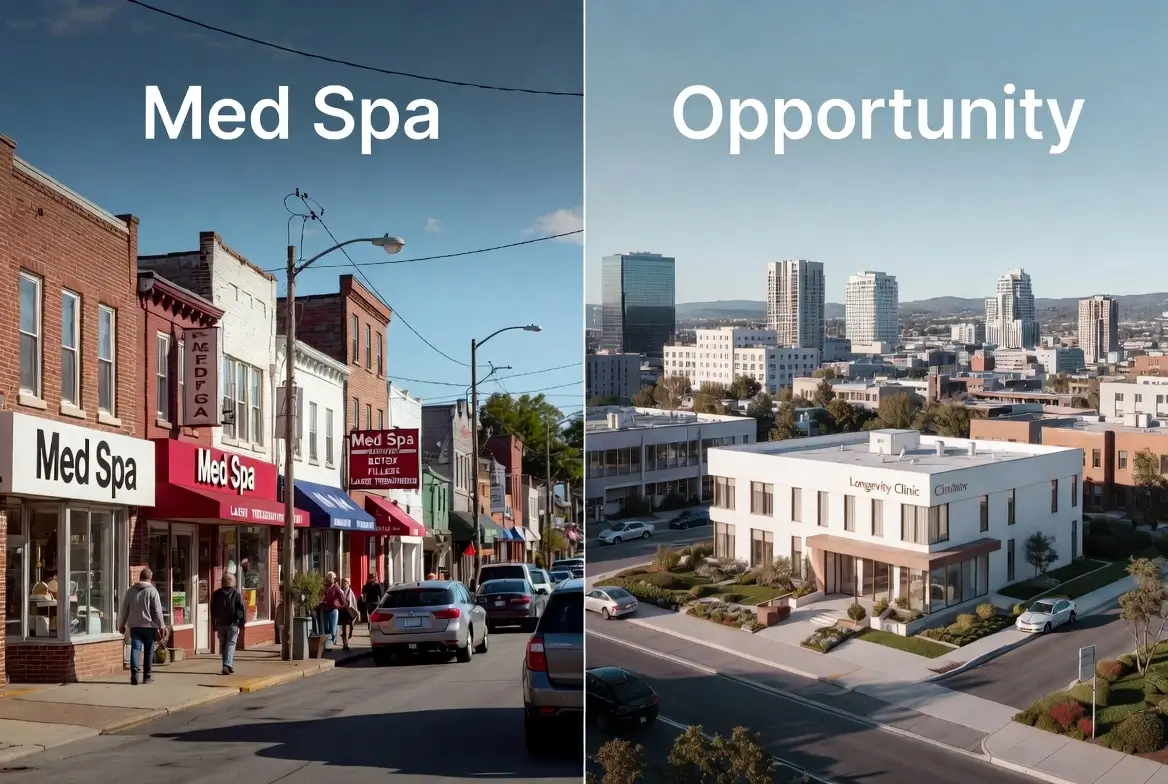
The U.S. medical spa market is large and growing — but meaningfully saturated in most mid-size and major markets. New entrants compete directly with established operators for the same patient demographic, using many of the same services. The competitive dynamic produces pricing pressure and margin compression that make it progressively harder for new operators to build durable profitability.
The Longevity Clinic Market
The longevity clinic market has consumer demand that significantly exceeds current supply in most U.S. markets outside of major coastal metros. Entrepreneurs entering a mid-size or secondary market with a properly positioned longevity clinic in 2026 are establishing the market-leading position in a category that does not yet have one — not competing for incremental share in a crowded field.
The Financial Profile Over Five Years
Over a five-year operating horizon, the financial profiles diverge significantly. A med spa generates strong revenue in its opening months as it leverages novelty, then faces the ongoing challenge of patient retention in a category where loyalty is limited and competition is constant.
A longevity clinic generates more modest revenue in its opening months as it builds enrolled patient base, then enters a compounding growth phase as membership enrollment accumulates, patient lifetime value extends, and referrals from enrolled patients bring new members in without significant acquisition cost. By year three, a well-run longevity clinic with a stable membership base generates revenue that is significantly more predictable and less dependent on new patient acquisition.
To discuss how this analysis applies to your specific market and goals, visit altosconsultinggroup.com/survey.
The Positioning Decision That Determines Which Patients You Attract and How Long They Stay
The longevity clinic versus med spa comparison is ultimately a positioning decision as much as a business model decision — and the positioning decision has consequences for every downstream operational choice the clinic owner makes. A clinic that positions as a longevity medicine practice attracts patients who are motivated by biological outcomes and willing to invest in ongoing monitoring. A clinic that positions as a premium med spa attracts patients motivated by appearance and willing to pay for treatments that produce visible results. These two patient populations overlap at the margins but they are not the same, and trying to serve both with the same brand positioning typically means serving neither as well as a focused competitor does.
The longevity clinic positioning statement is fundamentally clinical: this practice optimizes your biological function, measures the results through biomarkers, and manages your protocol over time to produce the best outcomes your specific biology is capable of. The med spa positioning statement is fundamentally experiential: this practice delivers premium aesthetic treatments in an environment that makes you feel pampered and cared for. The former builds a clinical authority relationship. The latter builds a service experience relationship. Both are valuable — but they attract different patients, convert through different consultation frameworks, and retain through different clinical and operational mechanisms.
The reason the longevity clinic wins on long-term financial durability is not that it is inherently a better business than a med spa. It is that the clinical nature of the longevity relationship creates retention mechanisms that an aesthetic-only relationship cannot replicate. A Botox patient can easily switch providers if a competitor opens nearby with better pricing or a promotional offer. A patient enrolled in a hormone optimization program with six months of monitoring data, an established relationship with the medical director, and a comprehensive biomarker history is not switching providers over a $50 price difference. The clinical investment in the relationship creates switching costs that go far beyond financial considerations — and those switching costs are what produce the patient lifetime value that makes the longevity clinic financially superior over a five-year horizon.
There is a third path that is worth examining: the clinical aesthetic longevity practice that integrates conventional aesthetic services with regenerative and longevity medicine under a positioning that is explicitly biologically oriented rather than cosmetically oriented. A practice that offers Botox alongside NAD+ IV therapy, PRP facials alongside hormone optimization, and laser treatments alongside biomarker-guided skin aging assessment is not splitting the difference between a med spa and a longevity clinic. It is creating a category — the clinic for patients who care about both how they look and the underlying biological health that determines how they age — that very few competitors have established in most markets.
The patient who chooses this kind of practice is the most commercially valuable patient in cash-pay health: willing to invest in both the aesthetic and the clinical dimensions of their care, highly motivated by measurable outcomes in both categories, and significantly less price-sensitive than either the pure aesthetics patient or the pure longevity patient because the breadth and depth of the clinical relationship creates a value that no single-category competitor can match. The positioning challenge is communicating this clearly enough that the patient who is looking for exactly this kind of practice finds it — which is a marketing and messaging decision that requires more precision than either the standard med spa positioning or the standard longevity clinic positioning alone.
The business model decision and the positioning decision are the same decision. Make it deliberately, with a clear understanding of who the patient is that the practice is designed to serve, what they are looking for, and what clinical and operational infrastructure is required to serve them at the standard that produces retention, referrals, and the compounding revenue that makes the business financially durable over time.
Frequently Asked Questions
Can a longevity clinic offer aesthetic services like a med spa?
Yes, and many do. Aesthetic longevity services — PRP for hair restoration, GHK-Cu peptides for skin health, body composition management — fit naturally within the longevity clinic positioning when framed around biological health rather than cosmetic enhancement. The distinction is positioning, not services. A longevity clinic offering these treatments within a longevity medicine framework attracts a different patient than a med spa offering them within a cosmetic enhancement framework.
Is a med spa easier to open than a longevity clinic?
In some respects, yes — the service scope is often narrower and the regulatory requirements less complex. However, ease of entry also means ease of competition. The same factors that make a med spa easier to open make it easier for a competitor to open next door with the same services and competitive pricing. The higher barrier to entry of the longevity clinic keeps the competitive landscape significantly less crowded.
Why are longevity clinics less saturated than med spas?
Longevity clinics require a more sophisticated compliance framework, a medical director relationship, and a clinical protocol infrastructure that the average wellness entrepreneur does not know how to build independently. These structural requirements create a higher barrier to entry that filters out less committed operators — and in doing so, keeps the competitive landscape significantly less crowded than the med spa market.
Written by Nova, Senior Content Strategist at Altos Consulting Group.