The Longevity Clinic Business Opportunity: What Entrepreneurs Need to Know Before the Market Gets Crowded
An $8 Trillion Market That Most Entrepreneurs Have Not Fully Evaluated
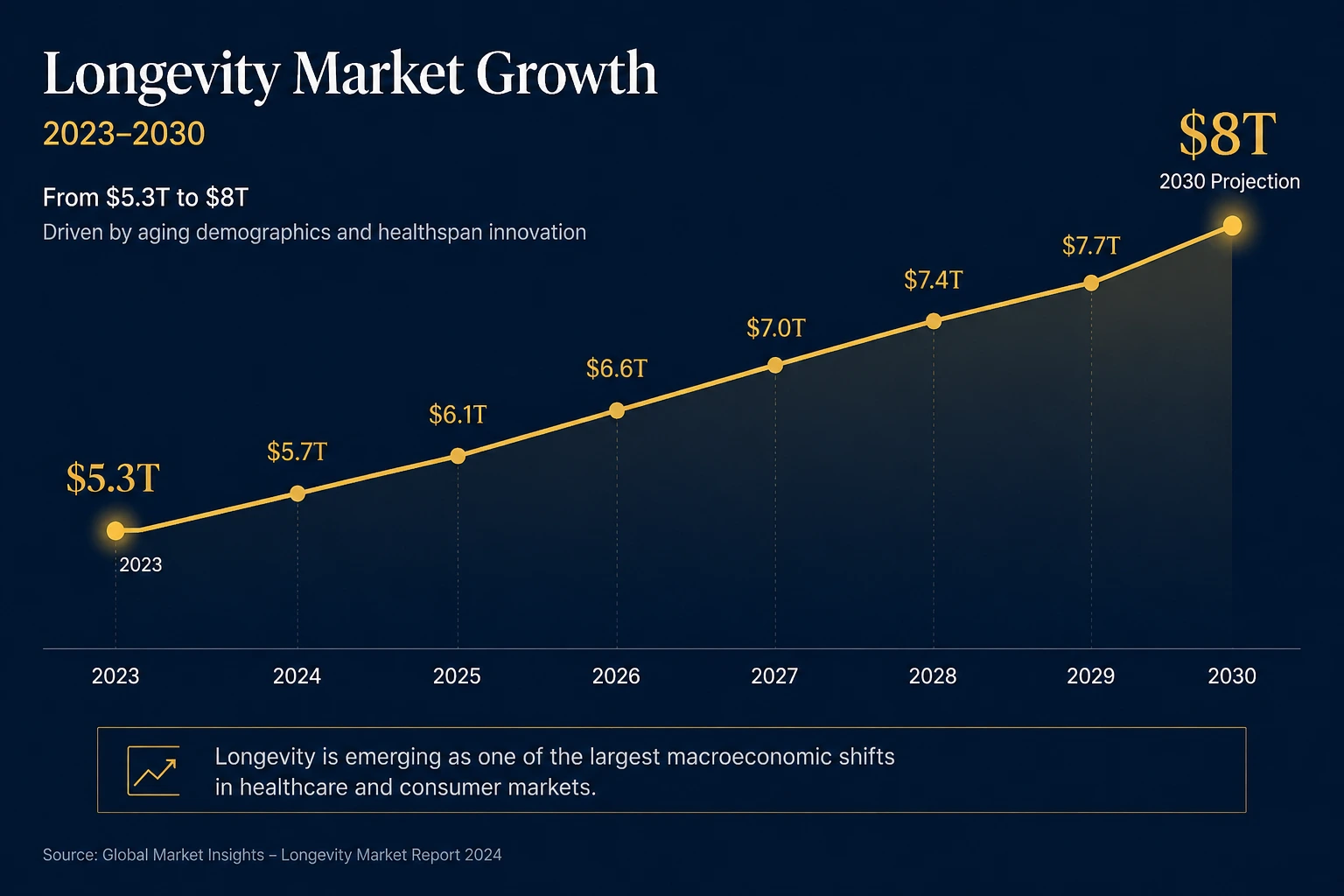
The longevity market is projected to grow from $5.3 trillion in 2023 to $8 trillion by 2030 — surpassing the projected size of the artificial intelligence market by 2027. During the World Economic Forum's 2026 Annual Meeting in Davos, healthy aging and preventative health were embedded in conversations about workforce participation, long-term economic growth, and fiscal sustainability. The longevity economy is no longer a wellness subcategory. It is economic infrastructure.
For entrepreneurs evaluating where to build a business with genuine long-term durability, the longevity clinic sits at the intersection of three forces that together make the timing argument compelling: demographic inevitability, consumer spending that has proven recession-resistant, and a competitive landscape that has not caught up to the scale of patient demand. Seventy-three million Baby Boomers are aging into the core longevity medicine patient demographic. Generation X follows immediately behind. Health-conscious Millennials who began investing in preventive health in their thirties are entering the decade when longevity medicine becomes personally relevant for the first time.
This post makes the complete business case for the longevity clinic in 2026 — the market data, the financial model, the service stack that drives recurring revenue, and what an entrepreneur who enters this market correctly is actually building. Altos Consulting Group has helped launch more than 350 clinics across the United States, including longevity medicine practices across multiple markets. To see the longevity clinics ACG has supported, visit altosconsultinggroup.com/clinics-supported/longevity.
What Is a Longevity Clinic and Why Is This the Right Moment to Enter
A longevity clinic is a cash-pay health practice focused on extending the patient's healthspan — the years of life spent in full cognitive, physical, and metabolic health — through proactive, data-driven, biomarker-guided protocols. This is not the same as an anti-aging clinic in the cosmetic sense. It is not a med spa. It is a precision medicine practice designed for the performance-oriented adult who wants clinical evidence that their biology is being actively optimized, not just aesthetically managed.
The services that anchor a longevity clinic are the ones that address the biological systems most directly affected by aging: hormone optimization for the hormonal environment that governs energy, recovery, body composition, and cognitive function; NAD+ IV therapy for mitochondrial health and cellular energy production; peptide therapy for tissue repair, growth hormone optimization, and immune resilience; GLP-1 metabolic programs for metabolic health and weight management; and advanced biomarker panels that give the patient — and the clinic — a data-driven picture of where their biology currently sits and where the protocol is taking it.
Searches for NAD+ therapy were up 122 percent year-over-year as of August 2025. Searches for Sermorelin were up 233 percent in the same period. The global anti-aging and longevity market exceeded $85 billion in 2025 and is projected to approach $120 billion by 2030. These numbers are not speculative projections about a market that might develop. They are documented measurements of a market that is already here — and growing faster in the clinic-based, precision medicine segment than in any other format.
The Financial Model: Why Longevity Medicine Is a Durable Business
The financial case for the longevity clinic is built on four structural advantages that most healthcare business models cannot replicate. Understanding each one — and how they interact — explains why the longevity clinic produces such favorable long-term unit economics relative to other cash-pay health businesses of comparable size.
Cash-Pay Eliminates Insurance Dependency
Longevity clinics operate entirely outside the insurance reimbursement system. Patients pay directly at the point of service. There are no reimbursement cycles, no coding requirements, no prior authorization bottlenecks, and no payer contracts to negotiate. Revenue is immediate and proportional to patient volume rather than billing efficiency. This eliminates the primary financial vulnerability that makes traditional healthcare businesses so difficult to scale — the dependence on external payers whose decisions about reimbursement rates and coverage policies can fundamentally alter the clinic's revenue model without any action by the clinic itself.
Membership Programs Create Predictable Recurring Revenue Floors
The longevity patient is not a one-time visitor seeking a single treatment. They are a long-term clinical relationship. A hormone optimization patient generates quarterly lab revenue and monthly protocol management revenue. Add NAD+ IV therapy and they generate additional monthly session revenue. Add an annual biomarker panel and they generate a recurring annual assessment event. Add peptide therapy and they generate protocol cycle revenue on top of all of the above.
A patient enrolled in a comprehensive longevity membership — covering two or three service categories at a monthly rate between $700 and $1,200 — generates between $8,400 and $14,400 per year in predictable recurring revenue from a single patient relationship. A clinic with 40 enrolled comprehensive membership patients at the midpoint of this range generates approximately $480,000 per year in annual recurring membership revenue — before new patient acquisition, additional service revenue, or lab fees. That revenue floor exists regardless of how many new patients the clinic acquires in any given month. It grows as enrollment increases and shrinks only with cancellations.
These figures are illustrative planning benchmarks — actual results depend on market conditions, patient volume, pricing structure, and operational execution. They are presented to demonstrate the revenue architecture of a membership-based longevity clinic, not to project specific outcomes for any individual practice.
High-Income Demographics With Inelastic Health Spending
The core longevity clinic patient demographic — adults between 40 and 65 investing proactively in their biological performance — skews strongly toward higher income brackets. This demographic is the one that research consistently identifies as least likely to cut health spending in economic downturns. During the 2008 recession, wellness spending grew while GDP contracted. During the 2020 COVID contraction, it grew again while virtually every other discretionary category declined.
The longevity patient does not shop for health optimization services on price. They shop on clinical credibility, demonstrated expertise, and the quality of the patient experience. A clinic that delivers those three things commands premium pricing and retains patients across economic cycles in ways that businesses serving price-sensitive demographics cannot. This is what makes longevity medicine one of the most genuinely recession-resistant business models in cash-pay healthcare.
The Service Ecosystem Creates Compounding Revenue Per Patient
A longevity clinic with a well-designed service ecosystem — in which each service creates a natural clinical pathway to the next — generates significantly more revenue per patient than one with isolated service lines. The hormone optimization patient whose labs reveal elevated inflammatory markers is a natural candidate for NAD+ therapy. The GLP-1 metabolic patient experiencing muscle loss is a natural candidate for a peptide protocol supporting tissue repair and growth hormone optimization. The patient enrolled in a comprehensive longevity protocol is a natural candidate for the annual biological age assessment that makes their progress measurable and their commitment to continuing the program obvious.
This ecosystem design is not upselling in the pejorative sense. It is clinical coherence — building the most complete picture of each patient's biology and offering the interventions that best serve their longitudinal health goals. The revenue follows from the clinical quality of the care. Clinics that get this right have patients who do not leave. They have patients who refer friends with the same health goals and the same demographics.
The Core Service Categories and Why Each One Matters
A longevity clinic's commercial durability is directly related to the depth and coherence of its service stack. Here is an analysis of the five service categories that anchor the most successful longevity medicine practices in 2026 — and the business rationale for each.
Hormone Optimization
Testosterone replacement therapy, estrogen optimization, thyroid management, and cortisol regulation represent the hormonal foundation of longevity medicine. Hormone optimization protocols require ongoing lab monitoring and periodic adjustment — which creates a recurring revenue structure built into the clinical necessity of the program. A patient enrolled in a hormone optimization program is not making a one-time purchase. They are entering a clinical relationship that by its nature requires quarterly monitoring and annual reassessment. This is the most reliable recurring revenue generator in the longevity clinic service stack and is typically the first service category that should anchor a new clinic's membership program.
NAD+ IV Therapy
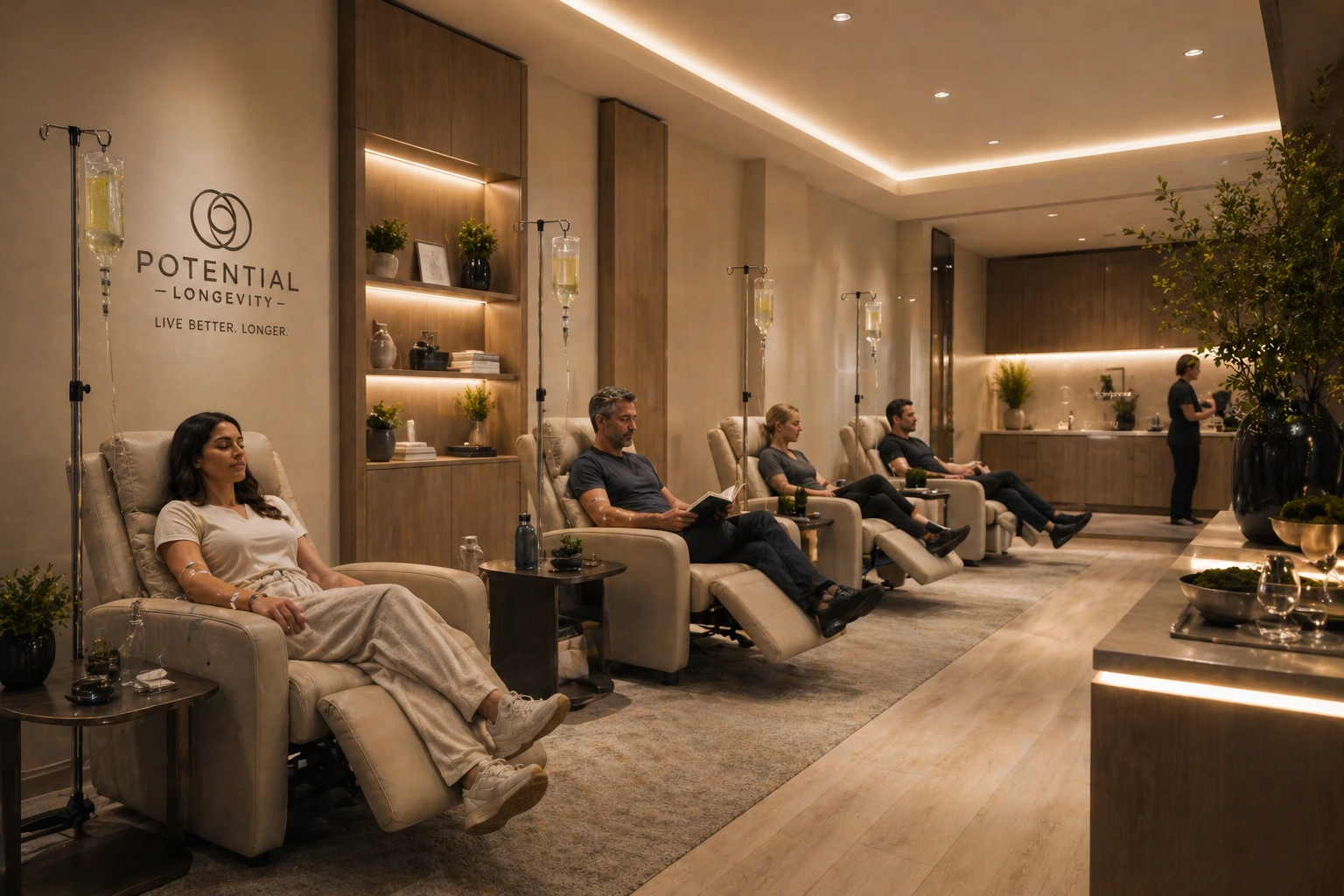
The NAD+ IV clinic market reached $512 million in 2025 and is projected to reach $1.05 billion by 2032 at a 10.8 percent CAGR. NAD+ therapy addresses mitochondrial decline — one of the earliest and most consistent markers of biological aging — by replenishing NAD+ levels that decline with age, supporting cellular energy production, DNA repair, and resilience under metabolic stress. As an anchor longevity clinic service, NAD+ therapy works because its patient appeal is broad — virtually every performance-oriented adult in the 40 to 65 demographic can identify with the goals it addresses — and because clinical results accumulate through series and maintenance sessions in ways that support ongoing patient engagement.
Peptide Therapy
Sermorelin, Ipamorelin, BPC-157, Thymosin Alpha-1, and the compounds being reinstated to legal compounding access through the 2026 reclassification process represent a service category that deepens the longevity clinic's clinical reach significantly. Peptide protocols address growth hormone optimization, tissue repair, immune resilience, and metabolic function — extending the clinic's ability to design personalized longevity programs that target each patient's specific biological gaps. Searches for Sermorelin alone were up 233 percent year-over-year as of August 2025, signaling that the patient demand for this category is not theoretical.
GLP-1 Metabolic Programs
Thirty million Americans are currently on GLP-1 medications. The GLP-1 market is tracking toward $201 billion by 2033. In a longevity clinic context, GLP-1 metabolic programs are not weight loss programs. They are metabolic optimization programs — designed to address insulin resistance, inflammatory load, cardiovascular risk markers, and body composition as part of a comprehensive biological health protocol. The GLP-1 patient who comes in through a metabolic program is typically a long-term clinical relationship candidate — they need monitoring, nutritional support, and integration with other longevity protocols that the clinic is already positioned to provide.
Advanced Biomarker Panels
Comprehensive biomarker assessment — covering hormonal status, inflammatory markers, metabolic health, mitochondrial function indicators, and increasingly biological age measures like epigenetic clocks — is both the clinical foundation of longevity medicine and a recurring revenue mechanism. A patient who receives a comprehensive biological baseline assessment and returns quarterly for monitoring panels is generating recurring lab revenue and generating the objective evidence of progress that makes their ongoing membership commitment obvious and emotionally reinforcing. Clinics that make biomarker monitoring central to their patient experience retain patients significantly longer than those that rely on symptom reporting and subjective assessment.
The Competitive Landscape: What the Market Actually Looks Like
The longevity clinic market in 2026 presents a picture that is unusual in healthcare: significant, documented, accelerating patient demand in most U.S. markets and a supply of professionally operated, premium-positioned longevity clinics that is significantly below that demand in all markets except the highest-concentration coastal metros.
Most markets across the United States — including mid-size cities, affluent suburban corridors, and secondary markets with strong professional demographics — have either no longevity medicine clinics or a small number of independently operated practices that opened without a structured business framework, without coherent positioning, and without the operational depth that makes a clinic retain patients and generate referrals at scale. The standard of care in the longevity medicine category in most U.S. markets has not been established. That is the opportunity.
The entrepreneur who enters a market in this position — with proper legal structure, a vetted supplier network, a clinical protocol framework built around the highest-demand service categories, and brand positioning calibrated to the performance-oriented longevity patient — is not competing for market share. They are defining the market. And a market position established at this stage of a category's development compounds in value as the category grows and more consumers begin actively searching for exactly what the market-leading clinic in their area already provides.

What ACG Provides and Why the Structure Matters
Opening a longevity clinic correctly requires a sequence of decisions — about entity structure, medical director relationships, supplier access, service mix, positioning, and operations — that are significantly more consequential than they appear at the outset. Each decision made incorrectly at the foundation stage creates a compounding problem: wrong entity structure creates compliance exposure that gets more expensive to fix as the clinic grows. Wrong supplier relationships create margin compression that becomes harder to address as the patient base expects consistent pricing. Wrong service mix creates a patient acquisition dynamic that exhausts the marketing budget without building the recurring revenue base that makes the business financially stable.
The ACG engagement for a new longevity clinic covers the full decision stack from market validation through post-launch optimization — and covers it in sequence, which is the only way the decisions build correctly on each other. Market and demographic validation before any location or legal commitment is made. Entity structure and MSO formation through healthcare counsel appropriate to the owner's state. Medical director introduction to vetted practitioners with longevity medicine experience. Supplier access to the compounds and lab services the clinic needs at pre-negotiated pricing. Clinical protocol setup and medical director sign-off on the service menu before the first patient is seen. Brand identity and website development included in the engagement fee. Staff training on protocols, consultation frameworks, and membership conversion. Two months of post-launch support covering marketing diagnosis, operational bottleneck identification, and data-driven adjustments to what the clinic is actually doing in the real market.
This is not a menu of optional consulting services. It is a structured process built around the decisions that determine whether a longevity clinic opens with a durable foundation or spends its first year discovering — one expensive lesson at a time — what it should have known at the start.
To see the longevity clinics ACG has helped launch across the United States, visit altosconsultinggroup.com/clinics-supported/longevity. To start the conversation about your specific market, capital position, and goals, visit altosconsultinggroup.com/survey.
The Patient You Are Building the Business For
Every strategic decision in a longevity clinic — service mix, pricing, positioning, consultation framework, marketing language — should be calibrated to a specific patient profile. Getting that profile right is what separates clinics that attract committed, high-value, long-term members from those that fill appointments with transactional visitors who disappear after the first session.
The longevity clinic patient is typically 42 to 65 years old, professionally accomplished, above-median income, and health-engaged in ways that go beyond gym memberships and vitamins. They are noticing the biological effects of aging — slower recovery, less consistent energy, hormonal shifts, changes in body composition — and they are not satisfied with their primary care physician's answer that their labs are normal. They want to know what optimal looks like and how close to it their biology currently sits. They want a clinical relationship, not a transaction. They want objective data about their progress, not subjective encouragement. And they are willing to invest in an ongoing clinical program that delivers measurable results at a level above what they can achieve independently.
This patient profile is commercially valuable not just because of their income or their willingness to pay premium pricing — though both matter. It is commercially valuable because of their orientation toward long-term clinical relationships, their tendency to refer peers with identical demographics and health goals, and their responsiveness to data-driven clinical evidence that the program they are enrolled in is working. This is the patient the longevity clinic business model is designed to serve — and when the clinic serves them well, the business compounds.
Frequently Asked Questions
How is a longevity clinic different from an anti-aging clinic?
Anti-aging is a broad category associated primarily with cosmetic treatments and the promise of reversing visible aging. Longevity medicine is a precision, data-driven clinical model focused on extending healthspan — optimizing biological function, metabolic health, hormonal balance, cognitive performance, and measurable biological age markers through evidence-informed protocols. The positioning distinction is commercially significant: longevity medicine attracts a proactive, performance-oriented patient demographic that commands premium pricing and produces stronger retention than the typical anti-aging aesthetic patient.
Is the longevity clinic market saturated?
No. Despite significant growth in consumer demand for longevity medicine services, the supply of professionally operated, premium-positioned longevity clinics remains significantly below market demand in most U.S. markets. Concentration of established longevity medicine practices is primarily in major coastal metros. Mid-size cities, affluent suburban corridors, and secondary markets with strong professional demographics represent high-opportunity entry points where market-leading positions are still available to first movers who enter correctly.
Do I need a medical background to own a longevity clinic?
No. Non-physician ownership of cash-pay longevity clinics is structured in most U.S. states through the MSO model — a management services organization owned by the entrepreneur, working with a clinician-owned professional entity under a Management Services Agreement. Clinical decision-making remains under the authority of the licensed medical director. ACG facilitates medical director introductions and ensures the entity structure is correct for the specific state from the beginning of the engagement.
How much does it cost to open a longevity clinic?
Total startup investment for an independently owned longevity clinic through ACG ranges from approximately $107,000 to $130,000 including the consulting engagement, clinical protocol setup, technology, staffing, and initial marketing. Build-out and equipment costs vary by market and service scope. This compares favorably to franchise models in adjacent healthcare categories that typically require $255,000 to $489,000 upfront plus ongoing royalties on gross revenue.
How long does it take to open a longevity clinic through ACG?
The ACG engagement targets a 60-day launch window from the start of the engagement to open doors — market and regulatory conditions permitting. This is not a guarantee. Timeline depends on the complexity of the owner's state regulatory environment, the speed of entity formation and medical director engagement, and the clinic's specific service mix. What the structured 60-day process compresses is the 12 to 18 months of trial, error, and sequential problem-solving that an independent operator navigates without experienced guidance.
What is the most important factor in longevity clinic success?
Market selection followed immediately by membership program design. A correctly positioned clinic in the wrong market — one without sufficient income demographics, appropriate age distribution, or competitive density that allows early-mover positioning — will struggle regardless of clinical quality. And a clinic in the right market with a transactional rather than membership-based revenue model will consistently underperform the financial potential its patient base represents. These are the two decisions that most directly determine whether a longevity clinic builds the compounding revenue base that makes it financially durable across multiple years of operation.
Written by Nova, Senior Content Strategist at Altos Consulting Group.