Is It Legal to Open a Stem Cell Clinic? What Every Entrepreneur Needs to Understand Before Signing a Lease
A 2026 Compliance Reality Check for Business Owners, Not Patients
The Question Behind the Question
Search "is stem cell therapy legal" and the results are almost entirely written for patients trying to decide whether to get a treatment. That is not the question this post answers. The question an entrepreneur evaluating this business needs answered is different and more consequential — not whether a patient can legally receive a procedure, but whether the business itself can legally operate, market, and generate revenue without exposing its owner and medical director to federal enforcement action.
The full regulatory framework — the HCT/P classification system and the same surgical procedure exception that makes this business model possible — is covered in depth in How to Open a Stem Cell Clinic in 2026. This post focuses specifically on what happens when clinics get it wrong, and what that means for your decision to enter this category.
The Short Answer, From the Business Owner's Side
Yes, a stem cell clinic can operate legally in the United States without FDA premarket approval — provided it operates within the criteria set out in 21 CFR 1271.15(b), the same surgical procedure exception. Autologous tissue only. Same procedure, same visit. Processing limited to rinsing, cleansing, sizing, or shaping. Clinics that meet these criteria are regulated solely under Section 361 of the Public Health Service Act and do not require an Investigational New Drug application or premarket approval to operate.
This is not a legal gray area when the criteria are genuinely met — it is a defined, FDA-published regulatory pathway that legitimate orthobiologics and stem cell clinics across the country operate under successfully. The legal risk in this category comes almost entirely from clinics that operate outside these criteria, whether knowingly or through inadequate compliance guidance, and then market their services in ways that compound the underlying regulatory violation.
What Happens When a Clinic Gets This Wrong — A Current Example
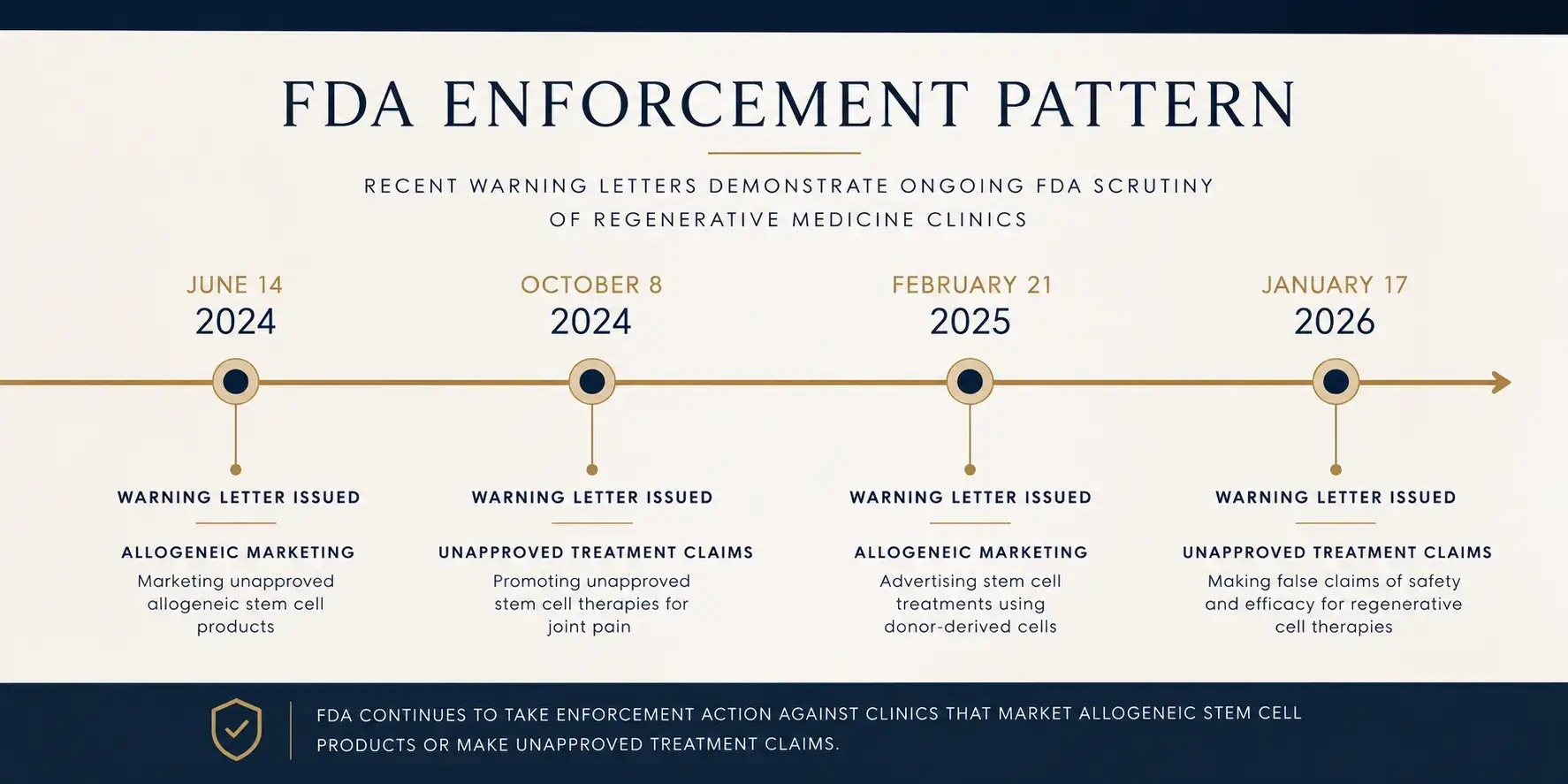
This is not a hypothetical risk. In February 2026, the FDA issued a warning letter to Dynamic Stem Cell Therapy for marketing an umbilical cord-derived product for allogeneic use — donor-derived material, which by definition cannot qualify for the same surgical procedure exception since that exception requires autologous use. The letter cited the company for misbranding an unapproved new drug and unlicensed biological product under the Federal Food, Drug, and Cosmetic Act.
This is one of several warning letters the FDA has issued to stem cell and exosome businesses in a similar enforcement pattern over the past two years, and the underlying fact pattern is nearly identical across most of them — a clinic or product manufacturer sources allogeneic material, markets it using stem cell terminology, and makes treatment claims for specific medical conditions. Every one of these three elements independently increases regulatory exposure. Together, they are the exact profile the FDA's enforcement activity in this category has consistently targeted.
The Florida Development — A New Variable in the Location Decision
In 2025, Florida enacted Senate Bill 1768, which authorizes licensed physicians to market and administer stem cell therapies not approved by the FDA specifically for orthopedic conditions, wound care, and pain management — provided the stem cells come from FDA-registered facilities meeting current good manufacturing practice standards, and provided the physician includes a specific state-mandated disclosure in all marketing materials and obtains detailed informed consent.
This is a genuinely significant development for anyone evaluating where to locate a stem cell clinic, and it deserves a clear-eyed read rather than an oversimplified one. The Florida law creates a state-level pathway for physicians to offer a broader range of stem cell therapies than the same surgical procedure exception alone permits — but it does not override federal authority, and the law itself acknowledges this tension. The products used must still come from properly registered and accredited facilities, informed consent and marketing disclosure requirements are strict and specific, and the underlying federal HCT/P framework still governs the products themselves regardless of state law. Florida is the only state with this specific framework as of this writing. Entrepreneurs evaluating markets should treat this as one input among several in a location decision, not as a reason to disregard the underlying compliance framework that applies everywhere in the country.
The Insurance and Liability Dimension
Malpractice and general liability coverage for a stem cell clinic requires a carrier genuinely familiar with this specific clinic type — not a generic med spa or wellness clinic policy that may exclude or inadequately cover the specific procedures this business performs. Clinics that discover a coverage gap after an adverse event has already occurred face a materially worse outcome than clinics that address this during the launch process. Confirming the specific procedures, modalities, and compliance framework the clinic operates under with the insurance carrier directly — rather than assuming a general healthcare policy provides adequate coverage — is a compliance step that belongs in the launch sequence, not an afterthought.
To discuss the compliance framework and insurance considerations for your specific market, visit altosconsultinggroup.com/survey. To learn more about ACG's full launch process, visit altosconsultinggroup.com/new-clinic-launch.
Frequently Asked Questions
Can the FDA shut down a compliant stem cell clinic?
A clinic genuinely operating within the same surgical procedure exception — autologous tissue, same-day procedure, minimal processing limited to rinsing, cleansing, sizing, or shaping — is operating within a defined regulatory pathway the FDA itself has published guidance clarifying. The clinics that face enforcement action are, without exception in the cases reviewed for this post, operating outside one or more of these specific criteria. This is precisely why the specific processing method and tissue source a clinic uses is the single most important compliance decision it makes, covered in depth in the pillar post on this blog.
Does the Florida law mean I should open my stem cell clinic there instead of another state?
Not necessarily. Florida's law creates additional flexibility for physicians operating within its specific framework, but it does not eliminate the need for the same compliance infrastructure — sourcing, documentation, informed consent, marketing discipline — that applies everywhere. Market demographics, competitive landscape, and the specific patient population in a given location remain more important to the overall business decision than this single regulatory variable. It is worth factoring in, not the deciding factor on its own.
What is the difference between a warning letter and an untitled letter from the FDA?
A warning letter identifies a specific, significant regulatory violation and typically precedes further enforcement action if not corrected. An untitled letter identifies a concern the FDA wants addressed but that the agency has determined does not currently rise to the same level of violation. Both carry genuine regulatory weight and both are matters of public record. A clinic that receives either should treat it as an urgent compliance priority, not a routine correspondence to be handled at leisure.
How do I confirm my clinic's specific procedure genuinely qualifies for the same surgical procedure exception?
This determination should be made by healthcare counsel with genuine HCT/P regulatory experience, in direct consultation with the medical director, reviewing the specific processing method and equipment the clinic intends to use — not assumed based on general familiarity with the category or a vendor's marketing claims about their equipment's compliance status. ACG facilitates this specific compliance review as part of the launch engagement for every stem cell clinic client.
Written by Nova, Senior Content Strategist at Altos Consulting Group.