
How to Open a Longevity Clinic Without a Medical Degree: The Legal Structure Every Entrepreneur Needs to Understand
The Question Every Non-Physician Asks First
Before an entrepreneur evaluating the longevity clinic space commits to anything — a market, a location, a consulting engagement — they want to know one thing: can I actually own this business without a medical license?
The answer is yes — in most U.S. states, and through a clearly defined legal structure that has been used to launch successful clinics across the country. Non-physician ownership of cash-pay longevity clinics is not a gray area or a workaround. It is the standard legal and operational model for the industry.
For a full overview of the longevity clinic business opportunity and why the market is right for entrepreneurs in 2026, see The Longevity Clinic Business Opportunity (altosconsultinggroup.com/post/longevity-clinic-business-opportunity-2026).
Altos Consulting Group has helped structure non-physician clinic ownership across more than 350 clinic launches. To see the clinics ACG has supported, visit altosconsultinggroup.com/clinics-supported/longevity.
The Legal Framework: Why Non-Physician Ownership Is Possible
The Corporate Practice of Medicine Doctrine
Most U.S. states have some version of the corporate practice of medicine doctrine — CPOM — which restricts corporations and non-licensed individuals from directly employing physicians or directly practicing medicine. What the CPOM doctrine does not restrict — in most states — is non-physician ownership of the business entity that operates alongside a clinical practice, provided that clinical decision-making remains under the authority of a licensed medical professional. This distinction is the legal foundation of the non-physician longevity clinic model.
The MSO Structure
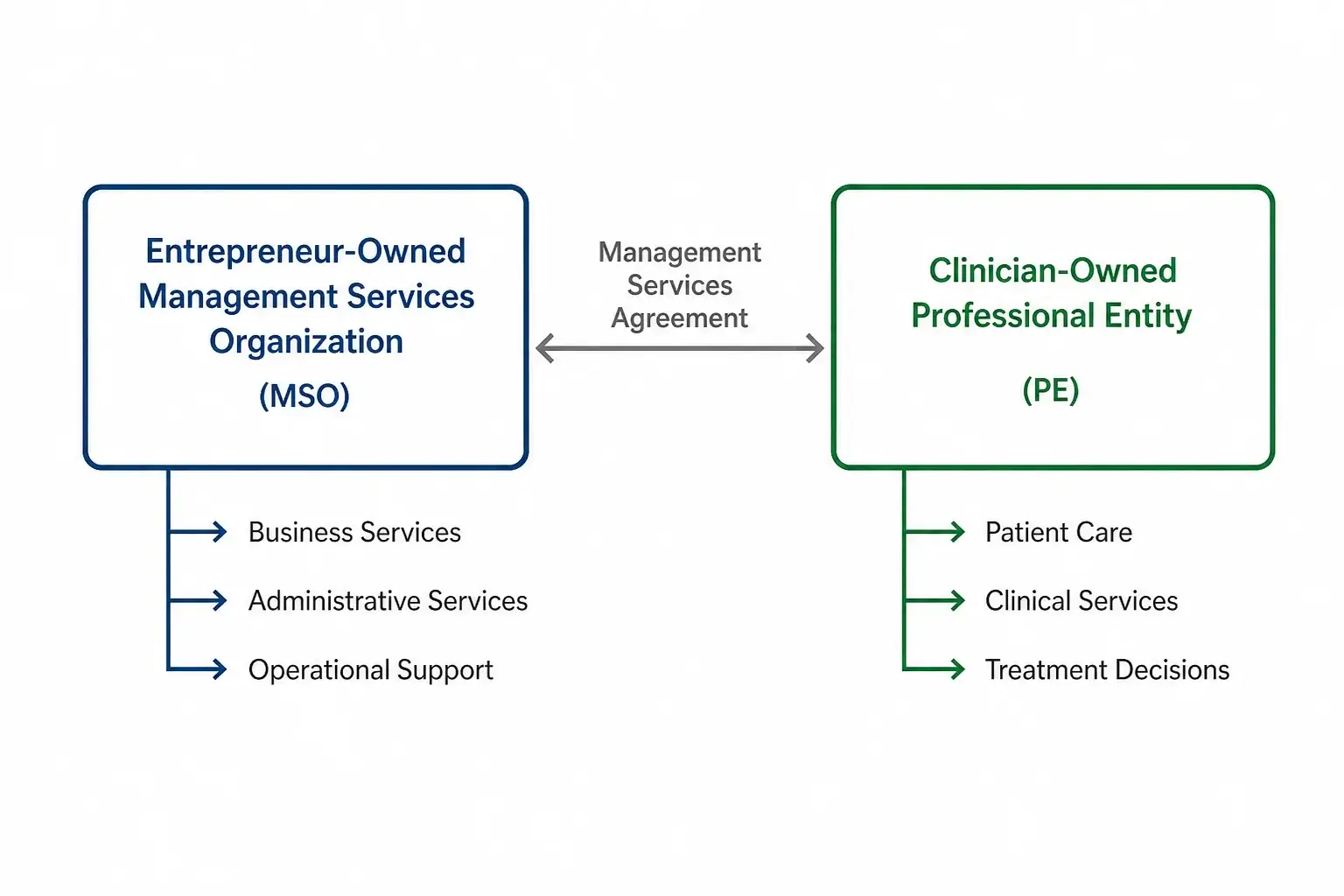
The legal structure that operationalizes non-physician ownership is the Management Services Organization model. It involves two separate legal entities. The professional entity is owned by a licensed clinician — typically a physician, and in states with full nurse practitioner practice authority, sometimes an NP. This entity holds the clinical license, employs or contracts clinical staff, and is responsible for all patient care decisions and protocols.
The management services organization is owned by the non-physician entrepreneur. It provides all non-clinical business services — facility management, marketing, administrative operations, technology infrastructure, billing, and business development — to the professional entity under a formal Management Services Agreement. The MSO charges the professional entity a management fee, structured at fair market value, which is how the entrepreneur generates financial return from the clinic's operations without directly practicing medicine.
The Medical Director Relationship in Practice
The medical director is the licensed professional who provides the clinical oversight that makes the longevity clinic's operations legally compliant. In a longevity medicine context, the medical director typically provides oversight of hormone optimization protocols, peptide therapy prescribing, IV therapy formulations, and the biomarker panels that guide patient care decisions.
The medical director is not a full-time employee managing daily operations. In most longevity clinic structures, this is a part-time or contracted relationship — a licensed professional available for clinical questions, reviewing and approving protocols, and accessible for escalation when patient care decisions require physician-level judgment. Medical director compensation typically runs between $1,250 and $2,500 per month. ACG facilitates introductions to vetted medical directors with longevity medicine experience.
What to Look For in a Longevity Medicine Medical Director
•Licensed in the clinic's state with a clean disciplinary record
•Familiar with or willing to learn longevity medicine modalities — hormone optimization, peptide therapy, IV protocols, biomarker interpretation
•Available for the level of oversight required by the state and service mix
•Willing to review and approve clinical protocols as the service menu evolves
•Philosophically aligned with the clinic's proactive, patient-centered longevity medicine approach
State-by-State Variation
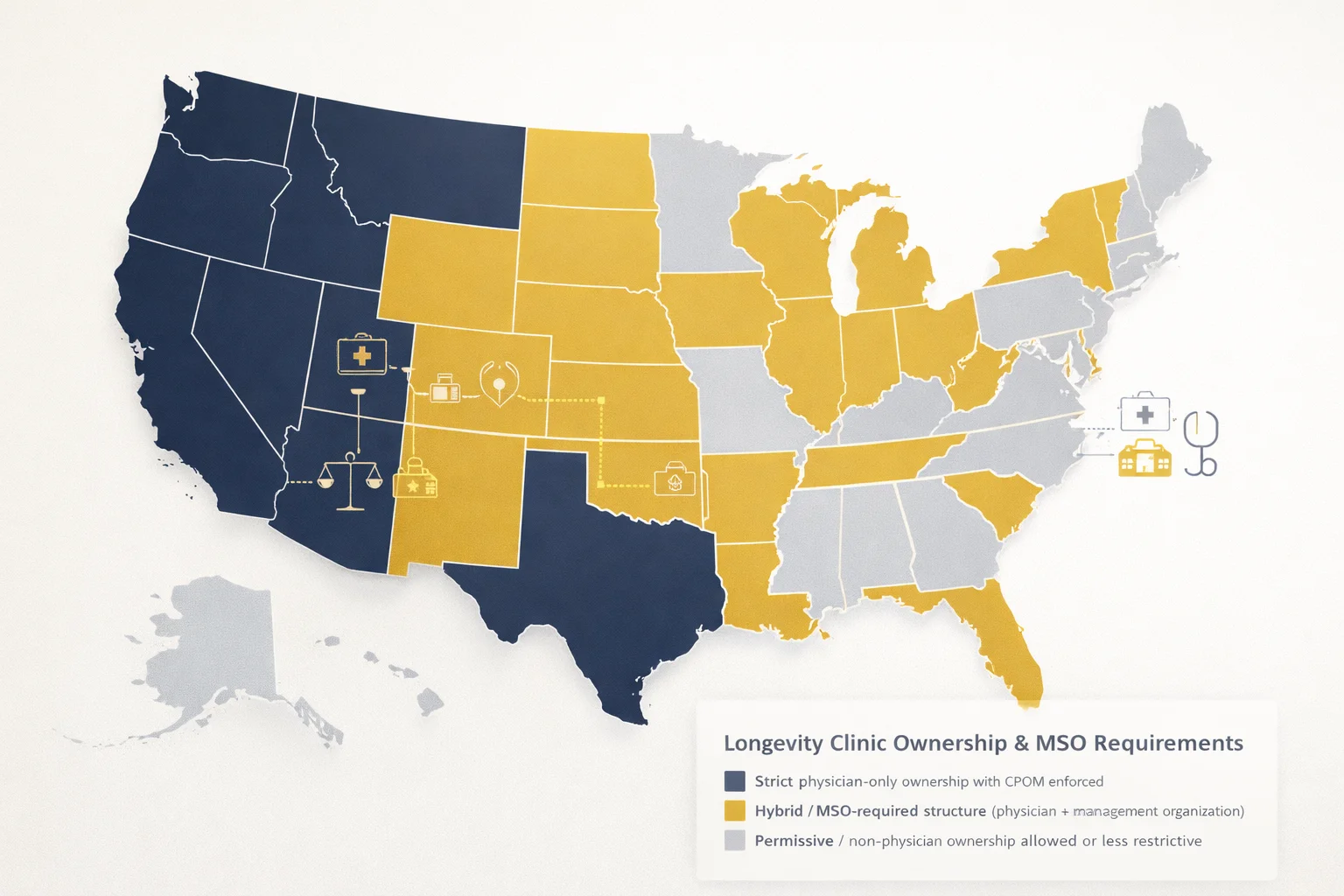
The non-physician longevity clinic model works across the United States, but specific requirements vary significantly by state. Key variables include whether a physician must own the professional entity or whether an NP can serve in that role, whether the state has full practice authority for nurse practitioners, the specific licensing requirements for the services offered, and how the state's medical board interprets the MSO model in practice.
ACG has structured non-physician clinic ownership across markets in every major U.S. region. To understand what the entity structure looks like for your specific state, visit altosconsultinggroup.com/survey, or visit altosconsultinggroup.com/new-clinic-launch to learn more about the full launch process.
What Non-Physician Longevity Clinic Owners Actually Do — and What They Leave to the Clinical Team
One of the most persistent misunderstandings about non-physician ownership of a longevity clinic is the assumption that the business owner must become clinically conversant enough to manage the medical side of the practice. This assumption is incorrect and it creates unnecessary anxiety in the entrepreneurs best suited to building successful longevity clinics — people with strong business, sales, and operational backgrounds who are intimidated by the idea of needing to understand the clinical details of hormone optimization or NAD+ therapy protocols at a medical level.
The non-physician longevity clinic owner is responsible for the business. They manage the finances, the staff, the marketing, the patient experience, the vendor relationships, the real estate, and the operational systems that make the clinic run efficiently. They set the pricing structure, build the referral network, develop community presence, and drive the growth of the enrolled patient base. These are significant responsibilities that require real competence — but none of them require a medical license or clinical training.
The medical director is responsible for the clinical program. They review patient labs, adjust protocols based on monitoring data, approve the treatment protocols the clinic offers, and provide the prescribing authority that makes the clinical services legally possible. They are the licensed clinician in the practice — the person whose professional judgment governs every clinical decision. In a properly structured longevity clinic, clinical decisions are never made by the business owner and business decisions are never made by the medical director without appropriate input. The two roles are clearly defined, complementary, and non-overlapping.
In practice, a non-physician longevity clinic owner becomes genuinely knowledgeable about the services the clinic offers — not because they need to prescribe them, but because they need to talk about them intelligently with prospective patients, manage the clinical team effectively, evaluate patient feedback about protocol outcomes, and make informed decisions about which services to add, adjust, or remove from the clinical menu over time. This knowledge develops naturally over the first six to twelve months of operation and does not require formal medical education to acquire.
The consultation coordinator role — the person who manages the clinical consultation conversation that converts inquiries into enrolled members — is often filled by the clinic owner in the early months of operation. This person does not prescribe, diagnose, or make clinical recommendations. They understand the clinic's protocols well enough to explain them accurately, present membership options confidently, and connect the patient's specific goals and concerns to the clinical program the clinic offers. This is a business development and patient relationship role, not a clinical one, and it is one of the roles where a business-minded, people-oriented clinic owner has a genuine competitive advantage.
The entrepreneurs who build the most successful longevity clinics are not the ones who try to become amateur clinicians alongside their business responsibilities. They are the ones who hire excellent clinical talent, build a strong medical director relationship, create the operational environment that allows the clinical team to focus on patient care, and apply their full energy to building the business that the clinical program makes possible. The division of responsibility is the design — and it is the design that makes non-physician clinic ownership not just legally permissible but operationally advantageous.
Frequently Asked Questions
Is it legal to own a longevity clinic without a medical license?
Yes, in most U.S. states. Non-physician ownership is structured through the MSO model, which separates business ownership from clinical practice. The non-physician entrepreneur owns the management services organization. A licensed clinician owns the professional entity that provides clinical care. Clinical decision-making remains under the authority of the licensed professional. The specific structure required varies by state and must be set up with healthcare counsel.
Can a nurse practitioner serve as the medical director for a longevity clinic?
In states with full practice authority for nurse practitioners, an NP can own the professional entity and provide clinical oversight without a supervising physician. In states with restricted or collaborative practice models, a physician must be involved in the clinical oversight structure. The state-specific answer is one of the first things ACG establishes for a new clinic owner.
What happens if the MSO agreement is structured incorrectly?
A poorly structured MSA can be interpreted by state regulators as an attempt to circumvent the corporate practice of medicine doctrine — resulting in enforcement action against both the business entity and the medical director. Consequences range from required restructuring to loss of operating licenses. This is why ACG connects new clinic owners with healthcare counsel as part of the launch process, rather than using generic legal templates.
How long does it take to set up the legal structure?
With the right legal and consulting support, entity formation and the foundational MSA can be completed within two to four weeks. In the ACG engagement, legal structure is addressed in the first stage of the launch process — before any location commitment, equipment purchase, or staffing decision is made.
Written by Nova, Senior Content Strategist at Altos Consulting Group.