How to Open a Women's Hormone Clinic in 2026
The Build, the Prescribing Structure, and Why the Market Just Shifted in Your Favor
The Number That Defines This Opportunity
In its February 2026 announcement on menopausal hormone therapy labeling, the FDA published a statistic that should stop any entrepreneur evaluating this category. In 2020, about 41 million U.S. women were ages 45 to 64 — yet only about 2 million women ages 46 to 65 received a hormone therapy prescription.
That is roughly five percent of the addressable population receiving treatment for a condition that affects essentially all of them. There is no other category in cash-pay health with a gap that wide between clinical need and clinical delivery.
For the full market and business case, see The Women's Hormone Health Clinic Business Opportunity. This post covers the build.
Why the Regulatory Environment Just Improved
For more than two decades, the boxed warning on estrogen products was the single largest obstacle to this business. Patients declined treatment because of it. Physicians hesitated to prescribe because of it. It shaped a generation of clinical practice.
On February 12, 2026, the FDA approved labeling changes to the first six menopausal hormone therapy products, removing risk statements related to cardiovascular disease, breast cancer, and probable dementia from the boxed warning. The agency initiated the change in November 2025 after a comprehensive review of the scientific literature, and 29 drug companies have submitted proposed labeling changes with more product updates expected.
The FDA also noted that randomized studies show women who initiate hormone therapy within 10 years of the onset of menopause — generally before age 60 — see a reduction in all-cause mortality and fractures.
One warning was retained: the boxed warning for endometrial cancer remains on systemic estrogen-alone products for patients with a uterus. A clinic should know that distinction and be able to explain it accurately rather than describing the change as a blanket removal.
The Prescribing Structure
Who can prescribe in the professional entity depends on the state. The American Association of Nurse Practitioners maintains a state practice environment map categorizing states as full practice, reduced practice, or restricted practice. In full practice states, a nurse practitioner can evaluate patients, order and interpret diagnostics, and initiate and manage treatments under the exclusive licensure authority of the state board of nursing.
This matters more for a women's hormone clinic than for most clinic types, because the economics differ meaningfully. In a full practice state, an NP-led model is frequently both more accessible and less expensive to staff than securing a physician medical director. In a restricted state, a collaborative physician relationship is required and should be identified before a location is selected.
Unlike a TRT clinic, most core products here are not controlled substances, which simplifies the setup considerably. Estrogen and progesterone do not carry the DEA registration requirement that testosterone does. Clinics that add testosterone therapy for women — a legitimate service, though prescribed off-label since no FDA-approved female testosterone product exists in the U.S. — do bring that requirement back into scope.

The Clinical Build
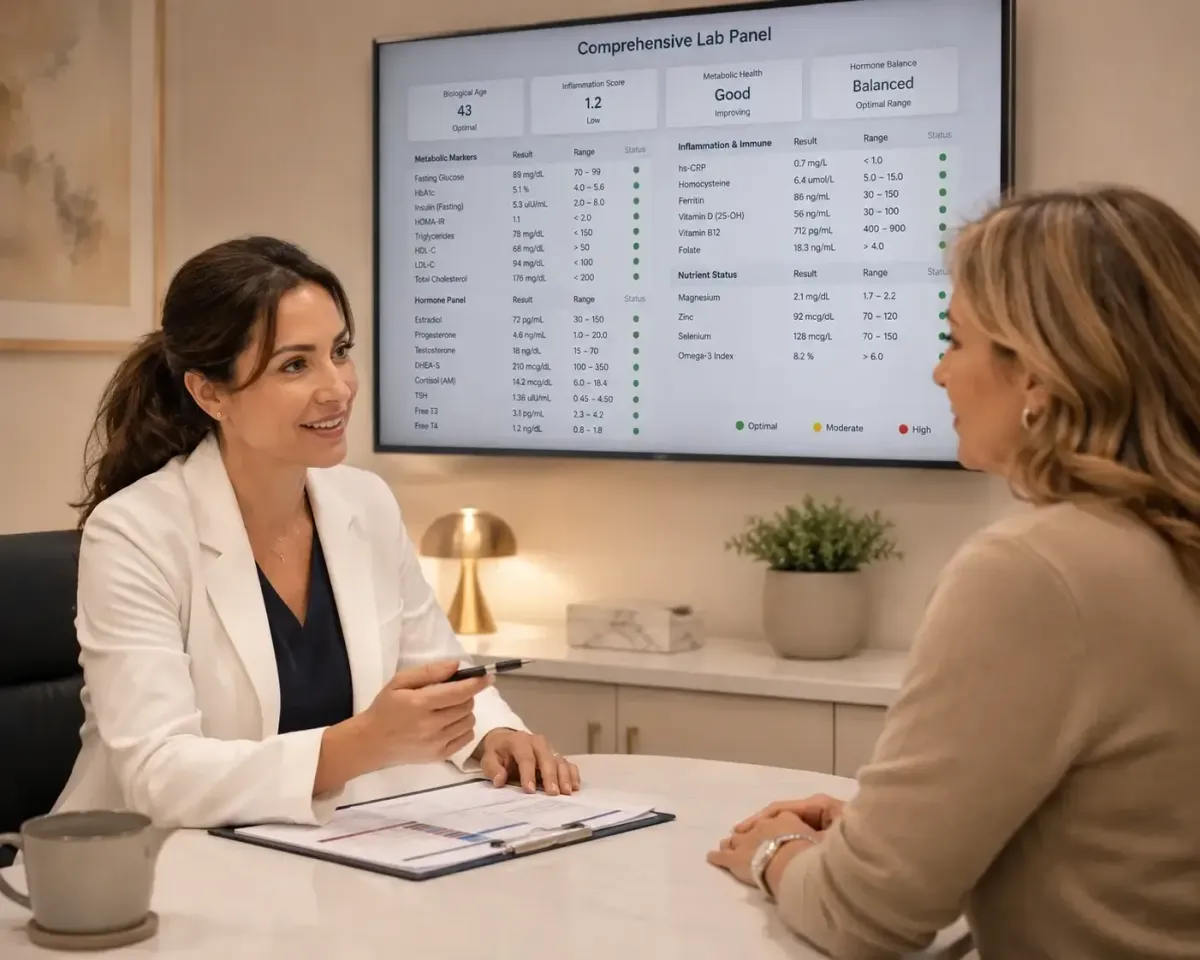
A women's hormone clinic needs a comprehensive baseline panel — estradiol, FSH, progesterone, total and free testosterone, DHEA-S, a full thyroid panel, and metabolic markers. Thyroid belongs in the baseline rather than as an add-on, because thyroid dysfunction is substantially more prevalent in this population and frequently produces the exact symptom picture patients arrive describing.
The monitoring cadence follows the same logic as other hormone practices: baseline before therapy, reassessment at roughly 90 days, then quarterly. In-office phlebotomy is worth the $3,000 to $7,000 setup for the same reasons it is in a TRT clinic — specimen control, schedule control, and the recurring clinical touchpoint that drives retention.
Formulary decisions deserve more deliberation than most clinics give them, and are covered in depth in the companion post on this blog comparing compounded and FDA-approved hormone therapy.
Positioning and the Consultation
The consultation framework for this patient differs fundamentally from a men's TRT consultation, and clinics that run the same script for both convert poorly on the women's side.
The male TRT patient typically arrives having decided he wants testosterone. The perimenopausal patient frequently arrives uncertain whether what she is experiencing is hormonal at all — because she has often been told it is not. She may have been offered an antidepressant for symptoms with a hormonal basis, or told her labs were normal when they were measured incompletely.
The consultation that converts her does not open with a product. It opens with a thorough symptom history and a comprehensive panel, and lets the data drive the recommendation. The clinical authority the clinic offers is the willingness to investigate properly — which is precisely what she has not received elsewhere.
Staffing the Clinic
The clinical team for a women's hormone clinic is smaller than most clinic types but the hiring bar on one role is higher.
At minimum the practice needs a prescribing clinician, a clinical staff member capable of running lab draws and managing the monitoring schedule, and a patient coordinator handling intake and the consultation-to-enrollment conversation.
The coordinator role carries disproportionate weight here. This patient frequently arrives having been dismissed elsewhere, and the first interaction with the practice either confirms that pattern or breaks it. A coordinator who can conduct a thorough intake conversation, ask about symptoms patients do not volunteer, and convey genuine clinical interest converts materially better than one working from a booking script. Many clinics find that hiring someone who has personally navigated this transition brings a credibility that cannot be trained.
Why the Timing Favors New Entrants
Three things converged in a short window. The FDA removed the boxed warning language that suppressed demand for two decades. Mainstream coverage of menopause has expanded substantially, producing a patient population that arrives informed and self-advocating. And treatment penetration remains at roughly five percent of the age-eligible population.
A market with rising demand, falling regulatory friction, and minimal existing supply is an unusual combination. It does not typically persist. Clinics that establish local authority in this category during the current window are positioned considerably better than those entering after competitors have built patient bases and search presence.
Startup Investment
A women's hormone clinic requires a total startup investment broadly comparable to a TRT clinic — roughly $95,000 to $125,000 covering legal structure, prescribing clinician engagement, in-office lab capability, technology, space, and pre-launch marketing. Clinics in full practice authority states operating an NP-led model frequently land at the lower end of that range.
Working capital above that should cover three to five months of fixed operating costs, typically $9,000 to $14,000 monthly. These are illustrative planning benchmarks — actual results depend on market, staffing model, and execution.
To discuss the build for your specific market, visit altosconsultinggroup.com/survey.
Frequently Asked Questions
Do I need to be a physician to open a women's hormone clinic?
No. Non-physician ownership is structured through the MSO model in most states, with a licensed clinician owning the professional entity and holding prescribing authority. In full practice authority states that clinician can be a nurse practitioner. ACG facilitates these introductions and structures the entity arrangement with healthcare counsel in the relevant state.
Does a women's hormone clinic need DEA registration?
Not for estrogen and progesterone therapy, which are not controlled substances. If the clinic offers testosterone therapy for women — prescribed off-label, since no FDA-approved female testosterone product exists in the U.S. — then DEA registration applies, since testosterone is Schedule III.
How is this different from opening a TRT clinic?
The compliance burden is lighter absent testosterone, but the clinical and consultation demands are higher. The symptom picture is broader, the panel is more comprehensive, thyroid assessment is more central, and the patient typically arrives less certain of what she wants. Clinics that treat this as TRT with different products underperform.
Is the market already saturated?
No. The FDA's own figures put treatment penetration at roughly five percent of the age-eligible population. Very few markets have a dedicated clinic serving this patient well, and the boxed warning removal is expected to increase patient-initiated demand meaningfully.