How to Open a Regenerative Health Clinic in 2026: The Complete Guide for Entrepreneurs
Why 2026 Is the Right Year — and Why the Process Matters More Than the Timing
The regenerative health clinic market in 2026 is projected to grow from $35 billion in 2024 to over $90 billion by 2030. Consumer search interest in longevity medicine, NAD+ therapy, hormone optimization, peptide therapy, and GLP-1 metabolic programs is surging across every major U.S. market. The demand is documented and accelerating.
But timing alone does not determine whether a clinic succeeds. The entrepreneurs who open Regenerative Health Clinics and build them into durable, profitable businesses are the ones who made the right decisions in the right order — market selection before location commitment, legal structure before lease, medical director before build-out, protocols before patients.
This post covers the complete process for opening a Regenerative Health Clinic in 2026 — every decision, in the right order, with the compliance and operational context needed to make each one correctly. Altos Consulting Group has guided more than 350 clinic launches across 46 U.S. states. To see the full launch process ACG uses, visit altosconsultinggroup.com/new-clinic-launch.
Step 1: Validate Your Market Before You Commit to Anything
Market selection is the single most consequential decision in the entire launch process — and the one most entrepreneurs make incorrectly by treating it as a default rather than a deliberate choice.
A Regenerative Health Clinic requires a specific demographic foundation to generate sustainable patient volume: adults between 40 and 65, above-median household income, documented health investment behavior, and a local competitive landscape that allows early-mover positioning. These factors do not align uniformly across U.S. markets. A city that looks attractive based on population alone may have income demographics that cannot support cash-pay premium services. A market that looks crowded at the surface may have low-quality independent operators who cannot retain patients.
The data points that matter: population demographics and income distribution in the target zip code cluster, local search volume for longevity medicine and regenerative health keywords, direct audit of existing operators and how they are positioned, and zoning and licensing complexity for the specific services the clinic intends to offer. This validation must be completed before any location commitment is made.

Step 2: Choose Your Clinic Type and Service Mix
The regenerative health space includes multiple distinct clinic models, each with a different patient demographic, service stack, compliance profile, and financial model. Choosing the right model for your specific market — before any legal structure or location work begins — prevents the most common and most expensive mistake in the launch process: building a clinic for a patient that does not exist in significant numbers in your market.
The highest-demand clinic models in 2026:
•Longevity clinics — NAD+ IV therapy, hormone optimization, peptide protocols, biomarker panels. Broadest patient demographic, highest lifetime value, strongest recurring revenue structure.
•Hormone optimization clinics — TRT for men, BHRT for women. 246,000+ monthly U.S. searches for TRT alone. Protocol-driven recurring revenue through ongoing monitoring and prescription management.
•Metabolic weight loss clinics — GLP-1 programs, metabolic health, body composition management. 30 million Americans currently on GLP-1 medications. Fastest-growing consumer health category by search volume.
•Peptide therapy clinics — Sermorelin, BPC-157, Ipamorelin, Thymosin Alpha-1. 281 percent year-over-year search growth as of April 2026. FDA reclassification restoring access to Category 2 compounds through 2026.
•Sexual wellness clinics — ED, women's intimacy, and libido optimization. Underserved in most U.S. markets, high retention, discreet patient base.
•Joint and musculoskeletal clinics — PRP, exosomes, shockwave therapy. Non-surgical alternative to conventional orthopedics. Two distinct patient populations — chronic joint pain and active recovery.
•Neurological wellness clinics — HBOT, NAD+ IV, nebulized exosomes, peptide protocols for TBI, PTSD, autism spectrum, stroke recovery. Mission-driven, deep patient loyalty, minimal competition in most markets.
•IV therapy and infusion clinics — NAD+, wellness drips, EBOO. Lower barrier to entry, works as a standalone model or complement to other services.
•Aesthetics and med spa clinics — Botox, fillers, laser treatments, PRP facials. Established category with high consumer demand.
•Hair regeneration clinics — PRP, exosomes, hair restoration. Consistent demand across gender demographics with high average ticket sizes.
Step 3: Establish the Legal Foundation
The legal structure of a Regenerative Health Clinic must be established before any other business commitment — before a lease, before a bank account, before a vendor contract. Getting this right is not bureaucratic formality. It is the foundational decision that determines whether the clinic can operate legally, attract the right medical director, and withstand regulatory scrutiny as the business grows.
The MSO Model for Non-Physician Owners
In most U.S. states, non-physician ownership of a cash-pay health clinic requires the Management Services Organization model — a management services organization owned by the entrepreneur providing all non-clinical business services to a clinician-owned professional entity under a formal Management Services Agreement. The MSO charges the professional entity a management fee at fair market value. This is how the non-physician owner generates financial return from the clinic's operations without directly practicing medicine.
Healthcare counsel admitted in the relevant state must draft the entity documents and the MSA. State-specific requirements for the CPOM doctrine, nurse practitioner practice authority, and entity structure requirements vary significantly across jurisdictions. ACG connects new clinic owners with healthcare counsel as a standard component of the launch engagement.
Licensing and Compliance by State
Every state has different licensing requirements for Regenerative Health Clinics. DEA registration requirements for controlled substances including testosterone. State business licensing requirements for health facilities. Zoning verification for medical use. Malpractice and general liability insurance requirements. Prescribing compliance requirements for specific modalities including GLP-1 programs, testosterone, and compounded peptides. ACG has navigated these requirements across 46 states — which means the state-specific compliance sequence is already mapped for every market ACG serves.
Step 4: Engage the Medical Director
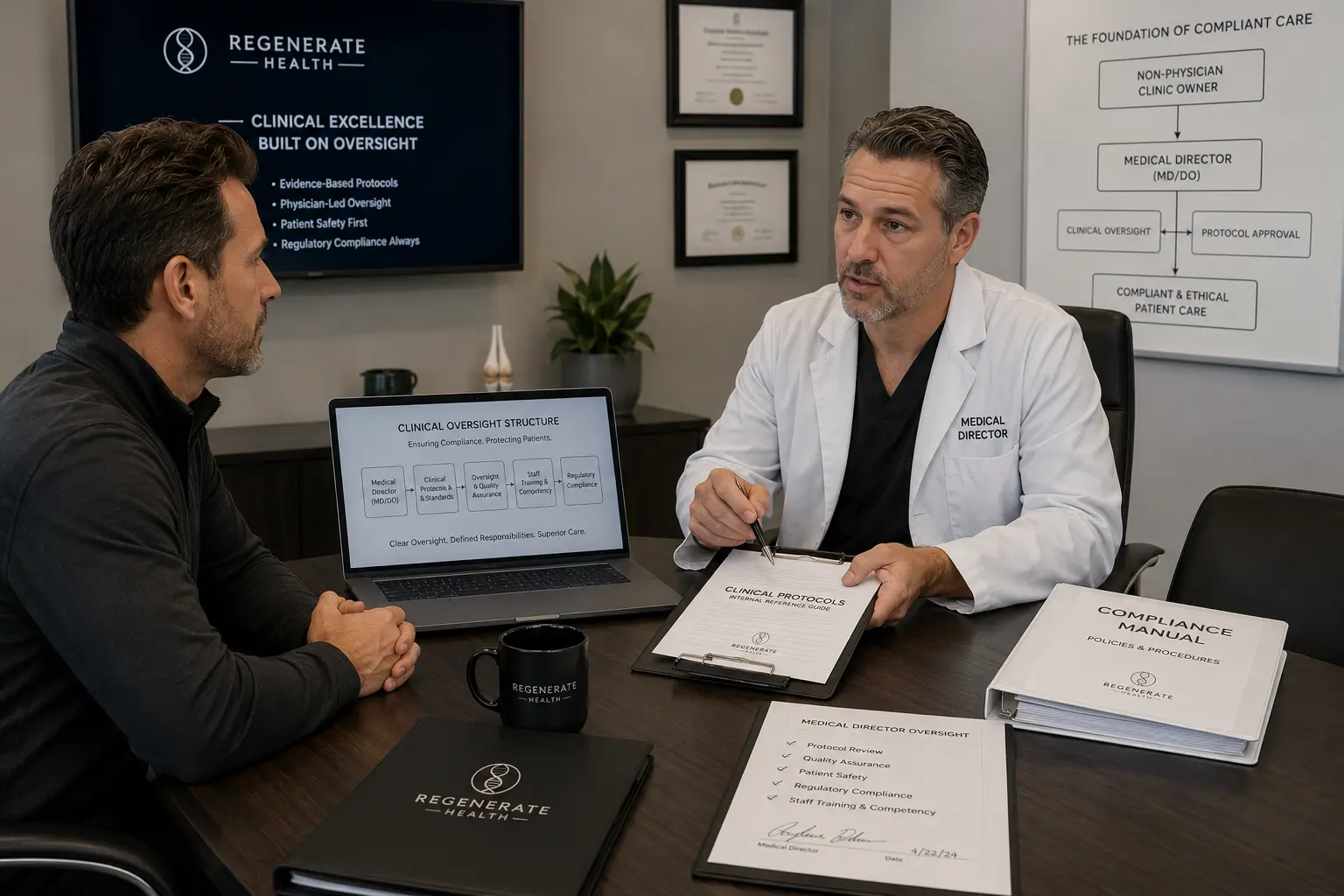
Every Regenerative Health Clinic requires a licensed medical director — a physician or, in states with full NP practice authority, a nurse practitioner — who provides clinical oversight, prescribing authority, and compliance assurance for the clinic's protocols. The medical director must be engaged before any physical build-out begins, because their specific protocol preferences and oversight requirements directly affect what the physical space and technology infrastructure need to support.
Medical director compensation for a Regenerative Health Clinic typically runs between $1,250 and $2,500 per month depending on the state, the service mix, and the scope of clinical involvement. ACG facilitates introductions to vetted medical directors across 46 states — practitioners with experience in the specific clinic type being built, not just any physician willing to sign a contract.
Step 5: Establish Supplier Access and Protocol Infrastructure
The supplier relationships that determine a Regenerative Health Clinic's gross margin structure must be established before the clinic opens. This means vetted 503A and 503B compounding pharmacy relationships for compounded peptides, testosterone, and GLP-1 compounds. Equipment suppliers for modalities including shockwave therapy, HBOT, and IV therapy infrastructure. Lab partners for biomarker panels and monitoring. EMR systems configured for the specific documentation requirements of the clinic's protocol stack.
ACG provides supplier access through pre-negotiated relationships across all of these categories — giving new clinic owners access to pricing that reflects the combined volume of ACG's 350+ clinic client base rather than the leverage of a single new account. The commercial impact of this access on gross margins is one of the most concrete financial advantages of the structured consulting engagement versus the independent launch path.
Step 6: Select Location, Build Out, and Configure Technology
With the legal structure in place, the medical director engaged, and the service mix and supplier relationships confirmed, the physical location can be selected with full clarity about what the space needs to support. A Regenerative Health Clinic typically operates in 800 to 2,000 square feet depending on the service mix — a reception and waiting area, one or two consultation rooms, treatment space appropriate to the modalities offered, and clinical supply storage with appropriate refrigeration.
Technology configuration — HIPAA-compliant EMR, scheduling, payment processing at negotiated rates, and patient communication systems — must be completed and tested before the first patient appointment. These systems are not setup tasks that can be assembled during the first week of clinical operations without negatively affecting the patient experience.
Step 7: Hire, Train, and Build the Team
A Regenerative Health Clinic needs a trained clinical team in place before opening. At minimum: a licensed nurse or nurse practitioner capable of administering the clinic's protocols, a medical assistant or patient coordinator, and a consultation coordinator to manage the inquiry-to-membership conversion process. All of these roles must be hired and fully trained before the first patient walks in.
Clinical training must cover the specific protocols the clinic will offer, the documentation standards for each modality, the adverse event recognition and reporting procedures, and the patient communication standards that set appropriate expectations. ACG delivers this training as part of the launch engagement — before the clinic opens.
Step 8: Launch Marketing Before Opening
The pre-launch marketing period — the two to three weeks before a clinic officially opens — is the window in which the local patient base is seeded. A pre-launch brand awareness campaign, local SEO activation across 100+ directories and maps, and paid advertising designed to drive consultation bookings for the first week of operation means the clinic opens to a populated schedule rather than an empty calendar.
ACG's launch engagement includes pre-launch marketing as a standard component — built specifically for the clinic type and the local market rather than using generic health clinic advertising creative. All advertising is structured to comply with platform-specific restrictions for healthcare categories.
To learn more about the full ACG launch process and what is included, visit altosconsultinggroup.com/new-clinic-launch. To start the conversation about your specific market, visit
Step 9: Open and Optimize
The first 90 days of a Regenerative Health Clinic's operation determine the financial trajectory of the first year. The consultation-to-membership conversion rate in the first 30 days establishes the recurring revenue floor. The clinical quality of the first patient cohort's experience determines whether those patients retain and refer. The marketing performance data from the first 60 days provides the information needed to optimize patient acquisition cost and lead quality before the marketing budget scales.
ACG's post-launch support covers exactly this window — 60 days of active advisory engagement after opening that includes marketing diagnosis and adjustment, operational bottleneck identification, and clinical protocol or staffing guidance based on what the clinic is actually experiencing in its real market.
Frequently Asked Questions
Do I need a medical background to open a Regenerative Health Clinic?
No. Non-physician ownership of cash-pay Regenerative Health Clinics is legally structured in most U.S. states through the MSO model. ACG facilitates medical director introductions and ensures the entity structure is correct for the owner's state. No medical background is required for the business owner.
How long does it take to open a Regenerative Health Clinic?
ACG's structured engagement targets 60 days from the day you receive your clinic keys to first patient — market and regulatory conditions permitting. This is achieved by running multiple workstreams in parallel: legal structure, medical director engagement, supplier access, and marketing development all run simultaneously with the physical location work. The 12 to 18 months an independent operator typically spends figuring it out alone is compressed into a sequenced 60-day sprint.
What is the total cost to open a Regenerative Health Clinic?
Total startup investment through ACG's structured engagement ranges from approximately $107,000 to $130,000 including consulting, clinical program setup, technology, staffing, and initial marketing. Build-out and equipment costs are additional and vary by market and service mix. ACG partners with vetted lending providers for entrepreneurs who need financing support.
Which type of Regenerative Health Clinic is most profitable?
The most profitable clinic type depends on the specific market's demographics, competitive landscape, and the entrepreneur's operational strengths. Longevity clinics and hormone optimization clinics consistently generate the highest lifetime value per patient through membership-based recurring revenue. Metabolic weight loss clinics generate the highest new patient volume due to current GLP-1 consumer demand. The right answer for any specific market requires the demographic and competitive analysis that validates the opportunity before capital is committed.
Written by Nova, Senior Content Strategist at Altos Consulting Group.