
How to Open a Peptide Therapy Clinic: The Compliance-First Approach That Protects Your Business
Why Compliance Is Not the Paperwork Problem — It Is the Foundation
The entrepreneurs who open peptide therapy clinics and build them into durable, profitable businesses share one foundational decision: they built compliance into the structure from the start rather than treating it as paperwork to be managed after the business was already running.
For the complete peptide therapy clinic market analysis — including why 2026 is the right moment, the financial model, and the service categories driving the most patient demand — see The Peptide Therapy Clinic Business Model.
Altos Consulting Group has helped open peptide therapy clinics across the United States. To see the practices ACG has supported, visit altosconsultinggroup.com/clinics-supported/peptide-therapy.
The Compliance Stack: What Every Layer Requires
Layer 1: The Legal Entity
The management services organization and the professional entity must both exist and be properly formed before any business activity begins. The MSO is owned by the entrepreneur and provides business services. The professional entity is owned by a licensed clinician and provides clinical care. The Management Services Agreement between them is drafted by healthcare counsel admitted in the relevant state — not from a template, but by an attorney who understands the CPOM doctrine's application to cash-pay health clinic structures.
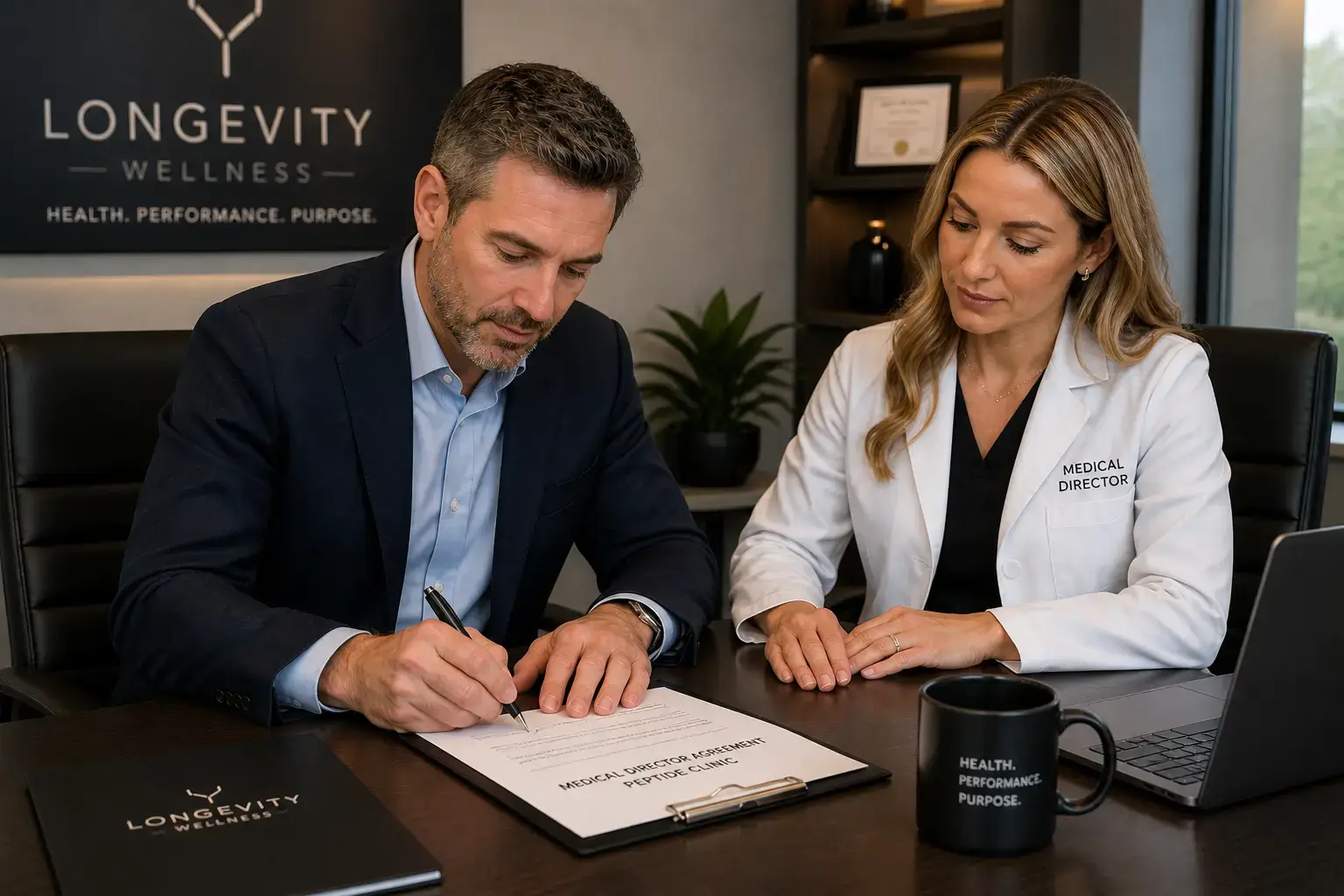
Layer 2: The Medical Director Agreement
The medical director agreement must clearly define the scope of clinical oversight, the prescribing authority, the protocol approval process, the availability requirements, and the compensation structure — all in terms appropriate to the state's medical board regulations governing collaborative practice agreements. A medical director relationship documented only as an informal arrangement is not a properly structured agreement and creates liability without legal protection.
Layer 3: Compounding Pharmacy Sourcing
Every peptide compound offered to patients must be sourced through a licensed 503A or 503B compounding pharmacy. The pharmacy relationship must be formally established before the first prescription is written. The pharmacy must be verified for current accreditation status. Documentation of the sourcing relationship must be maintained and available for regulatory review.
Layer 4: Protocol Documentation and Patient Consent
Every protocol the clinic offers must exist as a formal clinical document — approved by the medical director, describing the specific compound, formulation, dosing parameters, administration method, monitoring schedule, and adverse event reporting process. Patients must provide informed consent before receiving any protocol — consent that specifically describes the regulatory status of the compounded compound and the nature of the clinical relationship.
Opening in the Right Order
Market Validation First
Before any compliance infrastructure is built, the market must be validated. A peptide therapy clinic built with perfect compliance architecture in the wrong market will fail for business reasons before compliance becomes a consideration. Market validation confirms that the compliance investment being made is being made in a market where the business can succeed.
Legal Structure Second
The MSO formation and Management Services Agreement come before the lease, before the bank account, before the vendor contracts. This is the foundational rule of opening a peptide clinic correctly.
Medical Director Third
The medical director relationship is established before the formulary is finalized, before the build-out begins, and before any marketing for patients starts.
Supplier and Technology Fourth
Compounding pharmacy relationships and the technology infrastructure are established in parallel with the physical build-out. Both must be operational before the first patient appointment is scheduled.
Marketing Before Opening
The pre-launch marketing campaign begins two to three weeks before opening — building local search visibility, establishing the clinic's brand credibility, and driving consultation appointment bookings for the first week of operation.

The First Patient Experience Sets the Standard
The patient experience a peptide therapy clinic delivers to its first ten patients is the standard it will reinforce or repair for the next two years. The consultation framework must be practiced before those first ten patients arrive. The clinical delivery must be at the standard the clinic intends to maintain — not the training standard that improves over time.
ACG's pre-opening training covers both the consultation framework for the patient-facing team and clinical protocol training for the nursing team — before the clinic opens. The post-launch advisory support covers the first 60 days of real operations, providing data-driven guidance on marketing performance, conversion rates, and operational adjustments.
To understand how ACG structures the opening process for a peptide therapy clinic, visit altosconsultinggroup.com/new-clinic-launch. To start the conversation, visit altosconsultinggroup.com/survey.
Opening Week: How to Execute the Launch That Sets the Standard for Everything That Follows
Opening week at a peptide therapy clinic is not a soft launch. It is the first impression the clinic makes on its local market, on its first patients, and on the referring practitioners and community members who will determine the rate at which word-of-mouth spreads. Every clinic owner who has lived through an under-prepared opening week — where systems are not working, staff are not confident, and the patient experience is being improvised in real time — knows that the cost of that first week's friction extends well beyond the week itself. The patients who experienced it remember it. The clinical team that navigated it is less confident, not more, going into week two.
The operational elements that most commonly create friction in opening week — and that are entirely preventable with adequate preparation — are the ones that seem basic until they are not working. The EMR that was configured but not tested with real patient workflows. The payment processing system that encounters a transaction type the merchant account was not set up to handle. The informed consent form that the medical director wants to revise after seeing it in practice with real patients. The compound order that arrives two days late because the pharmacy's shipping estimate did not account for the shipping lag at the specific time of year. Each of these is a solvable problem in isolation. Together, during opening week, they consume the clinical team's attention and erode the patient experience simultaneously.
The preparation that prevents these failures is not glamorous. It is the meticulous walk-through of every patient touchpoint — every form, every system interaction, every staff role — before a real patient encounters it. ACG's pre-launch readiness review covers exactly this: simulating the patient journey from initial consultation booking through clinical service delivery through billing and follow-up, identifying every point where a system failure or a staff knowledge gap could create friction, and resolving those issues before opening day. Clinics that have completed this preparation open with a patient experience that feels practiced rather than improvised — because it has been.
The first week's consultation schedule should be intentionally modest. Not because the demand is low — the pre-launch marketing campaign should have generated more consultation requests than opening week can accommodate — but because the first four to six consultations are the ones where the clinical team is finding its rhythm with the consultation framework, the patient intake process, and the enrollment conversation. A clinic that books 25 consultations in opening week and runs 20 of them before the team has found its rhythm produces 20 first impressions of a practice that is still figuring things out. A clinic that books 10 consultations in opening week and runs them with a team that is prepared and confident produces 10 first impressions of a practice that knows exactly what it is doing. The second scenario produces better enrollment rates, better patient satisfaction, and a clinical team that enters week two with confidence rather than exhaustion.
The post-opening marketing adjustment is the final opening week task that is often deprioritized in the chaos of real clinical operations. The pre-launch campaign data — which ads drove the most consultation bookings, which landing page messaging converted at the highest rate, which patient demographics showed up for their appointments versus no-showed — contains the information needed to optimize the ongoing campaign budget allocation before significant marketing spend accumulates in under-performing channels. ACG's marketing review in the first two weeks of post-launch support covers exactly this data, identifying the campaign adjustments that improve cost per consultation booking and lead quality based on real opening-week results rather than pre-launch projections.
Opening week is the beginning, not the milestone. The clinics that execute it well set a standard that compounds into month two, month six, and year two. The ones that scramble through it spend the following months repairing first impressions instead of building on them. The preparation is the work. The opening is when the preparation pays off.
Frequently Asked Questions
Why does compliance-first matter for opening a peptide clinic?
In 2026, the FDA is actively monitoring the peptide compounding space and has taken enforcement action against clinics that operate outside the licensed compounding pharmacy framework. A peptide clinic that opens with the compliance architecture in place is protected from these enforcement actions and positioned to benefit from the improving regulatory environment as Category 2 compounds are reinstated.
What does 'compliant' mean in the context of a peptide therapy clinic?
Compliant means: the legal entity structure separates business ownership from clinical practice through a properly formed MSO and professional entity with a formally executed Management Services Agreement. The medical director relationship is documented through a formal agreement appropriate to the state's practice requirements. Every compound offered to patients is sourced through a licensed 503A or 503B compounding pharmacy. Every prescription is documented with appropriate clinical rationale, patient consent, protocol specification, and monitoring documentation. Marketing does not make medical efficacy claims and complies with platform-specific advertising policies.
How does ACG ensure a new peptide clinic opens compliantly?
ACG's launch engagement includes healthcare counsel referral for entity formation, medical director introduction and agreement facilitation, supplier access through vetted compounding pharmacy networks, clinical protocol documentation review and medical director sign-off, EMR configuration with appropriate documentation standards, and pre-launch compliance review of all marketing materials. Compliance is integrated into every phase of the structured launch process.
Written by Nova, Senior Content Strategist at Altos Consulting Group.