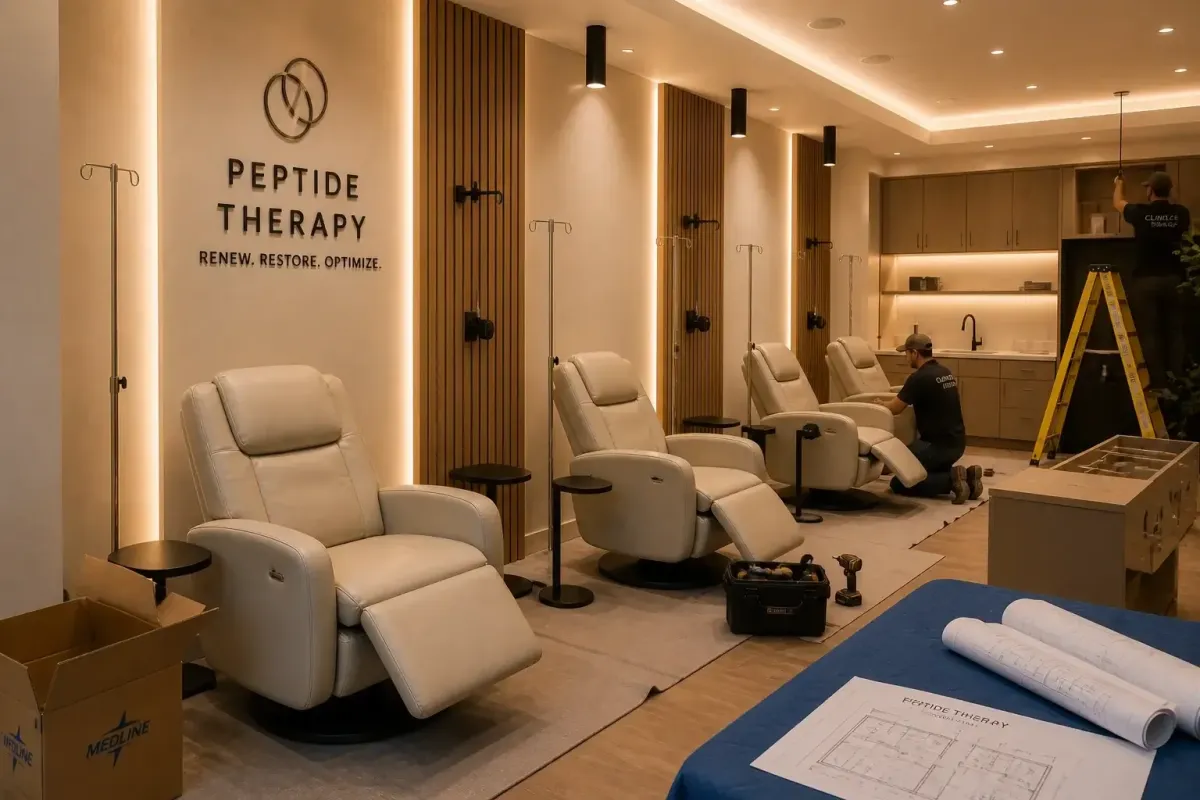
How to Build a Peptide Therapy Clinic: The Complete Step-by-Step Guide for 2026
Building Correctly Means Building in the Right Order
An entrepreneur who has decided to build a peptide therapy clinic faces a long list of decisions — legal structure, medical director, location, build-out, equipment, suppliers, technology, staffing, marketing. The order in which these decisions are made determines whether the clinic opens with a durable foundation or whether it spends its first six months correcting the consequences of decisions made out of sequence.
This post walks through the complete build process for a peptide therapy clinic in the correct order. For the full business case — including market data, FDA reclassification update, and financial model — see The Peptide Therapy Clinic Business Model.
Altos Consulting Group has guided the build of more than 350 clinics. To see the peptide therapy practices ACG has supported, visit altosconsultinggroup.com/clinics-supported/peptide-therapy.
Step 1: Validate the Market Before You Commit to Anything
Market validation is the first step — before a location is selected, before a lease is signed, before any business commitment is made. A peptide therapy clinic requires a specific demographic profile: adults between 35 and 65 with above-median household income, demonstrated health investment, and a local competitive landscape thin enough to allow early-mover positioning.
The validation data that matters includes population demographics in the target geography, household income distribution by zip code, local search volume for peptide therapy and longevity medicine keywords, and a direct audit of who is already operating in the market and how they are positioned. ACG completes this analysis for every new clinic engagement before any other decision is made.

Step 2: Build the Legal Foundation
The legal structure of a peptide therapy clinic must be established before any other business commitment. In most U.S. states, this means the MSO model — a management services organization owned by the entrepreneur, operating alongside a clinician-owned professional entity through a formal Management Services Agreement. Healthcare counsel must draft these documents for the specific state. In the ACG engagement, legal structure is addressed in the first stage of the process — before any location, lease, or hiring decision is made.
Step 3: Establish the Medical Director Relationship
A licensed medical director must be identified, vetted, contracted, and engaged before any physical build begins. The reason this step comes before the physical build is practical: the medical director's specific protocol preferences — the compounds they are comfortable prescribing, the monitoring requirements they want in place, the specific clinical documentation standards they require — directly affect what the physical space and technology infrastructure need to support.
Step 4: Establish Compounding Pharmacy Supplier Relationships
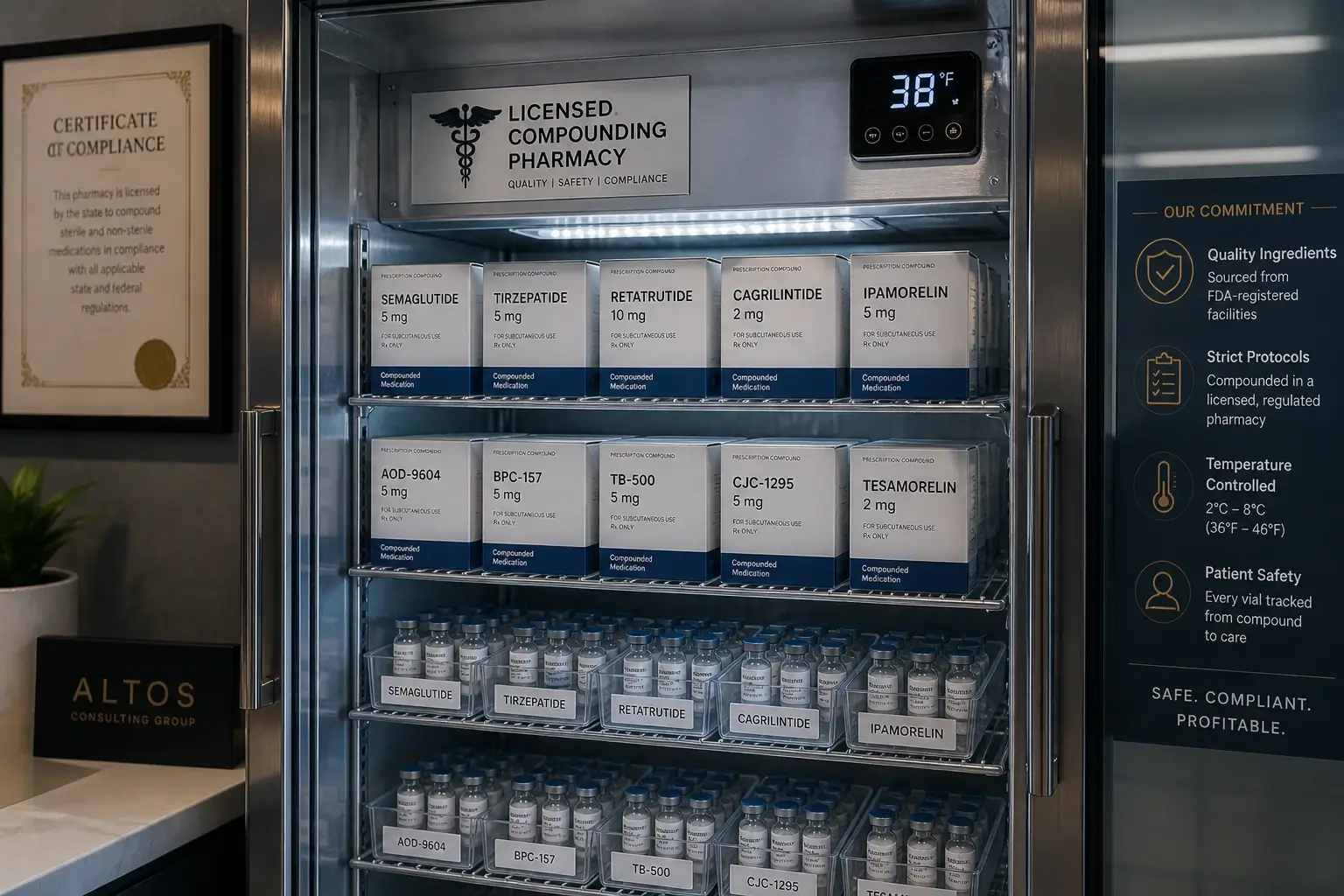
Before selecting a space or ordering equipment, supplier relationships with licensed 503A and 503B compounding pharmacies should be in active development. The pricing available from compounding pharmacies — which directly determines the clinic's gross margin structure — varies significantly based on the clinic's negotiating leverage. A clinic opening through ACG with access to pre-negotiated pricing gets significantly better economics from day one than an independent operator approaching pharmacies as a new client.
Step 5: Select and Build the Physical Space
A peptide therapy clinic focused on injectable protocols and consultation without IV therapy can function in 600 to 800 square feet. Adding IV therapy infusion capability needs 1,000 to 1,500 square feet minimum to accommodate treatment chairs, IV infrastructure, clinical supply storage, and a reception and consultation area. A clinic building a full longevity medicine platform needs 1,500 to 2,000 square feet or more.
The physical environment is a clinical credibility signal. The patient who walks in for a Sermorelin consultation or a BPC-157 protocol is making a significant health investment. The space should communicate the quality of care they are about to receive — through warm professional lighting, premium but not extravagant materials, and an intentional patient flow design.
Step 6: Configure the Technology Infrastructure
•HIPAA-compliant EMR configured for peptide prescription documentation and protocol tracking
•Online scheduling with automated confirmation and reminder sequences
•Payment processing at rates appropriate for cash-pay health services
•Patient communication platform for membership renewal and protocol check-in automation
•Telehealth capability if the clinic intends to offer remote consultation for protocol follow-up
ACG recommends and configures all of these systems as part of the standard launch engagement — including negotiated payment processing rates appropriate to cash-pay health services.
Step 7: Hire and Train the Team Before Opening
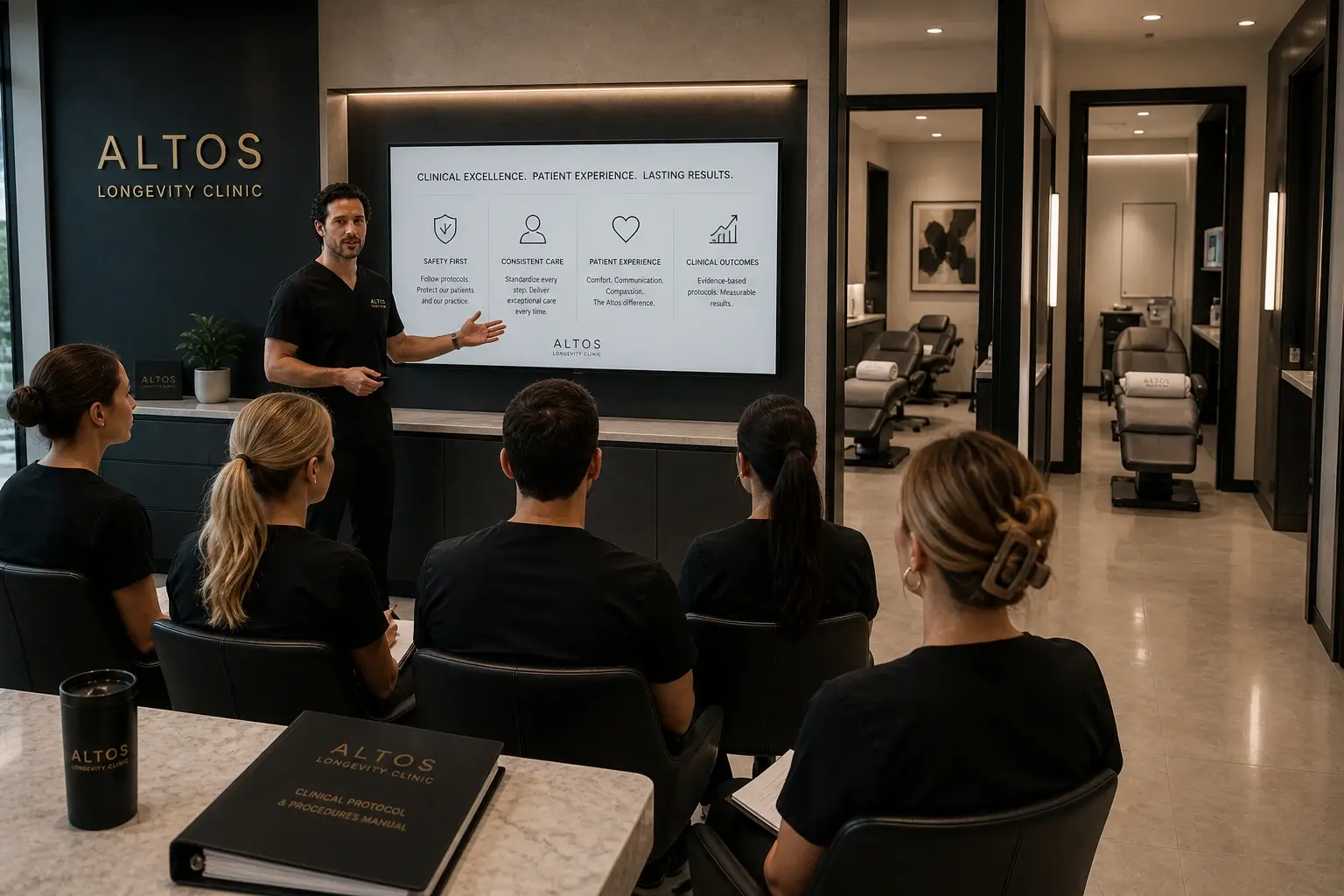
A peptide therapy clinic needs at minimum a medical director, a licensed nurse or NP capable of administering injectable protocols, and a patient-facing team member to manage consultations and membership conversion. These roles must be filled, trained, and operationally ready before the clinic opens. Clinical training for the nursing team must cover the specific protocols — the administration methods, monitoring requirements, adverse event recognition, and documentation standards for each compound in the formulary.
To learn more about how ACG structures the full peptide clinic build process, visit altosconsultinggroup.com/new-clinic-launch. To start the conversation about your specific situation, visit altosconsultinggroup.com/survey.
Configuring the Clinical Environment for the Peptide Therapy Patient — What They Expect and What Builds Trust
The peptide therapy patient is a distinctive clinical consumer. They are more likely than the average wellness patient to have done significant research before their first consultation. They may have listened to multiple podcasts about peptide therapy, read clinical summaries, and formed opinions about protocols before they have ever been examined by a provider. This means the first time a peptide therapy patient walks into a clinic, they are evaluating not just the physical environment but the clinical sophistication they perceive in it — the specificity of the protocol documentation on display, the qualifications of the clinical team they encounter, and the degree to which the consultation process reflects genuine clinical depth rather than a sales script.
The physical environment of a peptide therapy clinic should communicate clinical precision rather than spa luxury. The longevity clinic positioning leans toward premium comfort — warm lighting, comfortable infusion chairs, the extended-stay experience of a NAD+ loading series. The peptide therapy clinic positioning leans toward clinical credibility — organized supply management, visible documentation standards, a consultation room environment that signals that the provider who sits across the desk knows what they are talking about. These are not mutually exclusive — a peptide clinic can be both clinically credible and physically comfortable — but the design emphasis should reflect the thing the target patient is evaluating most carefully.
The consultation room specifically should be configured for a data-forward clinical conversation. Lab results should be accessible on a screen that both the provider and the patient can see simultaneously. A reference framework for interpreting the biomarker values in the context of the specific patient's age, sex, and goals should be part of the consultation toolkit. The protocol documentation — the specific compounds, doses, administration schedules, and monitoring intervals — should be presentable in a format that allows the patient to see and understand their clinical program, not just receive a verbal summary of it. Patients who can see their protocol in writing, with the monitoring schedule and the expected lab assessment points clearly mapped, have a significantly clearer understanding of what they are enrolling in and a stronger basis for the renewal conversation six months later.
The supply management area of the clinic — even if it is not visible to patients — should be organized to the standard of the clinical credibility the practice presents. Temperature-sensitive compounds in appropriate refrigeration with labeling that reflects the pharmacy documentation. Sharps disposal infrastructure that is accessible and properly maintained. Clinical supply inventory that is tracked and replenished before it runs low rather than managed reactively. These operational standards are not visible to patients, but they are visible to the medical director who oversees the clinical environment and to any regulatory body that might inspect the facility. And they reflect the operational culture of the practice — which is felt by patients even when they cannot see it directly.
The telehealth consultation capability is worth building into the clinical environment from the start even for clinics that begin as primarily in-person practices. Peptide therapy patients frequently want protocol check-ins that do not require an in-person visit — particularly for patients who travel, have demanding schedules, or live at the outer edge of the clinic's reasonable travel range. A secure, HIPAA-compliant telehealth platform configured into the EMR from day one means the clinic can offer this flexibility as a standard feature of the clinical relationship rather than as an accommodation that requires special coordination. Patients who can access their clinical team efficiently — through whatever channel is most convenient at any given moment — retain at significantly higher rates than patients for whom every clinical touchpoint requires an in-person appointment.
Frequently Asked Questions
What is the minimum space required to open a peptide therapy clinic?
A peptide therapy clinic offering consultation and injectable protocols without IV therapy can operate in as little as 600 to 800 square feet. Adding IV therapy infusion capability requires 1,000 to 1,500 square feet minimum. A full longevity medicine platform with multiple service categories needs 1,500 to 2,000 square feet or more.
How long does the full build process take?
In ACG's structured launch engagement, the target from engagement to open doors is 60 days — market and regulatory conditions permitting. The physical build-out component depends on the condition of the space. A space requiring primarily cosmetic improvements can be ready in two to three weeks. A space requiring structural work may take four to six weeks.
Do I need special equipment to open a peptide therapy clinic?
A peptide therapy clinic focused on injectable protocols requires a medical-grade procedure space, appropriate sharps disposal, refrigeration for temperature-sensitive compounds, and standard clinical supply inventory. Adding IV therapy requires IV poles or ceiling-mounted track systems, infusion chairs or recliners, and clinical supply storage. The specific equipment list is determined by the confirmed service mix and the medical director's protocol requirements.
Written by Nova, Senior Content Strategist at Altos Consulting Group.