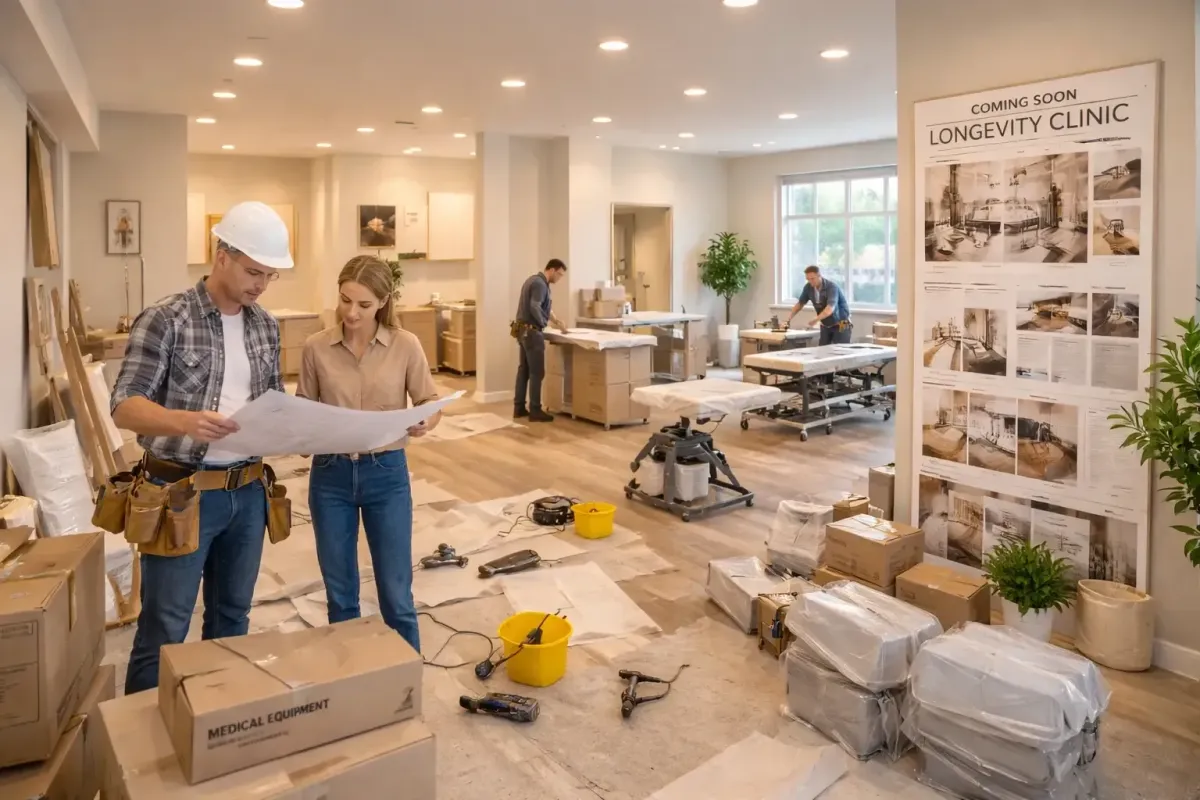
How to Build a Longevity Clinic from Scratch: The Step-by-Step Process for Entrepreneurs
Building a Longevity Clinic Is a Sequencing Problem First
Most entrepreneurs who decide to build a longevity clinic make the same mistake before they ever swing a hammer or sign a lease: they approach it as a construction project when it is actually a sequencing project. The physical space — the build-out, the equipment, the furnishing — is one of the last decisions made in a correctly structured launch, not one of the first.
This post covers the complete build process in the right order. For the full business case for why the longevity clinic is the right opportunity in 2026, see The Longevity Clinic Business Opportunity.
Altos Consulting Group has guided the build of more than 350 clinics. To see the longevity practices ACG has supported, visit altosconsultinggroup.com/clinics-supported/longevity.
Phase 1: Foundation Decisions Before You Touch the Space
Market Validation
Before selecting a location, before signing a lease, before any build-out conversation begins — validate the market. A longevity clinic requires a specific demographic profile to generate sustainable patient volume: adults between 40 and 65, above-median household income, existing health engagement, and a local competitive landscape that allows you to establish market-leading positioning without fighting established operators on day one.
ACG completes this market validation before any other decision is made in the launch process. A longevity clinic built in the wrong market — regardless of how beautifully it is designed or how clinically excellent its protocols are — will struggle to build the patient volume the membership revenue model requires.
Legal Entity Structure
The legal structure of the clinic must be established before any business commitment is made — before a lease, before a vendor contract, before hiring. In most states, a longevity clinic requires the MSO model: a management services organization owned by the entrepreneur, working in parallel with a clinician-owned professional entity through a Management Services Agreement. Healthcare counsel must draft these documents for the specific state. Getting this right from the start is significantly less expensive than correcting it after the clinic is already operating.
Medical Director Engagement
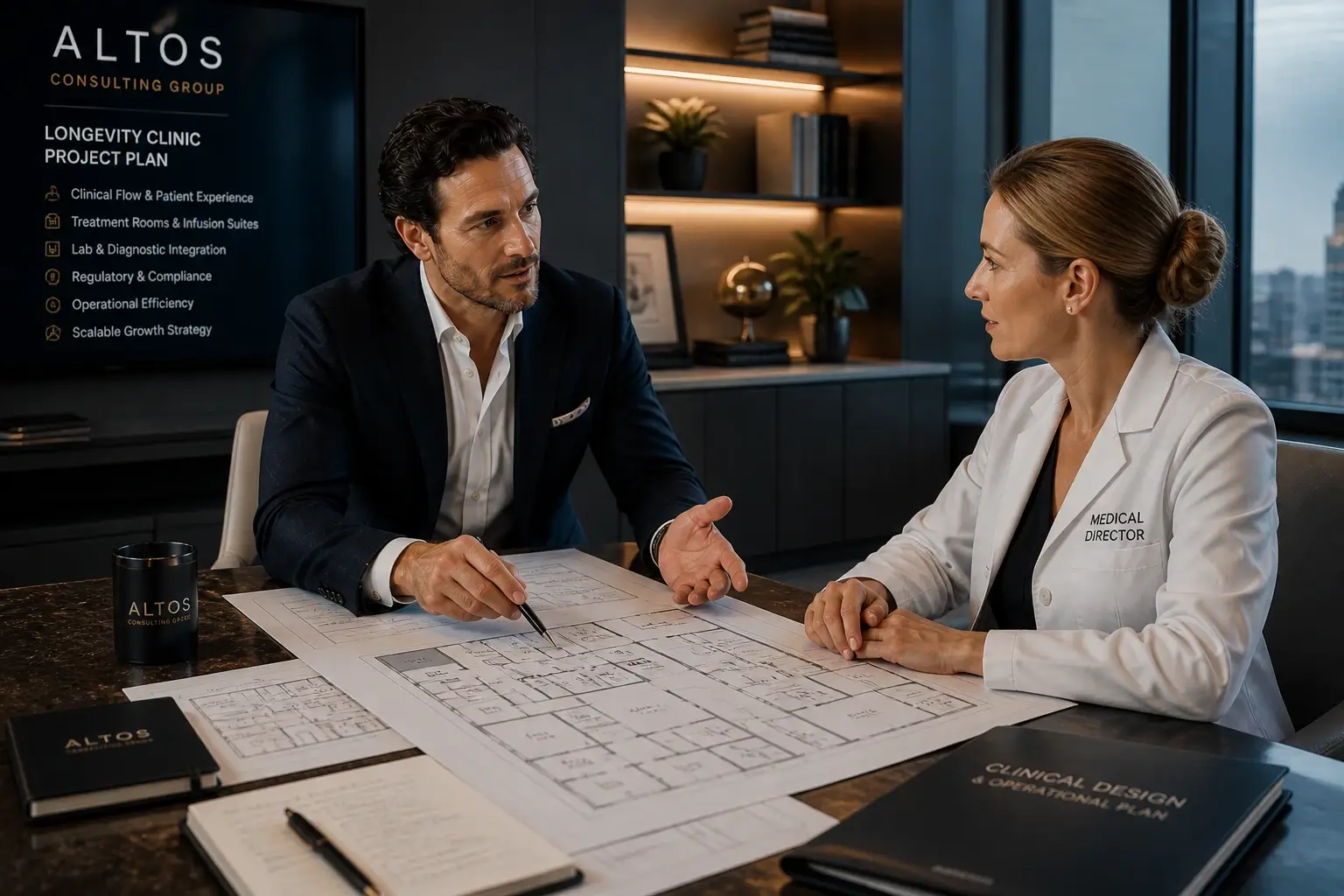
The medical director must be identified, vetted, and engaged before the physical build begins. The reason is practical: the medical director's protocol requirements will directly affect what the physical space needs to support. Build the space around the confirmed service mix. Confirm the service mix with the medical director before you build.
Phase 2: Location Selection and Lease
Space Requirements by Service Mix
A longevity clinic offering consultation, injectable protocols, and IV therapy typically operates effectively in 1,000 to 2,000 square feet. The physical layout needs a reception and waiting area calibrated to the premium patient demographic, consultation rooms with privacy for clinical conversations, treatment rooms with IV infrastructure and comfortable seating, and clinical supply storage with appropriate refrigeration. Class B professional medical space or premium retail medical corridors are the most common location types for longevity clinics.
Lease Negotiation
Healthcare clinic leases have specific requirements that standard commercial leases do not account for — plumbing access for IV therapy setup, ventilation requirements for clinical spaces, sharps disposal access, and ADA compliance for medical use. Confirming these provisions before signing prevents the discovery of expensive non-compliance after the lease is executed.
Phase 3: The Physical Build-Out
Design Standard
The longevity clinic patient demographic makes purchasing decisions based on the quality signals a clinical environment sends before the first consultation begins. The investment in building a physical environment consistent with the premium membership pricing the clinic needs to be financially viable is not optional. Lighting, materials, layout, and signage should be calibrated to the patient demographic rather than to the minimum functional requirement.
Clinical Infrastructure
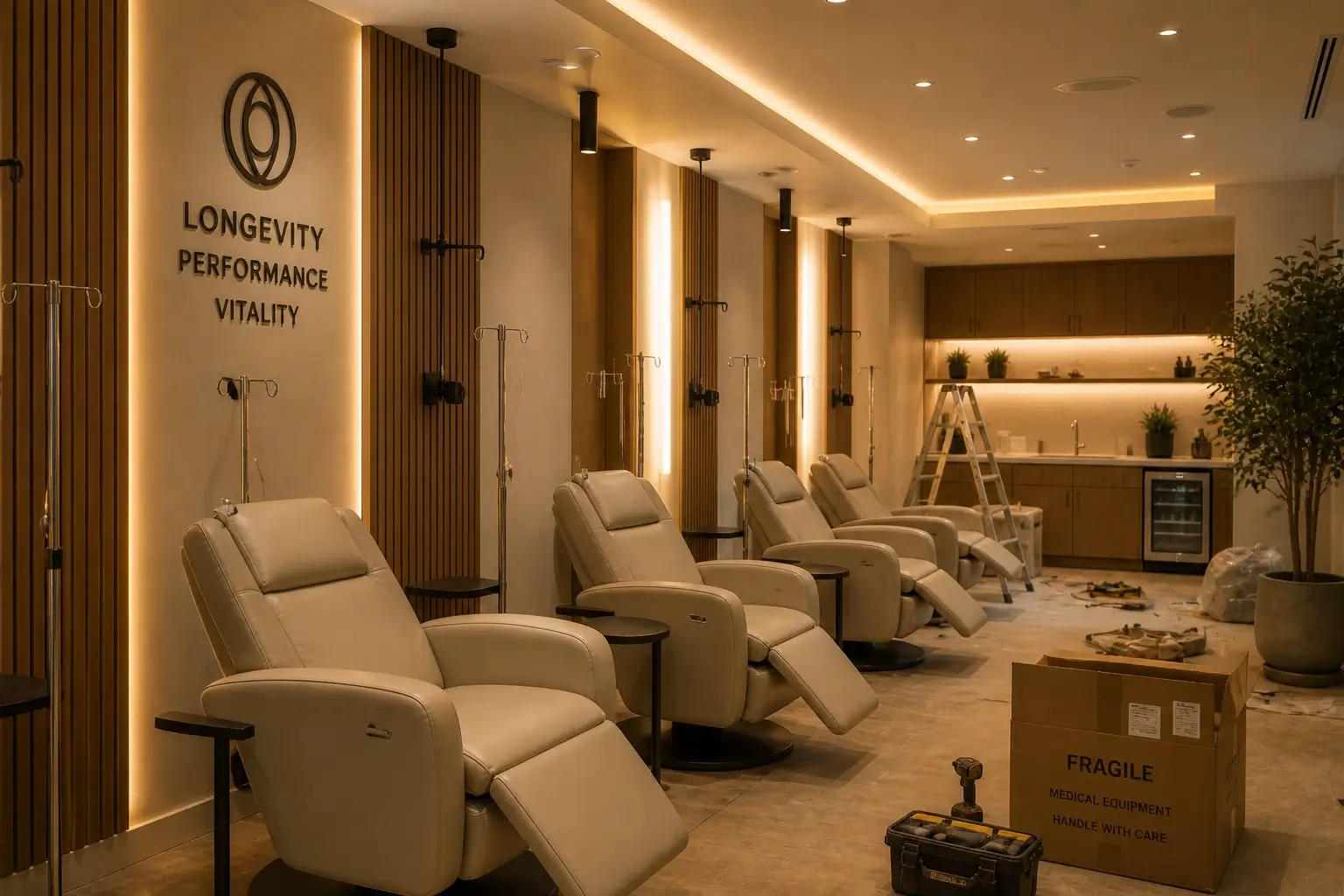
IV therapy requires wall-mounted or ceiling-mounted IV poles, medical-grade chair or recliner seating, IV pump infrastructure, and dedicated sharps and biohazard disposal access. Injection services require appropriate procedure space and medical supply storage with refrigeration for temperature-sensitive compounds. Biomarker panels require specimen collection capability and courier relationships with lab partners.
Phase 4: Technology Setup
•HIPAA-compliant EMR configured for longevity medicine protocols and biomarker tracking
•Scheduling system with online booking and appointment confirmation automation
•Payment processing at rates appropriate for cash-pay health services
•Patient communication tools for membership renewal, lab result delivery, and protocol check-in
•Lab partner portal access if ordering biomarker panels through an external lab service
ACG recommends and sets up all of these systems as part of the launch engagement — with configuration done before the clinic opens rather than during the first weeks of operation.
Phase 5: Staffing Before the First Patient
A longevity clinic needs at minimum a medical director, a licensed nurse or nurse practitioner capable of performing IV infusions and administering injectable protocols, a medical assistant or patient coordinator, and a consultation coordinator to manage the consultation-to-membership conversion process. These roles must be hired, trained, and in place before opening.
ACG provides staffing support and delivers training for all staff before the clinic opens — including clinical protocol training for the nursing team, consultation framework training for patient-facing staff, and operations training for the full team.
To learn more about how ACG structures the full longevity clinic build process, visit altosconsultinggroup.com/new-clinic-launch. To start the conversation, visit altosconsultinggroup.com/survey.

The Build Decisions That Patients Never Notice — and That Determine Whether They Come Back
Every longevity clinic owner focuses on the visible elements of the build: the interior design, the signage, the reception area, the treatment room aesthetic. These matter. The longevity patient demographic makes judgments about clinical quality based on environmental cues, and a poorly designed space signals inadequate clinical standards to a sophisticated health consumer before they have ever met the clinical team. But the build decisions that most directly affect patient retention — the operational and clinical infrastructure decisions — are largely invisible to the patient and often receive less attention than they deserve during the build process precisely because they are not visible.
The patient flow design is the most undervalued invisible build decision in most longevity clinic launches. How does a patient move from arrival at reception through check-in, to the consultation or treatment room, through the clinical service, and back out to scheduling and payment? In a well-designed patient flow, this journey feels effortless — the patient is never waiting without purpose, never confused about what happens next, never interrupted by a clinical team member managing a logistical problem that should have been invisible. In a poorly designed patient flow, the patient notices friction — waiting in the wrong place, being handed off awkwardly between staff, experiencing a clinical process that feels improvised rather than practiced. That friction erodes the premium brand positioning the clinic's physical design was intended to create.
The documentation infrastructure is the second invisible build decision with significant clinical and commercial consequences. A longevity clinic's monitoring data is its most clinically valuable asset and its most powerful retention tool. When a patient's hormone panel results, IGF-1 trends, inflammatory marker profile, and biological age assessment are all accessible in a well-organized EMR that the clinical team can navigate efficiently, the monitoring appointment becomes a compelling clinical experience — the provider can pull up six months of data, show the trend line, and connect the patient's subjective experience to objective biological evidence. When the documentation infrastructure is poorly organized — data in different places, inconsistent recording standards, results that require manual compilation to review — the monitoring appointment feels like an administrative exercise rather than a clinical one, and the retention value of the monitoring relationship is largely lost.
The IV therapy suite design is the third build decision that affects patient experience in ways the clinic owner may not anticipate before opening. The longevity patient receiving a NAD+ infusion is going to spend two to four hours in the treatment chair. That experience — the lighting quality, the chair comfort, the acoustic environment, the temperature management, the entertainment options or lack thereof, the ability to work or read comfortably — is the longevity clinic's most extended patient touchpoint. A patient who spends four hours in an uncomfortable, poorly lit treatment room with inadequate climate control is not the same patient who would have emerged from a well-designed, comfortable, premium infusion environment. The first patient is tolerating the treatment. The second is having an experience they will tell others about.
The operational systems build — the staff communication protocols, the appointment confirmation sequences, the pre-appointment patient preparation instructions, the post-treatment follow-up process — is the fourth invisible build area that determines the quality of the patient experience at every touchpoint the clinic does not control through its physical environment. These systems should be designed, documented, and trained before the clinic opens — not improvised during the first weeks of patient care. The clinic that opens with its operational systems in writing, practiced by the clinical team, and understood by every staff member is the one whose patient experience is consistent from day one. Consistency is what builds the reputation that drives referrals.
Frequently Asked Questions
How long does it take to build a longevity clinic?
ACG's structured launch engagement targets 60 days from engagement to open doors — market and regulatory conditions permitting. The physical build-out depends on the condition of the space. A space requiring primarily cosmetic improvements can be ready in two to three weeks. A space requiring structural work may take four to six weeks. ACG sequences all workstreams to run in parallel so no phase is waiting on another.
What does it cost to build out a longevity clinic space?
A space requiring primarily cosmetic improvements can be built out for $10,000 to $20,000. A space requiring new plumbing for IV therapy setup, partitioning for treatment rooms, and a premium design build-out can run $30,000 to $60,000 or more depending on the market and the contractor.
Can I build a longevity clinic in a shared medical office space?
In some markets, shared medical office or medical suite concepts provide a lower-cost entry point for testing service model and patient demand. The trade-off is limited brand control and scheduling constraints. For a longevity clinic targeting a membership model, a dedicated space that can be fully branded and controlled is the stronger long-term positioning choice.
Written by Nova, Senior Content Strategist at Altos Consulting Group.