
How Much Does It Cost to Open a TRT Clinic in 2026?
A Complete Startup Investment Breakdown for Entrepreneurs Entering the Hormone Optimization Space
Why a TRT Clinic Budget Looks Different From Other Cash-Pay Clinics
A TRT clinic has a lower equipment burden than almost any other Regenerative Health Clinic type covered on this blog. There is no processing centrifuge, no infusion suite, no shockwave device, no hyperbaric chamber. What a TRT clinic requires instead is a compliance and clinical infrastructure that is more specific than most — because testosterone is a controlled substance, and because the monitoring protocol that makes the clinic clinically defensible is also the monitoring protocol that generates a meaningful share of its recurring revenue.
The practical consequence is that a TRT clinic can be opened for less capital than a joint clinic or a stem cell clinic, but with less tolerance for shortcuts in the legal and clinical setup. The money that would go to equipment in another clinic type goes to entity structure, prescribing authority, and lab infrastructure here.
For the full market analysis behind this clinic type — search demand, patient lifetime value, and the service stack — see The Hormone Optimization Clinic Business Opportunity.
Legal Structure and Entity Formation
The MSO structure that allows non-physician ownership of a hormone clinic must be drafted by healthcare counsel admitted in the clinic's state, not assembled from a generic LLC template. For a TRT clinic specifically, the Management Services Agreement needs to be written with awareness of how the state treats prescribing authority and controlled substance dispensing within a management services arrangement — a narrower question than general cash-pay clinic formation.
Budget $5,000 to $12,000 for entity formation and the MSA, with the higher end of that range applying in states with more stringent corporate practice of medicine enforcement. This is the line item where paying for genuine healthcare counsel rather than a general business attorney produces the clearest return, because a defective MSA in a controlled-substance clinic is significantly more expensive to remediate than to draft correctly the first time.
Medical Director and Prescribing Infrastructure
Medical director compensation for a TRT clinic typically runs $1,500 to $3,000 per month — modestly above the general Regenerative Health Clinic range, reflecting the controlled substance oversight the role carries. This is an ongoing operating cost rather than a startup line item, but the first two to three months of medical director compensation should be budgeted as part of the startup capital since it accrues before the clinic sees meaningful patient revenue.
DEA registration is required for the clinic to dispense or administer testosterone as a Schedule III controlled substance. The registration fee itself is modest, but the timeline is not — application processing can take several weeks, and the registration must be in place before the first prescription is written. Starting this process in week one of the launch sequence rather than week six is the single most common timeline correction ACG makes with new hormone clinic clients.
Lab Infrastructure — The Line Item That Pays for Itself
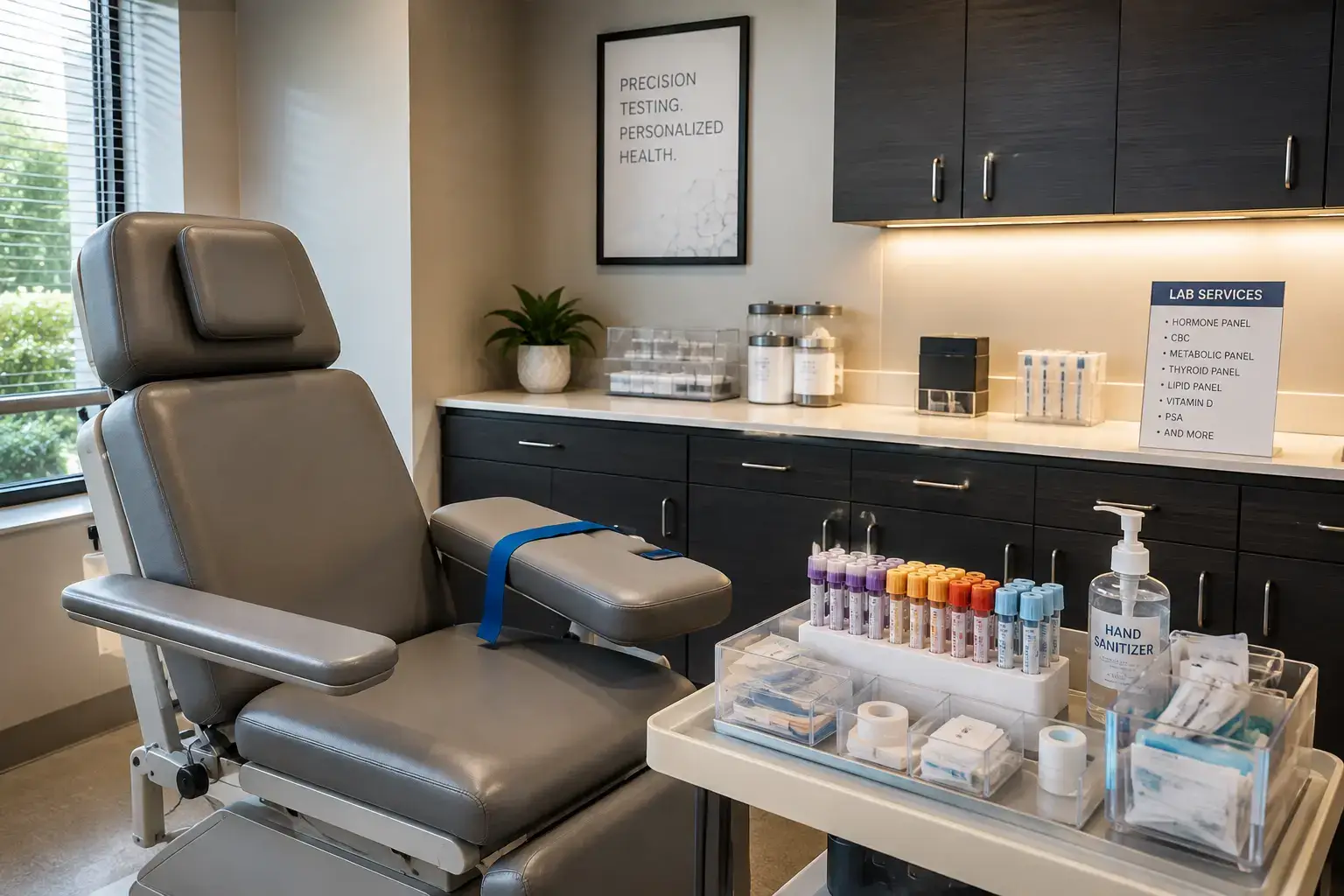
In-office phlebotomy capability is the single highest-return infrastructure investment a TRT clinic makes, and it is frequently underbudgeted. A phlebotomy chair, centrifuge for specimen processing, refrigeration for sample handling, and the supply inventory to support it typically runs $3,000 to $7,000 in initial setup.
The reason this pays for itself is clinical rather than financial. The American Urological Association's testosterone deficiency guideline sets out a monitoring framework that requires baseline labs before therapy begins and repeat measurement at defined intervals throughout treatment — including hemoglobin and hematocrit, PSA in men over 40, and periodic testosterone levels. A clinic that can draw those labs in-office controls its own monitoring schedule and specimen quality. A clinic that sends patients to a third-party draw site loses control of both, and loses the clinical touchpoint that drives retention.
Compounding Pharmacy vs. Commercial Product Sourcing
Many TRT clinics default to compounded testosterone without evaluating the alternative. It is worth noting that the AUA guideline expresses a preference for commercially manufactured testosterone products over compounded testosterone where feasible. Compounded testosterone remains widely used and is legal when sourced through a licensed 503A compounding pharmacy, but the sourcing decision deserves a genuine clinical conversation with the medical director rather than a default to whichever option has the better margin.
Initial compound or product inventory for a clinic launching with a focused formulary typically runs $2,000 to $5,000, with ongoing supply cost scaling directly with enrolled patient volume.
Technology, Space, and Launch Marketing
A HIPAA-compliant EMR configured for controlled substance documentation and longitudinal lab tracking runs $1,500 to $3,000 for first-year setup. A TRT clinic operates efficiently in 800 to 1,200 square feet — consultation rooms, a draw station, and a small injection area — putting first and last month plus deposit at $6,000 to $10,000 in most mid-size markets. Pre-launch marketing to populate the opening consultation schedule typically runs $3,000 to $6,000.
Entrepreneurs structuring the capital stack across these categories may find the SBA's startup cost planning framework useful for organizing one-time versus recurring expenses, though the healthcare-specific compliance line items above will not appear in any general small business template.
The Total Investment Picture
A TRT clinic built with correct legal structure, engaged medical director, DEA registration, in-office lab capability, technology, space, and pre-launch marketing requires a total startup investment in the range of $95,000 to $125,000 — at the lower end of the Regenerative Health Clinic range covered across this blog, reflecting the absence of major capital equipment.
Working capital above that figure should cover three to five months of fixed operating costs, which for a TRT clinic typically run $9,000 to $14,000 per month. These are illustrative planning benchmarks — actual results depend on market conditions, state-specific compliance costs, and operational execution.
To discuss the specific investment picture for your market, visit altosconsultinggroup.com/survey.
Frequently Asked Questions
Do I need DEA registration to open a TRT clinic?
Yes, if the clinic will dispense or administer testosterone directly. Testosterone is a Schedule III controlled substance, and the registration must be secured before the first prescription is written. The application timeline is the reason this belongs at the very start of the launch sequence rather than near the end — processing takes weeks, and every other clinical milestone depends on it being complete.
Is in-office phlebotomy worth the cost for a new TRT clinic?
For most TRT clinics, yes. Testosterone therapy requires ongoing monitoring at defined intervals, and a clinic that controls its own draw schedule controls both specimen quality and the recurring clinical touchpoint that drives patient retention. Clinics that outsource draws to third-party sites consistently report lower monitoring compliance and weaker renewal rates than those that draw in-office.
Can I open a TRT clinic for under $75,000?
A minimal-footprint consultation practice partnering with an external lab and an existing physician practice can be structured for less. What that reduced budget typically sacrifices is in-office lab capability and the pre-launch marketing spend that populates the opening schedule — two of the highest-return line items in the entire budget. Cutting legal structure or DEA compliance to hit a lower number is not a viable trade-off at any budget level.
How does a TRT clinic budget compare to a longevity or peptide clinic?
A TRT clinic typically requires modestly less startup capital than a longevity clinic, which carries IV therapy infrastructure and a larger physical footprint, and meaningfully less than a stem cell clinic, which carries processing equipment costs. Where the TRT clinic budget runs higher is in compliance-specific categories — DEA registration timeline, controlled substance documentation infrastructure, and medical director compensation.