
How Much Do TRT Clinics Make? A Revenue Breakdown for 2026
Unit Economics, Patient Lifetime Value, and What Actually Drives Profitability in a Hormone Clinic
The Number That Matters Is Not Revenue Per Visit
Entrepreneurs evaluating this category usually ask what a TRT clinic charges per visit. It is the wrong metric, and reaching for it tends to produce a distorted picture of the business. A hormone clinic's economics are not driven by transaction volume. They are driven by how many patients are enrolled, how long they stay enrolled, and how completely the monitoring protocol is being followed.
The reason this matters commercially is that testosterone therapy is not a course of treatment with an endpoint. A patient who responds well and is properly monitored continues indefinitely. That structural characteristic is what makes the hormone clinic one of the highest patient lifetime value businesses in cash-pay health — and it is also why a clinic that neglects monitoring compliance quietly erodes the exact mechanism that makes it profitable.
For the full market opportunity behind this clinic type, see The Hormone Optimization Clinic Business Opportunity.
The Two Revenue Streams
A TRT clinic generates revenue from two sources that reinforce each other. The first is protocol management — a monthly fee covering prescription oversight, dose adjustment, clinical check-ins, and the ongoing provider relationship. This typically prices between $150 and $350 per patient per month depending on market and the depth of the service.
The second is monitoring. Testosterone therapy requires ongoing laboratory assessment at defined intervals — the AUA testosterone deficiency guideline establishes a framework covering baseline testing before therapy and periodic reassessment during treatment, including hematologic monitoring and PSA in men over 40. This is not an optional add-on the clinic sells. It is clinically required, which means the revenue it generates is structurally durable in a way that discretionary services are not.
Quarterly monitoring panels typically generate $200 to $400 per event depending on panel depth and lab partner pricing. A patient on a standard monitoring schedule generates that revenue several times per year for as long as they remain in treatment.
Unit Economics at Realistic Patient Volumes
Combining both streams, an enrolled TRT patient generates roughly $2,600 to $5,800 in annual revenue depending on protocol depth, monitoring frequency, and market pricing. Applied across realistic patient volumes:
•50 enrolled patients at the midpoint of that range — approximately $210,000 in annual recurring revenue
•100 enrolled patients — approximately $420,000
•150 enrolled patients — approximately $630,000
Against fixed monthly operating costs typically running $9,000 to $14,000 for a clinic of this type, the breakeven point sits somewhere in the range of 40 to 55 enrolled patients depending on pricing and cost structure. These are illustrative planning benchmarks — actual results depend on market conditions, pricing, retention, and operational execution.
What Actually Drives the Difference Between Clinics
Two TRT clinics in comparable markets with comparable pricing can produce materially different financial outcomes, and the variable is rarely marketing spend. It is retention.
A clinic retaining patients at 85 percent annually against one retaining at 60 percent is not 25 percent more profitable — it is dramatically more profitable, because every retained patient is revenue that required no acquisition cost, and because the acquisition spend the low-retention clinic must sustain simply to hold its patient count flat is money the high-retention clinic redirects to growth.
Retention in a hormone clinic is driven almost entirely by two things: whether the patient is achieving the clinical result they came for, and whether the monitoring relationship gives them objective evidence of it. A patient who can see their testosterone levels normalized and their symptoms resolving in their own lab data has a reason to continue that no marketing message replicates.
The Margin Structure
Gross margin on protocol management is high because the primary input is clinical time rather than product cost. Margin on monitoring depends significantly on lab partner pricing and whether draws happen in-office. Broader medical practice financial benchmarks — the kind published in MGMA's practice benchmarking data — are useful for contextualizing staffing ratios and overhead expectations, though cash-pay hormone clinics operate on a different revenue model than the insurance-based practices those benchmarks primarily reflect.
The largest controllable cost line in a mature TRT clinic is clinical staffing, followed by medical director compensation and marketing. Product and lab costs, while real, are typically a smaller share of revenue than most entrepreneurs assume going in.
To discuss realistic revenue modeling for your specific market, visit altosconsultinggroup.com/survey.
The Ramp Period Nobody Models Correctly
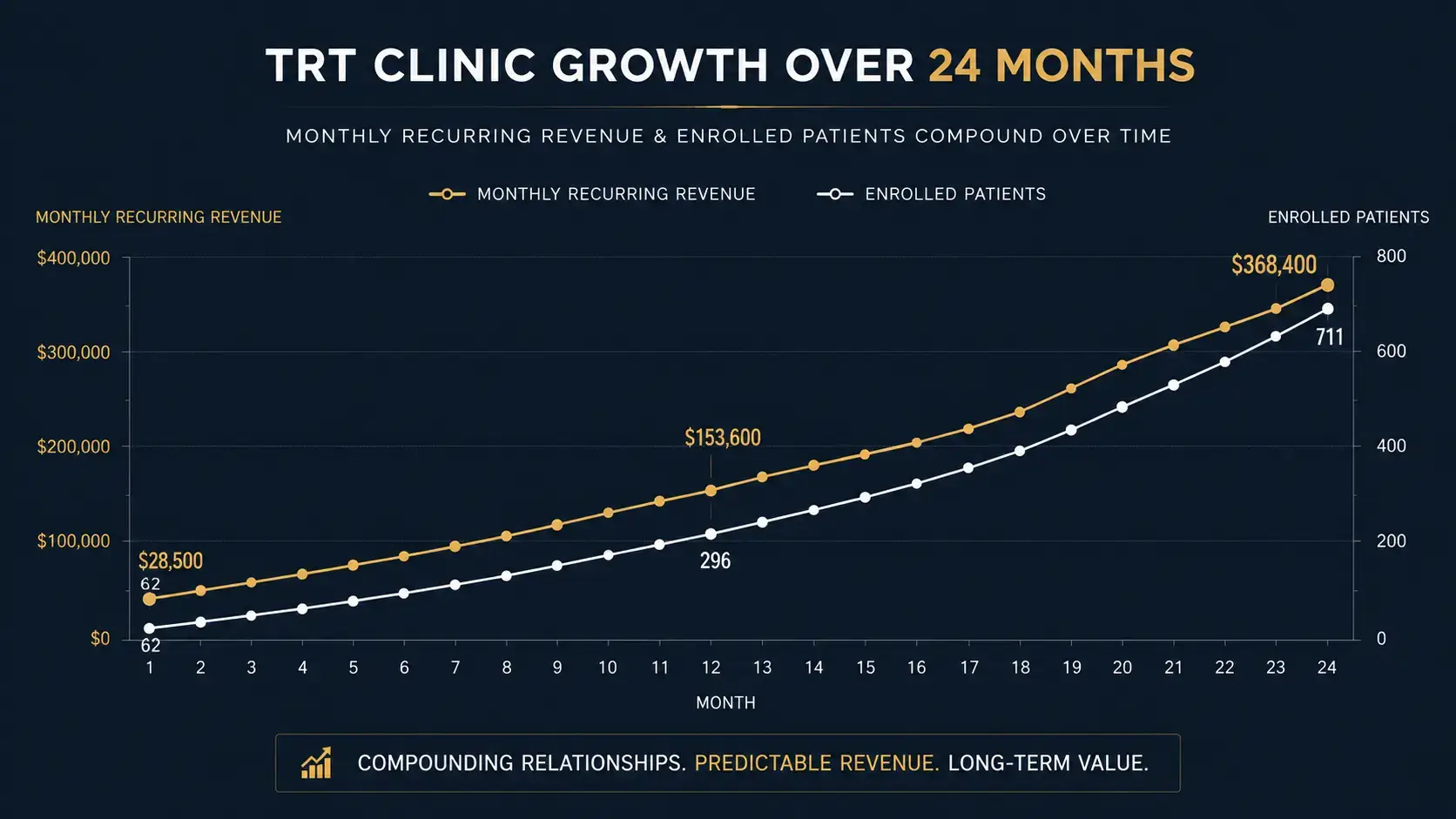
Revenue projections for this clinic type routinely fail in the same place — they model the mature state without modeling how long it takes to get there. A clinic that will eventually run at 120 enrolled patients does not arrive there in month three, and the gap between opening day and breakeven is where undercapitalized clinics get into trouble.
The realistic pattern looks roughly like this. Months one and two produce a small enrolled base, typically well below breakeven, built from whatever the pre-launch marketing generated. Months three through six are where the compounding starts to become visible — the first cohort is renewing, referrals begin appearing, and the enrolled count climbs at a steadier rate than raw new-patient volume alone would suggest. Most clinics that reach breakeven do so somewhere between month four and month eight depending on market and consultation conversion.
This is why the working capital reserve matters more than the startup number in this category. A clinic that opens with the doors funded but nothing behind it is forced into decisions during exactly the months when patience produces the most value — cutting the marketing that is building the pipeline, or discounting membership pricing in a way that is very difficult to reverse later.
Where the Revenue Model Breaks Down
Three failure patterns account for most of the gap between projected and actual revenue in hormone clinics.
•Monitoring drift — patients stay enrolled but stop completing their lab schedule, which removes both the clinical justification for continued therapy and a meaningful revenue stream
•Consultation conversion below expectation — the clinic generates leads but converts too few into enrollments, usually a consultation process problem rather than a lead quality problem
•Pricing set reactively against telehealth competitors, which compresses margin without meaningfully changing which patients choose the clinic
Each of these is correctable, and each is significantly easier to correct in month three than in month eighteen once patterns have set.
Frequently Asked Questions
How many patients does a TRT clinic need to be profitable?
Breakeven typically falls between 40 and 55 enrolled patients for a clinic with fixed monthly costs in the $9,000 to $14,000 range and pricing in the ranges described above. Clinics reach that threshold at varying speeds depending on market demographics, pre-launch marketing, and consultation conversion rate — the last of which is frequently the limiting factor rather than lead volume.
Is TRT clinic revenue seasonal?
Less than most cash-pay health categories. Because patients are on continuing therapy rather than booking discretionary appointments, enrolled revenue is relatively stable month to month. New patient acquisition does show some seasonality, but the recurring base does not fluctuate the way appointment-driven businesses do — which is one of the structural advantages of this clinic type.
What is the patient lifetime value at a TRT clinic?
At $2,600 to $5,800 in annual revenue and average enrollment durations frequently measured in years rather than months, lifetime value in this category is among the highest in cash-pay health. A patient retained for three years at the midpoint of that annual range represents roughly $12,600 in lifetime revenue. The figure is highly sensitive to retention, which is why monitoring compliance is a financial issue and not only a clinical one.
Do telehealth TRT platforms undercut in-person clinic pricing?
Frequently, yes — direct-to-consumer platforms often compete on price and convenience. In-person clinics generally do not win that comparison on price and should not try to. They win on clinical depth: in-office draws, a consistent provider relationship, and monitoring that is actually followed rather than nominally offered. Clinics that position against telehealth on price tend to erode their own margins without changing the outcome.