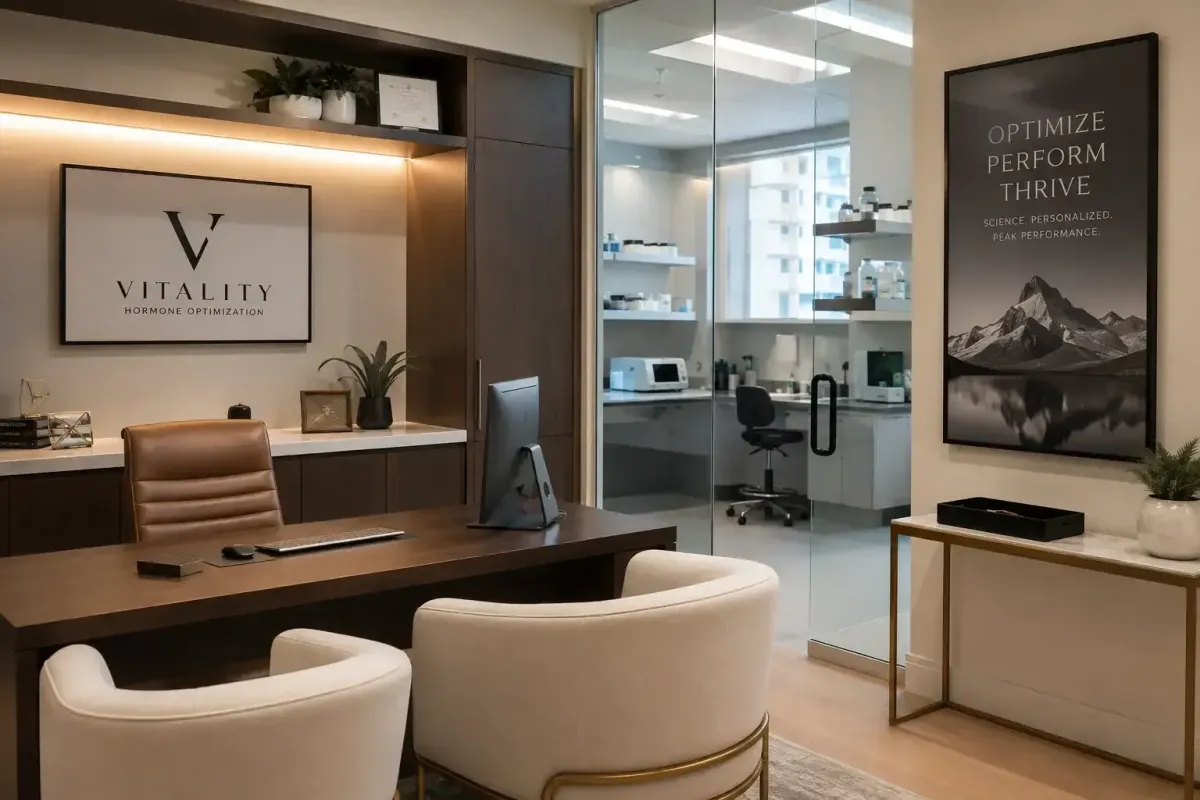
The Hormone Optimization Clinic Business Opportunity: Why 411,000 Monthly Searches Are Looking for a Clinic That Does Not Exist in Your Market
The Numbers That Define the Opportunity
Testosterone replacement therapy generates over 246,000 U.S. searches per month — more than any other single men's health treatment category. Hormone replacement therapy for women generates 165,000 additional monthly searches. BHRT adds 82,000 more. Together, the hormone optimization search category represents over 411,000 monthly U.S. searches for clinical services that most markets cannot adequately supply with in-person care.
The gap between search demand and local clinical supply is the hormone optimization clinic business opportunity. Telehealth providers have captured significant volume in this category by removing the barrier of finding a local provider. But telehealth has structural limitations that in-person hormone optimization clinics can exploit: no in-office lab draws, no in-person provider relationship, no physical community presence that builds the kind of trust that drives long-term retention and referrals. The entrepreneur who opens the well-positioned local hormone optimization clinic in an underserved market captures what telehealth cannot.
Altos Consulting Group has helped launch hormone optimization clinics across the United States. To see the clinics ACG has supported in this category, visit altosconsultinggroup.com/clinics-supported/hormone-optimization.
Why the Hormone Patient Is the Highest-LTV Patient in Cash-Pay Health
The hormone optimization patient is not a one-time visitor. They are a long-term clinical relationship. A TRT patient who starts on a protocol in January and gets labs monitored quarterly is still enrolled — and still paying — in January two years later. The average patient retention duration for hormone optimization clinics is six to twenty-four months. At monthly protocol management fees of $150 to $350 plus quarterly lab panels of $200 to $400, a single enrolled TRT patient generates $2,200 to $5,800 in annual recurring revenue.
This is the financial case for the hormone optimization clinic as a business model. Not the single transaction revenue — the compounding annual revenue from a patient base that stays enrolled because the protocols are working and because the monitoring relationship makes disengagement clinically inconvenient. A clinic with 80 enrolled hormone patients at the midpoint of the annual revenue range above generates approximately $320,000 in annual recurring revenue from a patient base that is not leaving.
These figures are illustrative planning benchmarks — actual results depend on market conditions, patient volume, pricing structure, and operational execution.
Those figures compound in ways that are difficult to see from a single-patient view. How Much Do TRT Clinics Make models the unit economics at 50, 100, and 150 enrolled patients, identifies where breakeven actually falls, and explains why retention — not marketing spend — is what separates high-performing clinics from average ones.
The Service Stack: What a Hormone Optimization Clinic Offers
TRT — Men's Testosterone Replacement Therapy
The core service for most hormone optimization clinics targeting a male demographic. Injectable, pellet, and topical testosterone protocols prescribed and monitored by the clinic's medical director. TRT requires DEA registration — testosterone is a Schedule III controlled substance — and generates recurring revenue through ongoing protocol management and quarterly lab monitoring. ACG has navigated TRT compliance requirements across all 46 states where it operates.
BHRT — Women's Bioidentical Hormone Replacement Therapy
The female hormone market is accelerating as the mainstream conversation around menopause, perimenopause, and women's hormonal health moves from taboo to front page. Searches for hormone replacement therapy clinic among women are growing consistently year-over-year. BHRT — bioidentical hormone replacement therapy — using compounded estrogen, progesterone, and testosterone protocols for women represents a distinct clinical and business opportunity from men's TRT, with a different patient demographic, different compliance requirements, and a different marketing approach.
Peptide Add-Ons for Hormone Patients
The hormone optimization patient is a natural candidate for peptide therapy adjuncts — Sermorelin for growth hormone optimization in men over 40, PT-141 for sexual wellness, and peptide protocols supporting tissue repair and metabolic function. These add-ons increase monthly revenue per patient without requiring new patient acquisition and deepen the clinical relationship that drives retention.
Lab Panel Monitoring
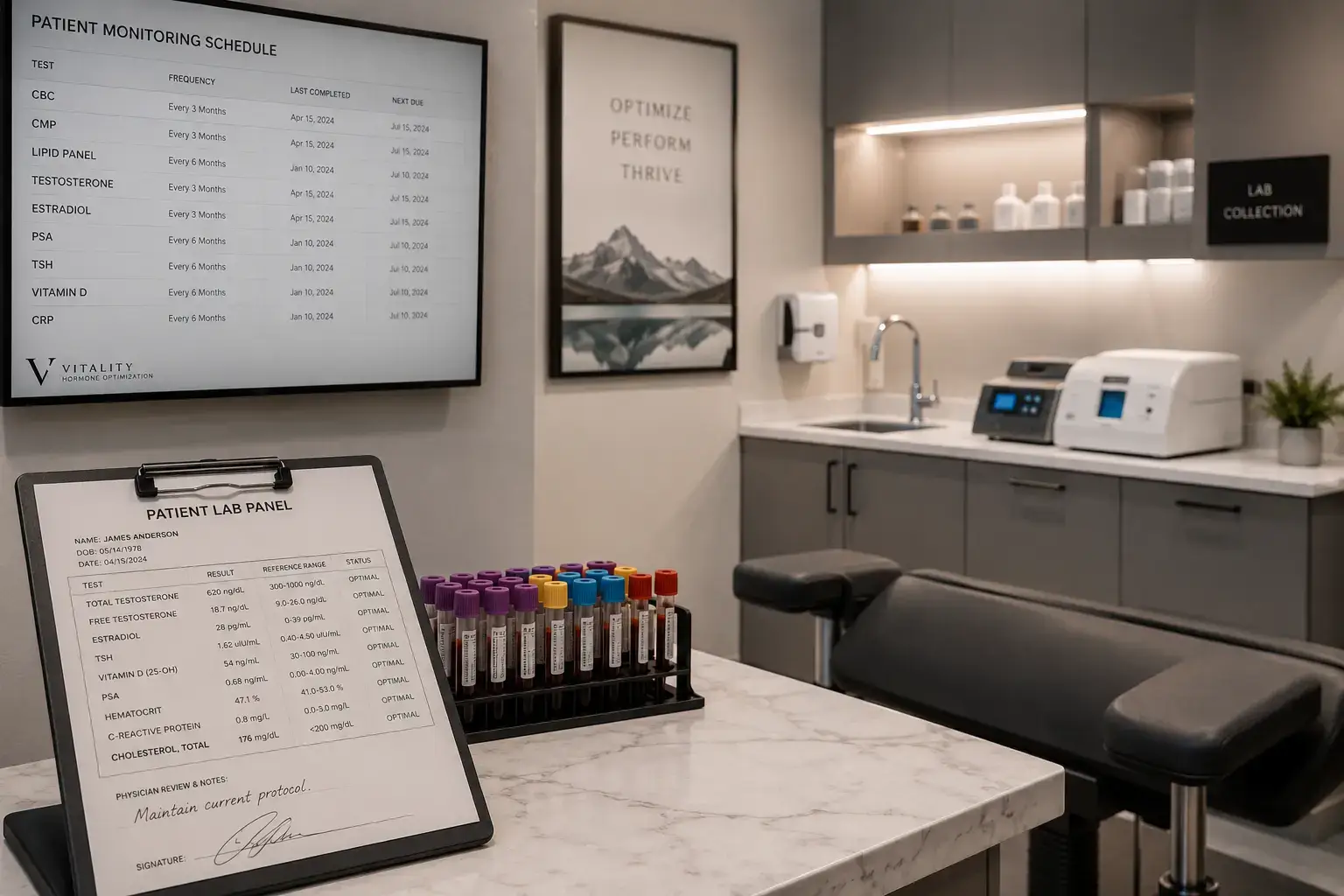
Baseline and ongoing lab monitoring — comprehensive hormone panels, metabolic panels, and CBC — creates the recurring clinical touchpoint that keeps patients engaged and provides the objective data that justifies protocol continuity. Lab panels generate recurring revenue on their own and create the clinical rationale for ongoing prescriptions.
The Compliance Picture: What Makes Hormone Clinics More Complex Than Most
Hormone optimization clinics operate in one of the most compliance-intensive cash-pay health categories. Testosterone is a Schedule III controlled substance requiring DEA registration, specific record-keeping, and prescribing structure that must be correct before the first prescription is written. Compounding pharmacy relationships for testosterone, BHRT compounds, and peptide adjuncts must be established with vetted 503A and 503B pharmacies. Medical director oversight must be structured correctly for the specific state — prescribing authority for compounded testosterone and BHRT compounds varies significantly by state.
That state-by-state variation is the single most consequential structural decision in a hormone clinic launch, and it should be resolved before a location is selected rather than after. Can a Non-Physician Own a TRT or Hormone Clinic covers the MSO model in full, including where these arrangements go wrong.
ACG has navigated hormone clinic compliance requirements across 46 states. The DEA registration sequence, medical director agreement structure, compounding pharmacy vetting, and informed consent framework for hormone optimization patients are all part of the standard ACG launch engagement for this clinic type.
Sub-Specialties: Men's Health TRT and Women's Health BHRT
The hormone optimization category naturally divides into two distinct sub-specialty clinic models — each with its own patient demographic, search audience, marketing compliance requirements, and protocol stack. Some entrepreneurs open one or the other based on their market's specific demand profile or their own professional background. Others open a combined practice that serves both.
Men's Health TRT clinics position around the specific language, imagery, and clinical credibility signals that resonate with a male patient demographic seeking testosterone optimization. Women's Health BHRT clinics position around the specific concerns of the perimenopausal and postmenopausal woman — energy, mood, cognition, sexual health, and the quality-of-life dimensions that conventional medicine has historically undertreated in this demographic.
For a dedicated analysis of each sub-specialty, see the ACG pages for Men's Health and TRT and Women's Health and Hormones.
Why the Telehealth Gap Is Your Competitive Advantage
The telehealth TRT and hormone optimization market grew rapidly between 2020 and 2024 for a straightforward reason: it solved an access problem. Men and women who wanted hormone optimization could not find local providers who understood it, so they found virtual ones. Companies like Hone Health, Maximus, and Joi built significant patient bases by removing the geographic barrier entirely.
But telehealth solved one problem and created several others — and those problems are the in-person hormone optimization clinic's competitive advantage in 2026.
The first problem telehealth cannot solve is the in-office lab draw. Most telehealth hormone programs rely on at-home blood spot testing or require patients to find a local lab service center independently. Neither produces the quality of specimen or the ease of experience that an in-clinic draw provides. A patient who can walk into your clinic, have blood drawn by a nurse who knows their protocol history, and receive results interpreted by a provider who has been managing their case for eight months is having a clinical experience that a telehealth provider structurally cannot replicate. Lab quality matters clinically. The monitoring data that guides protocol adjustments is only as good as the specimen collection process that produces it.
The second problem is the absence of a provider relationship with any continuity. Most telehealth hormone platforms optimize for volume — patient throughput across a large subscriber base with provider consultations that are efficient rather than deep. The patient who has a genuinely complex hormonal picture — elevated estradiol alongside suboptimal testosterone, thyroid dysfunction complicating the metabolic picture, or a history of medications affecting the hormonal environment — needs a provider who knows their case, not a provider who is reviewing their chart for the first time at each check-in. The in-person hormone optimization clinic that builds genuine longitudinal clinical relationships with its patients has a retention advantage that no telehealth platform can match on volume economics.
The third problem is the community dimension. A telehealth provider exists nowhere physically. It has no local presence, no community relationships, no physician referral network, no word-of-mouth ecosystem rooted in a specific geography. The in-person hormone optimization clinic that becomes the recognized local resource for hormone health — through community presence, physician referral relationships, and the patient-to-patient word-of-mouth that happens in physical communities — is building something that is genuinely difficult for a national telehealth platform to displace.
This does not mean telehealth is not a competitor. It is. But it is a competitor with structural limitations that an in-person clinic does not share, and understanding those limitations clearly allows a clinic owner to position their practice around exactly the dimensions where in-person wins — clinical depth, genuine provider relationships, lab quality, and the local community authority that produces the referral engine telehealth cannot build.
The Male and Female Patient: Two Distinct Clinical Opportunities Under One Roof
The hormone optimization clinic that serves both men and women is not simply doubling its addressable market. It is building two distinct clinical programs that attract different patient demographics, convert through different consultation frameworks, and retain through different protocol structures — but that share the same compliance infrastructure, the same supplier relationships, and the same clinical team.
The male hormone optimization patient is typically driven by performance — energy, body composition, sexual function, and cognitive performance are the four categories of outcome that consistently motivate men to seek TRT. The consultation framework that converts this patient connects the clinical findings directly to these functional goals. A total testosterone of 380 ng/dL on a comprehensive panel is not just a number below the optimal range. In context, it is the biological explanation for the fatigue, the body composition changes, the recovery limitations, and the libido decline the patient has been attributing to stress, age, or insufficient sleep. Making that connection specifically and confidently — not generically — is what moves the male hormone patient from consultation to enrollment.
The female hormone optimization patient is typically driven by quality of life — the cluster of symptoms that perimenopausal and menopausal women experience across energy, mood, cognition, sleep, and sexual health that conventional medicine has historically undertreated. The consultation framework for this patient is different because her relationship with her symptoms is different. She may have been told her labs are normal. She may have been offered antidepressants for symptoms that are hormonal in origin. She may have resigned herself to the idea that what she is experiencing is simply aging. The clinical authority the hormone optimization clinic offers this patient is the explicit rejection of that framing — the message that her symptoms are real, their biological basis is measurable, and a clinical program exists that addresses the underlying hormonal environment rather than managing individual symptoms in isolation.
These two patient demographics — with their different motivations, different clinical needs, and different consultation frameworks — can be served under one roof with a clinical team trained to conduct both conversations. The combined practice captures the full household in markets where both demographics are strong, creates natural referral pathways between male and female patients in the same social and family networks, and builds the broadest possible local reputation as the definitive hormone health resource in the market.
What ACG Provides
ACG's launch engagement for a hormone optimization clinic covers market validation for the specific patient demographic being targeted, entity structure and MSO formation with healthcare counsel, DEA registration sequence and compliance navigation, medical director introduction to a vetted practitioner with hormone clinic experience, compounding pharmacy supplier access at pre-negotiated pricing, clinical protocol setup and medical director sign-off, brand and website development, and 60 days of post-launch advisory support.
ACG also works with established practices adding hormone services rather than launching from zero — a materially different path, since the patient panel already exists. How to Add Hormone Therapy to an Existing Practice covers prescribing requirements by state, the clinical infrastructure required, and the patient conversation that converts.
To start the conversation about the hormone optimization opportunity in your specific market, visit altosconsultinggroup.com/survey.
Frequently Asked Questions
Is a hormone optimization clinic a good business in 2026?
Yes. The combination of 411,000+ monthly searches for hormone services with inadequate local clinic supply in most U.S. markets, the highest patient lifetime value of any cash-pay health category, and the structural recurring revenue model produced by ongoing monitoring and protocol management makes hormone optimization one of the most commercially durable cash-pay health businesses an entrepreneur can build in 2026.
Do I need a medical background to open a hormone clinic?
The MSO structure and the state-by-state variation in prescribing authority are covered in full in Can a Non-Physician Own a TRT or Hormone Clinic. The entrepreneur owns the management services organization. A licensed medical director — a physician or NP with appropriate prescribing authority — provides clinical oversight and prescribing. ACG facilitates medical director introductions across 46 states.
What does it cost to open a hormone optimization clinic?
Total startup investment typically runs $95,000 to $125,000, covering legal structure, DEA registration, medical director engagement, in-office lab capability, technology, space, and pre-launch marketing — with a working capital reserve above that covering three to five months of fixed operating costs. The full breakdown, including the line items most first-time owners underestimate, is in How Much Does It Cost to Open a TRT Clinic.
What makes hormone optimization clinics different to operate than other clinic types?
The primary differences are the DEA Schedule III requirements for testosterone and the state-by-state variation in prescribing authority for compounded BHRT compounds. These compliance requirements are more specific than most cash-pay health clinic categories and require careful navigation before the first patient is seen. ACG has done this across 46 states — the compliance sequence is already mapped.
Written by Nova, Senior Content Strategist at Altos Consulting Group.