The Hair Regeneration Clinic Business Opportunity: Why 80 Million Americans With Hair Loss Are Searching for a Clinical Solution That Actually Works
80 Million Americans. One Underserved Market.
Androgenic alopecia — male and female pattern hair loss — affects approximately 50 million men and 30 million women in the United States. The market for hair loss solutions is massive, multi-decade, and currently dominated by topical products, supplement companies, and surgical hair restoration practices that either require daily compliance from the patient or significant upfront investment in procedures that are outside the financial reach of most patients.
Regenerative hair restoration — PRP, exosome therapy, and the peptide protocols that support follicle health — occupies a commercially powerful position in the middle of this market: clinically credible enough to produce documented results for the right patient, non-surgical enough to be accessible to patients who are not ready or qualified for transplant, and recurring enough in its protocol structure to generate the subscription-like revenue that makes the business financially durable.
The hair regeneration clinic that positions correctly — as a precision clinical practice rather than another product-selling hair loss center — captures the patient who has already tried minoxidil, already tried the supplements, and is ready for a clinical approach that addresses the underlying biology of hair follicle health rather than managing the symptom from the outside.
Altos Consulting Group has helped launch hair regeneration clinics across the United States. To see the clinics ACG has supported, visit altosconsultinggroup.com/clinics-supported/hair-regeneration.
The Business Model: High Average Ticket, Strong Repeat Patient Revenue
Hair regeneration clinic economics are favorable for the same structural reasons as joint and sexual wellness clinics — the conditions being treated require protocol-based care over time rather than single-episode treatment, and the patient who achieves results through the clinical relationship has a strong motivation to maintain those results through ongoing treatment.
A PRP hair restoration series — typically three to six sessions over three to six months — generates $2,500 to $5,000 in initial treatment revenue per patient. Adding exosome therapy as a premium tier above PRP alone adds $1,500 to $3,500 per treatment episode. Ongoing annual or semi-annual maintenance sessions generate $800 to $2,000 per maintenance treatment event. The hair regeneration patient who completes an initial series and enrolls in maintenance protocols generates between $3,000 and $7,000 in the first year of care and $1,500 to $4,000 in each subsequent year.
These figures are illustrative planning benchmarks — actual results depend on market conditions, patient volume, pricing structure, and operational execution.
The Service Stack
PRP for Hair Restoration — The Anchor Service
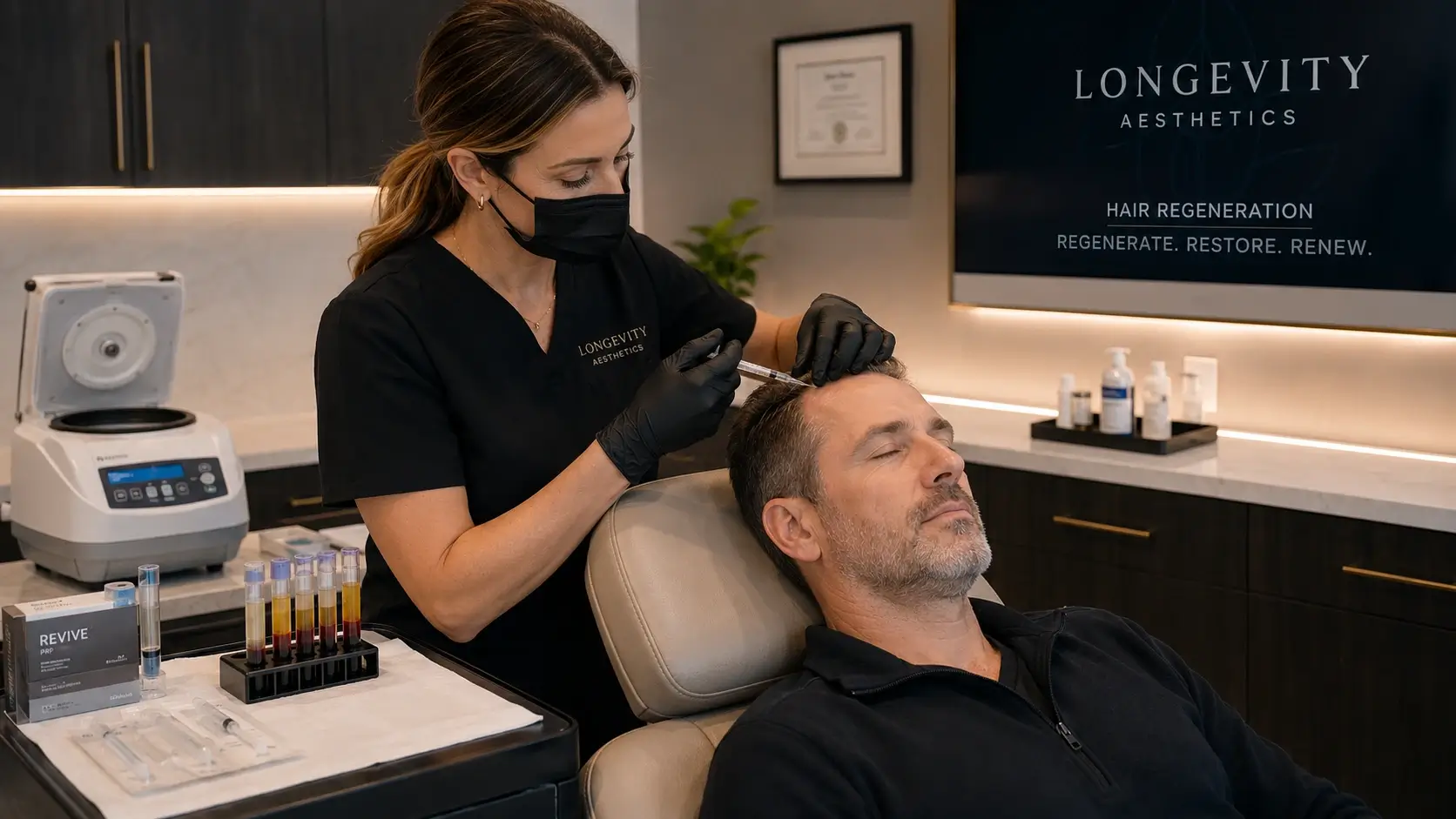
Platelet-rich plasma injected into the scalp to stimulate hair follicle activity and slow the androgenic alopecia progression. The clinical evidence base for PRP in hair restoration is stronger than for most aesthetic regenerative treatments — multiple randomized controlled trials have documented improvements in hair density and thickness for patients in the appropriate Norwood or Ludwig classification range. PRP positions the hair regeneration clinic within a scientifically defensible clinical conversation that consumer product competitors cannot match.
Exosome Therapy for Hair Restoration
Exosome therapy applied topically to the scalp post-microneedling or injected locally represents the premium clinical tier above PRP for hair restoration. The cell-signaling mechanisms of exosomes — delivering growth factors, cytokines, and microRNA signals that influence follicle cell behavior — produce documented improvements in follicle density and hair thickness that patients with more advanced hair loss than optimal PRP candidates may respond to. Premium pricing, meaningful clinical differentiation, and an increasingly sophisticated patient awareness of exosome therapy in the longevity medicine space.
Low-Level Laser Therapy
FDA-cleared LLLT devices for hair restoration — in-office treatment and take-home devices — add a non-invasive, equipment-based service line that extends the treatment frequency and home maintenance component of the hair restoration protocol. LLLT complements PRP and exosome protocols and gives the patient an active role in their treatment between clinic visits.
Hormonal Assessment for Hair Loss
Androgenic alopecia is hormonally driven — DHT sensitivity, testosterone levels, thyroid function, iron status, and nutritional factors all contribute to the rate and pattern of hair loss. A hair regeneration clinic that includes hormonal and nutritional assessment as part of its initial evaluation — rather than treating the follicle in isolation from the hormonal environment that governs it — delivers better clinical outcomes and creates a natural pathway to hormone optimization enrollment from the hair restoration patient base.
Peptide Protocols for Follicle Health
Copper peptides including GHK-Cu have documented effects on follicle health, scalp tissue repair, and hair growth stimulation that make them a logical adjunct to PRP and exosome protocols. Topical and injectable copper peptide protocols represent a premium add-on that increases per-patient revenue, deepens the clinical relationship, and communicates the biological sophistication of the clinic's approach.
Compliance Requirements
Hair regeneration clinics are among the more accessible in terms of compliance complexity — PRP is autologous and does not require the same controlled substance framework as hormone or peptide clinics; LLLT devices are FDA-cleared for hair loss. Exosome sourcing requires vetted manufacturer relationships. Hormonal assessment and any compounded topical formulations require medical director prescribing authority. Microneedling scope of practice varies by state — some states require physician or advanced practice provider administration; others permit trained aestheticians under appropriate supervision.
What ACG Provides
ACG's launch engagement for a hair regeneration clinic covers market analysis, entity structure, medical director introduction with hair restoration experience, PRP system and exosome supplier access at preferred pricing, LLLT device sourcing, clinical protocol setup, brand and website development, and 60 days of post-launch advisory support.
To start the conversation about the hair regeneration clinic opportunity in your specific market, visit altosconsultinggroup.com/survey.
Or to learn about getting started with your own hair regeneration clinic, please visit https://altosconsultinggroup.com/clinics-supported/hair-regeneration.
The Telehealth Gap in Hair Restoration — Why In-Person Wins Every Time
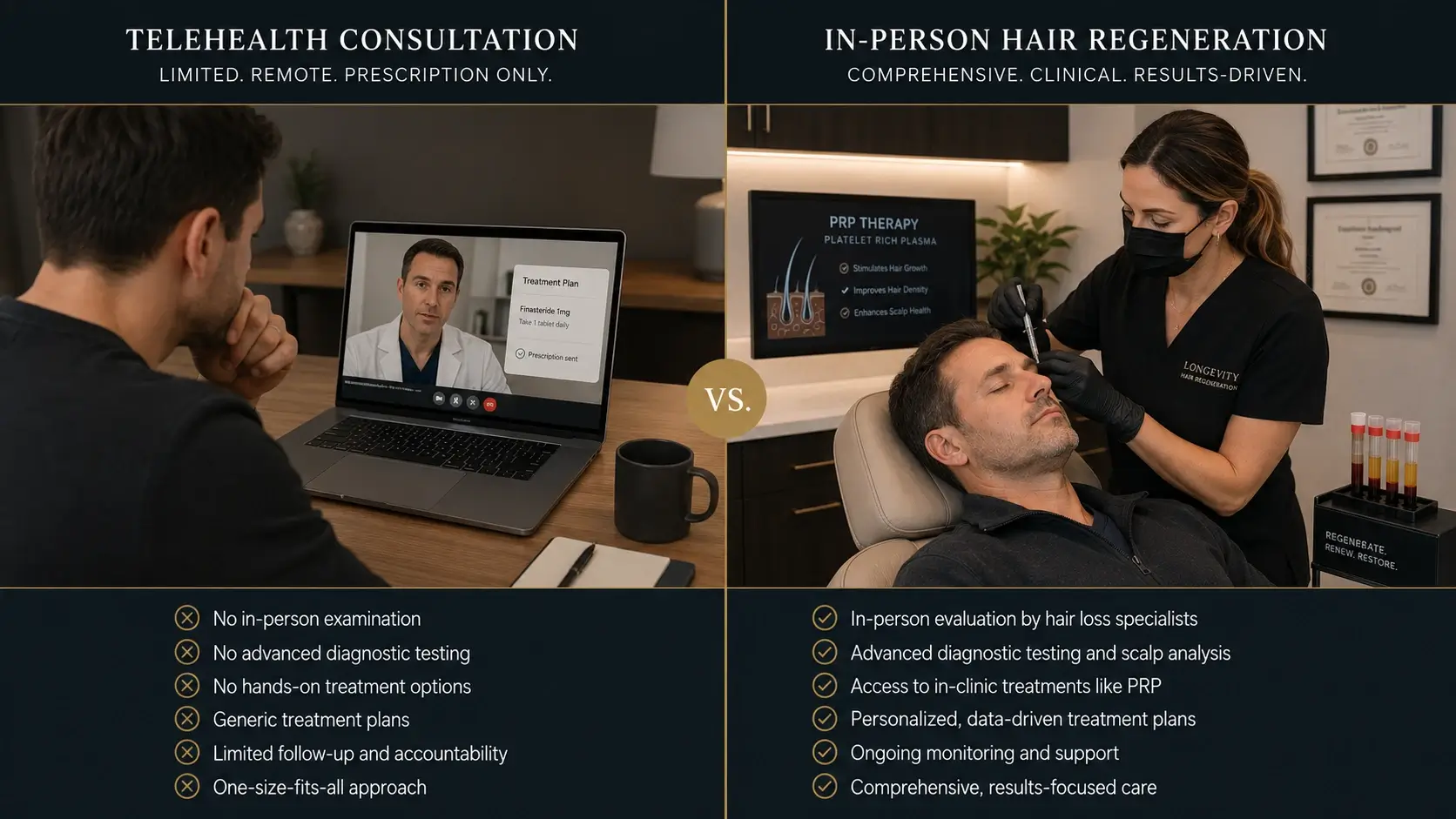
The hair loss treatment market has followed the same telehealth trajectory as hormone optimization and GLP-1 programs — direct-to-consumer platforms offering finasteride and minoxidil prescriptions via video consultation have captured significant volume by removing the friction of finding a local provider. Keeps, Ro, and Hims have built substantial businesses on this model. But the telehealth hair loss market has a structural ceiling that an in-person hair regeneration clinic does not share — and that ceiling is the reason the in-person market remains dramatically underserved despite high consumer demand.
Telehealth platforms can prescribe finasteride and topical minoxidil. They cannot perform PRP injections. They cannot administer exosome therapy. They cannot operate a low-level laser therapy device. They cannot draw blood for an IGF-1 panel or a comprehensive hormonal assessment that identifies the biological drivers of hair loss specific to that patient. Every clinical procedure that actually addresses the underlying biology of hair follicle health — rather than temporarily slowing its decline — requires an in-person clinical environment with trained staff and appropriate equipment.
This is the competitive position of the in-person hair regeneration clinic in 2026. The telehealth platforms have validated consumer willingness to pay for hair loss treatment and created a patient population that is actively seeking better clinical options than a prescription that requires daily compliance and produces modest results. The in-person hair regeneration clinic captures the patient who has already tried the telehealth route and wants something that addresses the problem at a deeper biological level — which is the highest-converting, highest-retaining patient profile available in the hair restoration category.
The marketing implication is direct. Content targeting searches like "PRP hair restoration near me," "hair loss clinic beyond finasteride," and "exosome hair therapy" captures a patient who has already crossed the awareness threshold, already spent money on a telehealth solution, and is specifically looking for the clinical depth that only an in-person provider can offer. This patient converts at significantly higher rates than a cold awareness-stage lead because the research journey is already complete. They are not deciding whether to pursue treatment. They are choosing a provider.
Building the Patient Retention System That Compounds Revenue Year Over Year
The hair regeneration clinic that treats each patient as a single treatment episode — a PRP series completed, a check-in at six months, and then silence until the patient decides they want another series — is leaving the majority of its potential lifetime revenue on the table. The hair regeneration patient who has experienced meaningful results from a clinical program has the strongest possible motivation to maintain those results. The clinical team that builds a structured retention system around this motivation turns a one-time treatment revenue event into a multi-year patient relationship.
The retention architecture for a hair regeneration clinic has three components that work together. The first is the maintenance protocol — a defined treatment cadence after the initial series that keeps the patient engaged with the clinic and the clinical results stable. Depending on the treatment modality this typically means PRP maintenance injections every four to six months, periodic LLLT sessions, and annual exosome booster treatments for patients whose initial response warrants it. Each maintenance event generates procedure revenue, clinical touchpoint data, and the patient interaction that makes the referral conversation natural.
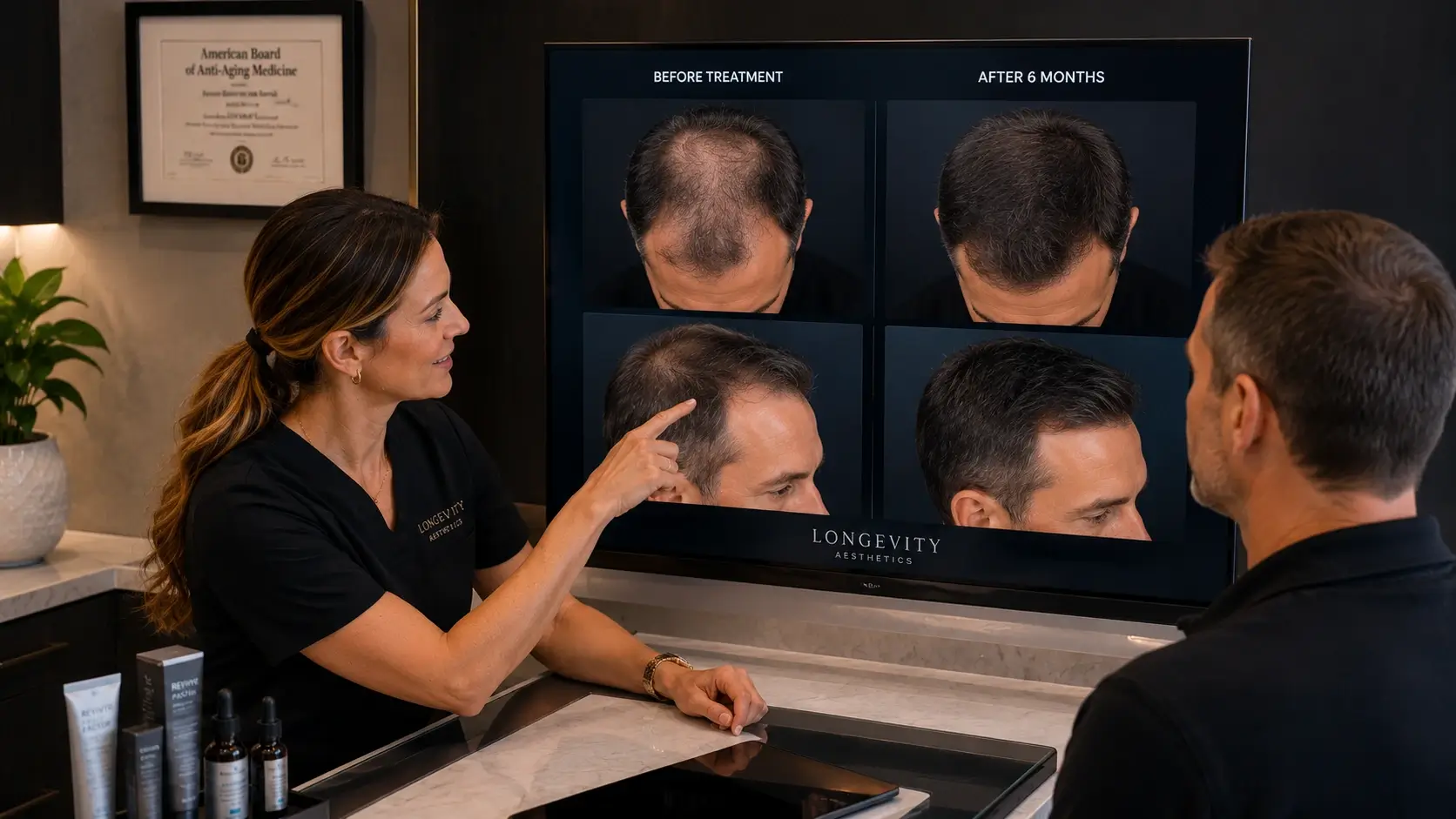
The second component is the monitoring relationship. Hair loss clinics that incorporate scalp photography and hair density assessment at regular intervals give the patient objective evidence of their results over time — the same mechanism that drives retention in hormone optimization and peptide therapy clinics. A patient who can see their hair density improving in standardized photographs taken six months apart has objective evidence that the clinical relationship is working. That evidence makes the maintenance protocol feel clinically necessary rather than commercially motivated — because it is clinically necessary.
The third component is the protocol progression pathway. The patient who enters on a PRP-only program and responds well is a natural candidate for exosome adjunct therapy at their six-month maintenance visit. The patient whose hormonal assessment reveals a testosterone or thyroid abnormality contributing to their hair loss is a natural candidate for hormone optimization enrollment alongside the hair restoration protocol. Each of these progressions deepens the clinical relationship, increases monthly revenue per patient without new acquisition costs, and improves the clinical outcome — because the underlying biological drivers of their hair loss are being addressed comprehensively rather than treated at the surface.
A hair regeneration clinic with 60 active patients across a combination of initial series, maintenance protocols, and multi-service enrollments generates significantly more monthly revenue than one with the same patient count treated transactionally. The difference is not the patient count. It is the retention architecture. These are illustrative planning benchmarks — actual results depend on market conditions, patient volume, pricing structure, and operational execution.
Frequently Asked Questions
Is there enough demand for a standalone hair regeneration clinic?
In markets with appropriate demographics — adults between 30 and 65 with above-median income and documented awareness of hair loss solutions — yes. Hair restoration is one of the highest-commitment consumer health categories because the patient motivation is emotionally significant and personal. The challenge is patient acquisition: hair loss patients often research for months before choosing a clinical provider. A clinic with strong local SEO presence and clinical credibility signaling — physician oversight, documented protocol, published results — converts this patient consistently.
Can a hair regeneration clinic be combined with an aesthetics practice?
Yes, and many of the most successful hair regeneration practices are embedded within broader aesthetic or longevity clinic frameworks. Hair restoration fits naturally alongside aesthetic services (PRP facials), longevity protocols (hormonal assessment and optimization), and IV therapy (NAD+ and nutrient infusions that support follicle health systemically). A combined practice captures the hair restoration patient and creates natural pathways to enrollment in additional services.
What kind of results can patients expect from clinical hair regeneration?
PRP for hair restoration produces documented improvements in hair density and thickness in patients in the appropriate classification range — typically Norwood I through III for men and Ludwig I through II for women. Exosome therapy shows results for patients with more advanced loss. Hair regeneration is not hair transplant — it works best as a preventive, maintenance, and early-stage restoration intervention rather than a solution for advanced baldness. Setting accurate patient expectations at the consultation is the most important factor in hair restoration clinic patient satisfaction and long-term retention.