BHRT vs. FDA-Approved Hormone Therapy: What Clinic Owners Need to Know
The Formulary Decision That Determines Your Clinical Credibility and Your Liability Exposure
The Distinction Most Clinic Marketing Gets Wrong
Ask most patients what bioidentical hormone therapy means and they will say compounded. Ask most clinic websites and they will imply the same thing. Both are wrong, and the error is commercially consequential.
Bioidentical describes molecular structure — a hormone with exactly the same chemical structure as the one the body produces. It says nothing about who manufactured it or under what oversight.
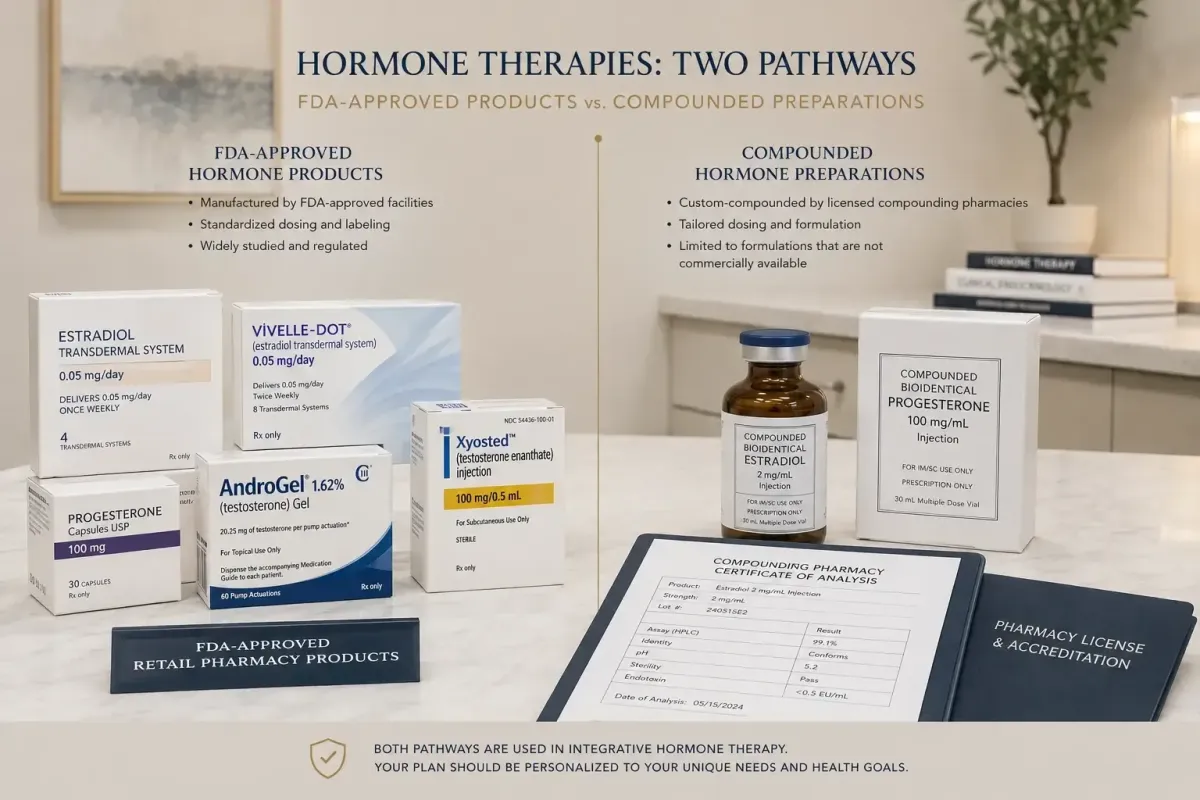
Many FDA-approved hormone preparations are bioidentical. As the Endocrine Society's position statement notes, hormone therapy with structures identical to endogenous hormones is available as FDA-approved preparations including oral estradiol, transdermal estradiol patches, gels, sprays and lotions, estradiol vaginal creams, tablets, rings and inserts, and micronized oral or vaginal progesterone.
This means a clinic can offer bioidentical hormone therapy using FDA-approved, manufacturer-produced, retail-pharmacy-dispensed products. The choice is not between bioidentical and synthetic. It is between compounded and FDA-approved — and those carry very different oversight profiles.
Where the Major Societies Actually Stand
Clinic owners should know this before building a formulary, because patients increasingly arrive having read it.
The Endocrine Society's position is direct: there is no evidence-based medical need for the use of compounded hormone therapy when an FDA-approved preparation is available. The statement notes that compounded preparations are not subject to FDA oversight for dose, purity, safety, or efficacy, and that post-market surveys have uncovered inconsistencies in dose and quality.
The Menopause Society's 2022 position statement identifies similar concerns with compounded bioidentical hormone therapy — minimal government regulation and monitoring, overdosing or underdosing, presence of impurities or lack of sterility, absence of scientific efficacy and safety data, and no label outlining risks.
Both organizations identify narrow circumstances where compounding is appropriate: an allergy to an ingredient in an approved formulation, or a dose not available in any approved product. Where compounded therapy is prescribed, the guidance is to document that specific indication.
The Pellet Question
Pellet therapy deserves specific attention because it is heavily marketed to clinic owners as a high-margin service and because the clinical literature is less favorable than the sales materials suggest.
The Endocrine Society position statement references a study of blood levels well above the anticipated range in women using compounded pellet therapy. The Menopause Society has characterized subdermal implants and pellets among nonstandard, untested routes of administration.
The operational concern compounds the clinical one: a pellet cannot be dose-adjusted or removed easily once implanted. In a therapy where individualized titration is the stated rationale for compounding in the first place, a delivery route that eliminates the ability to titrate is a genuine contradiction that clinic owners should think through rather than inherit from a vendor's pitch.
This is not a claim that no clinic should offer pellets. It is a claim that the decision deserves the medical director's independent clinical judgment rather than a margin calculation.

Salivary Testing
Compounded hormone dosing is frequently marketed alongside salivary hormone testing as the mechanism for personalization. Both the Endocrine Society and the Menopause Society have concluded that salivary testing is unreliable for this purpose, citing differences in hormone pharmacokinetics and absorption, diurnal variation, and interindividual and intraindividual variability.
A clinic building its clinical differentiation on rigor should use serum testing and be prepared to explain why. A clinic using salivary testing because a vendor packaged it with a compounding relationship is building on a foundation that a well-informed patient — or an expert witness — will find easy to challenge.
The Formulary Position That Actually Differentiates
Here is the commercially useful insight in all of this. The competitive landscape in women's hormone health is crowded with clinics whose entire clinical proposition is compounded pellets and salivary testing. That is now the default, which means it differentiates nothing.
A clinic that builds its formulary primarily on FDA-approved bioidentical preparations — with updated labeling that no longer carries the cardiovascular, breast cancer, and dementia boxed warnings — and uses compounding only where a documented clinical indication exists, occupies a position almost nobody else in the category is claiming.
That position is defensible clinically, aligned with every major society's guidance, and increasingly attractive to a patient population that has become more sophisticated about this exact question.
Sourcing and Documentation
Where a clinic does use compounded preparations for a documented indication, the same 503A framework that governs all patient-specific compounding applies. The product must be compounded for an identified individual patient on receipt of a prescription, from a licensed pharmacy.
Practices should verify the pharmacy's licensing and accreditation status directly rather than relying on marketing materials, and should retain documentation of the clinical indication that justified compounding over an available FDA-approved alternative. That documentation is what distinguishes a considered clinical decision from a default formulary choice if the question is ever raised.
The medical director should review and approve the formulary in writing, including the specific circumstances under which compounded preparations will be used. A formulary assembled from vendor relationships without that review is a clinical decision made by a sales process.
How to Have This Conversation With Patients
Patients arriving at a women's hormone clinic frequently ask for bioidentical hormones specifically, and often mean compounded when they say it. Handling that well matters.
The accurate and reassuring answer is that bioidentical describes molecular structure, that many FDA-approved products are bioidentical, and that the clinic can offer bioidentical therapy with the added benefit of manufacturing oversight for dose and purity. Most patients hear that as an upgrade rather than a refusal, because what they actually want is a hormone identical to what their body produces — which is exactly what they get.
Where a patient specifically requests compounded therapy or pellets, the clinician should explain the considerations honestly and document the discussion. Patients who understand the reasoning generally accept the clinical recommendation. Those who insist on a specific product regardless of clinical rationale are, in most cases, patients a clinic is better off not enrolling.
To discuss formulary strategy for your clinic, visit altosconsultinggroup.com/survey.
Frequently Asked Questions
Does bioidentical mean compounded?
No. Bioidentical describes molecular structure — identical to hormones the body produces. Many FDA-approved products are bioidentical, including oral and transdermal estradiol and micronized progesterone. Compounding refers to who prepares the product and under what oversight. Conflating the two is one of the most common errors in clinic marketing.
When is compounded hormone therapy clinically appropriate?
Major society guidance identifies narrow circumstances: an allergy to an ingredient in an FDA-approved formulation, or a dose not commercially available. Where prescribed, the clinical indication should be documented rather than assumed. Compounding as a default formulary choice, absent one of these indications, is not supported by current guidance.
Should my clinic offer pellet therapy?
That is a decision for the medical director based on independent clinical judgment. Clinic owners should be aware of the literature on supraphysiologic serum levels with pellet therapy, the characterization of pellets as a nonstandard route by the Menopause Society, and the practical inability to titrate or remove a pellet after implantation.
Are FDA-approved products more expensive for patients?
Not necessarily, and less so than clinic owners often assume. Coverage varies and many products have manufacturer savings programs. The FDA also approved a generic conjugated estrogens product as part of its November 2025 actions, which the agency indicated is expected to improve affordability and access. Clinics should verify current pricing rather than relying on assumptions formed several years ago.