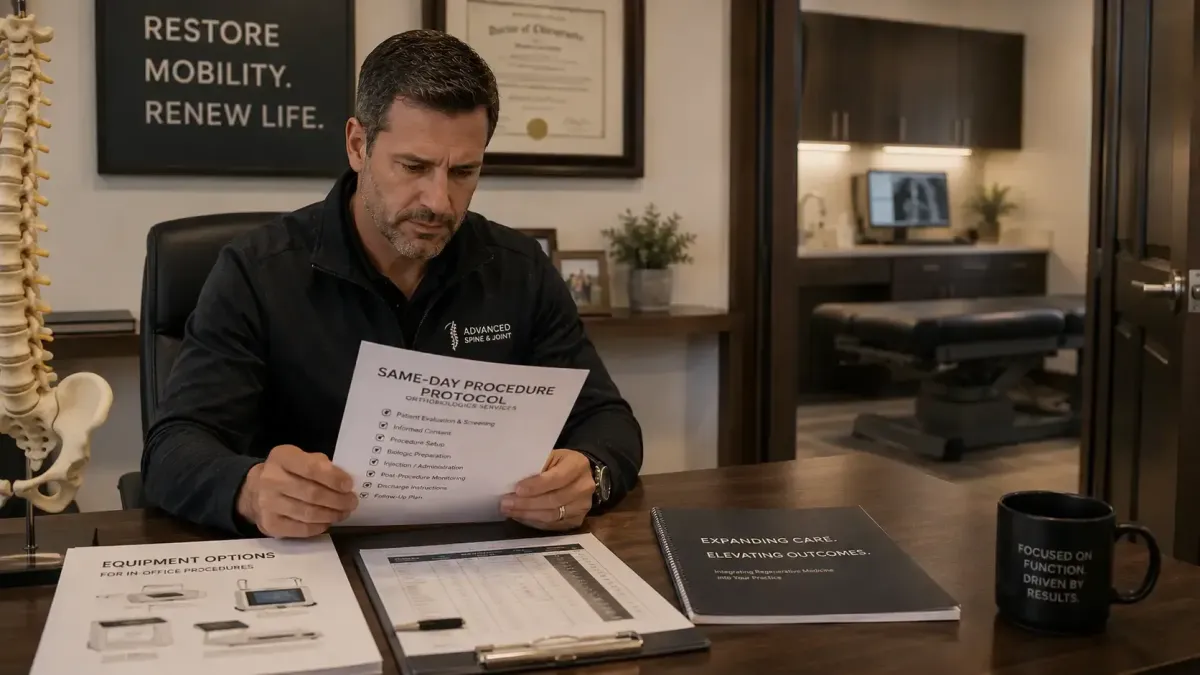
How to Add Stem Cell Therapy to an Existing Chiropractic or Orthopedic Practice
A 2026 Expansion Guide for Practice Owners Whose Patients Are Already Asking About This
Why This Is the Most Natural Expansion Path in the Entire Category
Every chiropractic and orthopedic practice already serves the exact patient population that a stem cell clinic is built for — adults managing chronic joint degeneration, tendon and ligament injuries, and persistent musculoskeletal pain who are actively looking for a non-surgical path forward. The patient overlap between an established chiropractic or orthopedic practice and the stem cell clinic patient described in the pillar post on this blog is not incidental. It is close to complete.
This is why adding stem cell therapy to an existing practice is one of the most commercially efficient expansions covered anywhere in this content series — the patient base, the clinical trust, and often much of the physical infrastructure already exist. For the complete regulatory framework this expansion needs to operate within, see How to Open a Stem Cell Clinic in 2026.
The Scope of Practice Question Every Chiropractor Needs Answered First
A chiropractor cannot independently perform bone marrow aspiration or administer the reimplantation procedure that the same surgical procedure exception requires. The American Chiropractic Association's own published overview of the profession describes chiropractic care as centered on manual therapies such as spinal manipulation, along with therapeutic and rehabilitative exercise and nutritional and lifestyle guidance — a scope that does not extend to performing an invasive tissue collection and reimplantation procedure. This holds regardless of how experienced the practitioner is in musculoskeletal care generally, and regardless of state, since no U.S. jurisdiction includes this specific procedure within chiropractic licensure.
This is the first and most important compliance question an existing chiropractic practice needs answered before pursuing this expansion, and it has a clear answer: the procedure requires a licensed physician or, in some states, an appropriately credentialed advanced practice provider performing or directly supervising the collection and reimplantation.
This does not close the door on chiropractic practices adding this service — it defines the structure the expansion needs to take. The compliant model is a collaborative arrangement in which a physician performs or directly oversees the procedure itself, while the chiropractic practice provides the patient relationship, the referral pathway, the facility, and often the broader musculoskeletal care plan the stem cell procedure fits within. This is structurally similar to how chiropractic practices have added other physician-dependent regenerative services covered elsewhere on this blog. The chiropractor's existing clinical relationship with the patient — built over months or years of musculoskeletal care — is genuinely valuable in this structure, because it is the chiropractor, not the collaborating physician, who most credibly identifies which patients are appropriate candidates for the procedure and follows their recovery afterward.
What an Orthopedic Practice Can Add More Directly
An existing orthopedic practice with a physician owner or physician on staff has a more direct path — the physician can perform the procedure personally, provided the practice builds the same compliance infrastructure any new stem cell clinic requires: verified HCT/P-compliant processing protocols, chain-of-custody documentation, compliance-reviewed marketing, and appropriate informed consent specific to the regulatory status of the procedure. An orthopedic practice already performing procedures such as joint injections or minor surgical interventions typically has much of the procedural infrastructure in place already, meaningfully reducing the build-out timeline compared to a clinic starting from zero.
The physician-owned orthopedic practice also has an advantage the collaborative chiropractic model does not — direct, undivided control over both the clinical procedure and the marketing claims made about it. There is no second party's scope of practice limitation to navigate, no collaborative agreement to draft and maintain, and no ambiguity about who is ultimately responsible for the compliance decisions the pillar post on this blog covers in depth. This does not mean the orthopedic pathway is risk-free — the same enforcement patterns covered elsewhere in this content series apply equally here — but it does mean the practice can move through the compliance build-out with fewer moving parts and fewer external dependencies than a chiropractic practice building a new collaborative relationship from scratch.
The Two Paths Side by Side
The chiropractic pathway trades a longer setup timeline and an ongoing collaborative relationship for access to a large existing patient base and referral network built over years of musculoskeletal care — often the practice's single greatest asset going into this expansion. The orthopedic pathway trades a smaller existing patient volume in many cases for direct procedural control and a faster path to launch, since much of the clinical infrastructure a stem cell procedure requires already exists in a practice that performs other interventional orthopedic care.
Neither path is categorically better. The right one depends on the specific practice's existing patient relationships, its physician access, and its facility infrastructure — which is exactly why the compliance and operational audit covered in the next section should happen before either practice type commits capital to a specific expansion structure.

The Compliance Audit Every Existing Practice Should Run First
Before either practice type commits to this expansion, a compliance audit specific to the same surgical procedure exception should confirm several things. Does the practice have, or can it establish, the physician relationship required to perform or directly oversee the procedure? Does the existing facility have or can it build the sterile processing space the procedure requires? Is the practice's current medical malpractice coverage adequate for this specific procedure, or does it need to be amended? Are the practice's existing marketing materials — website, social media, patient intake materials — free of the specific claim patterns that have drawn FDA enforcement attention in this category, covered in detail in the compliance content elsewhere on this blog?
An existing practice that completes this audit before committing capital avoids the most common and most expensive mistake in this specific expansion — building the clinical capability correctly while overlooking the marketing and documentation compliance that determines whether the clinical capability can be safely and legally promoted to patients.
The Revenue Impact of This Expansion
A chiropractic or orthopedic practice with an established patient base of 100 or more active musculoskeletal patients that successfully identifies and converts even 10 to 15 percent of that base to a same-day BMAC or adipose-derived procedure adds meaningful procedure revenue without the patient acquisition cost a new clinic would face. A single BMAC procedure typically generates $2,500 to $5,000 in revenue depending on the joint or tissue treated and the market, with many patients returning for a second treated joint or a maintenance procedure within twelve to eighteen months. These are illustrative planning benchmarks — actual results depend on patient volume, pricing structure, market conditions, and execution.
ACG's optimization engagement for existing practices begins with a structured audit identifying the specific expansion opportunity that fits the practice's existing patient base and infrastructure. To learn more, visit altosconsultinggroup.com/existing-clinic-growth. To start the conversation, visit altosconsultinggroup.com/survey.
Frequently Asked Questions
Can a chiropractor legally offer stem cell therapy in their own practice?
Not independently performing the collection and reimplantation procedure itself, since this falls outside chiropractic scope of practice in every U.S. state. A chiropractic practice can add this service through a collaborative structure with a licensed physician who performs or directly oversees the procedure, while the chiropractic practiceprovides the patient relationship and broader care plan. This is a legal and structural question that should be reviewed with healthcare counsel specific to the practice's state before any commitment is made.
How long does it take to add stem cell therapy to an existing practice?
For an orthopedic practice with an existing physician owner and procedural infrastructure already in place, four to eight weeks is a realistic timeline once the compliance documentation and equipment are finalized. For a chiropractic practice building a new collaborative physician relationship from scratch, the timeline typically runs longer — eight to twelve weeks — to allow for establishing that relationship correctly alongside the compliance and equipment work.
Does adding this service require a completely separate business entity?
In many cases yes, particularly for a chiropractic practice adding this service through a collaborative physician arrangement — the same MSO-style structure covered in the pillar post is often the correct framework, separating the business operations from the physician-supervised clinical procedure. An existing orthopedic practice with a physician owner already performing procedures under their own license may be able to add this service within the existing practice structure, depending on the state and the practice's current entity setup. This determination should be made with healthcare counsel reviewing the specific practice structure.
What is the biggest mistake existing practices make when adding this service?
Building the clinical and equipment capability correctly while treating the marketing and documentation compliance as an afterthought. The same enforcement patterns covered in the compliance content elsewhere on this blog apply equally to an established practice adding this service as to a brand-new clinic — an existing practice's years of good standing do not create any exemption from the marketing and sourcing compliance requirements every stem cell provider operates under.